Saturday, 12 July 2008

Holland - Friesland Teamracing 2008

Later today I'm off to go to the "Kaag" for some umpiring at the Holland - Friesland Team races.
These races are done in Regenbogen (Rainbows), the yachts you see on the front picture of this blog. Traditionally it's done with five against five, which makes keeping score a particular difficult issue. When is a team in a winning position?
In able to see this I've plasticized a Excel-sheet with possible winning and losing scores. You can download a copy here: Team-zeilen winst of verlies kaart.xls

New this year is, that after calculating the score for each race, the winning team is awarded one point. With six planned races, a possible tie will be sailed off by a seventh. Makes it a little more equal.
I'm suppose to be unpartial as an umpire and will flag (hopefully) without any prejudice, but being from Friesland, I can't but hope that team will win this year. (We haven't for a long time.....)

Friday, 11 July 2008

Timing (in) the rules

In rule 61.1 there's a critical timing in displaying the red flag and hailing protest with the words: "first reasonable opportunity for both".

PC's are asked to give a decision on that timing when the validity of an protest is being investigated. In my opinion there are a couple of criteria that should be considered before deciding this:

  • Where there any safety issues that delayed the hailing or displaying the flag?
  • What was said first?
  • Was the flag available to be displayed immediately?
  • What where the circumstances? I.e. waves, wind strength, type of boats, place of the incident, etc, etc.

After rule 61.1 there is another directly linked timing issue in rule 44.1: How much time does a boat get to decide to take a penalty after a protest has been hailed and a flag has been shown?

The wording in rule 44.1 is a lot less specific: "may take a penalty at the time of the incident" The penalty itself in rule 44.2 may have a specific short time: "... as soon after the incident as possible", but that time only starts after you have decided you may have broken a rule. Something that now has been emphasized by the other boat showing a red flag....

"... at the time of the incident" ?

Well, for sure, not half an hour later on a different leg or just before the finish. But a minute? Or maybe two? Or should it be within seconds?

Can we find a couple of criteria that should be considered when faced with this question? For instance: Is the other boat close enough to recognize that the hailing and red flag are about a specific incident? Is there a good reason for delaying in taking a penalty? Could a boat see and react?

A balance between common sense and the rules.

With a group of three judges the probability they will get that right, is about 85%. That increases to 92% with 5 judges (an International Jury) and even to 98% with 10 people (some appeals committees), but decreases to maybe 80% if there's only one (arbitration). And that is only if the members in all these panels are fairly competent....

Please think about this and give me your opinion:
What would you accept as " at the time of the incident "?

Wednesday, 9 July 2008

Finishing Second?

Some comments have been written on Finishing Third? Before I give you my opinion on the issue, I have something for you to consider:


In one of the qualification races the fleet is split into two groups, which start with a five minute interval. At the finish of the first race a boat in the first group hits the "pin-end"-mark of the finish line and drags it behind it's rudder some 30 - 40 meters downwind, before she manages to get it released.


The RO tells the mark boat to get the finish mark back to it's original position, as soon as group one are all finished and before group two get too close. The mark boat DOES NOT manage this due to miscommunication and the mark is left in it's altered place. The first three boats of group two are about one hundred meters from the finish, with two boats at the committee-boat side and one at the left side.


The first one (Yellow) finishes at the committee boat side and 40 seconds later the second (Green), finishes at the pin-end side. The third (Blue), crossing the line at the committee boat side, another 10 seconds later.


Blue request redress, claiming she would have finished second if the mark was put back in it's proper position. She states on her request form: "According to rule 34, the PC has to replace a mark in its correct position, if its missing or out of position"


Does this change your view on the issue in the first post?

How would you decide on this request for redress?

Tuesday, 8 July 2008

Racing Rules of Sailing 2009-2012 | 4

The next changes in part 2 after the preamble start in rule 14.
Rules 10 trough 13 have NOT been changed in any way.

In rule 14 a new definition has been added:

14 AVOIDING CONTACT

A boat shall avoid contact with another boat if reasonably possible. However, a right-of-way boat or one entitled to room or mark-room

(a) need not act to avoid contact until it is clear that the other boat is not keeping clear or giving room or mark-room, and

(b) shall not be penalized under this rule unless there is contact that causes damage or injury.

Intent en purpose of rule 14 is not changed! Only a new "room" definition is added; the room at a mark.

Mark-room is defined as:

Mark-Room Room for a boat to sail to the mark, and then room to sail her proper course while at the mark. However, mark-room does not include room to tack unless the boat is overlapped to windward and on the inside of the boat required to give mark-room.

Room at the mark has not been changed by this. In the preamble of rule 18 in the current rule book this was already added to the definition of room. Now it has been structured by making it a defined word. The second sentence in this new definition gives a boat who is overlapped to windward and inside boat, the right to tack in rounding a leeward mark.

He has to to do it before he himself or the other boat has passed the mark. After that the outside boat is no longer required to give mark-room. A tacking boat would then be subject to rule 13.

Monday, 7 July 2008

Appealing the PC

This evening I'll have the opportunity to attend my first appeal committee meeting. As I posted before I was invited to attend this year as an observer.

Last month three appeals have been send in. Due to the confidentiality in this process I'm not allowed to tell you about the actual cases, just yet.

Appeals are the second layer provided in the rules, in case parties do not agree with the decision of the protest-committee. Only a party to the hearing can "appeal" that decision to the National Authority. In the Netherlands our MNA has formed "de Zeilraad" (translates as: Sailing Counsel) to handle those appeals.

Most PC's are done by more knowledgeable sailors or persons who have studied the rules, like me. But still we amateurs. And we do make mistakes or don't know everything. Therefore it's not something to feel ashamed of if your decision is appealed. Unless a PC has been very sloppy or made procedural mistakes, it should welcome the help of experts.

Appeal committees have a couple of options: (rule 71.2 RRS)

- They can uphold, change or reverse the decision of the PC

After collecting all the relevant papers and asking for comments on the appeal from all parties, they will give a decision. The facts found however are not open to appeal. This is because the appeal committee does not conduct a hearing finding those facts. That was the job of the PC and unless they are missing or inadequate, the appeal committee accepts the facts as found. On those facts they will draw a conclusion based on the rules and give a decision.

- They can declare the protest or request for redress invalid

If the appeals committee finds that validity has been compromised they will draw this conclusion.

- They can send the protest or request back for another hearing to the original or different protest-committee.

Typically this will be done when those facts are missing or inadequate. Sometimes because the procedure to get those facts were not adhered to. Like parties not present during the hearing or validity not established or witnesses not allowed. A new hearing is then conducted and the facts found, conclusion and decision are send to the appeals committee.
langweer valken 07 020

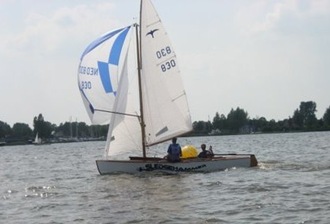
A picture of Valk 830 "Sledgehammer" sailed by Onno Yntema and Klaas Weissenbach jr. They won the National Championship 2008 yesterday!

In the past I have had a couple of appeals on protest were I was a member of the PC. With the first ones I felt a little anxious and nervous. Would the appeals committee agree with the decision? But lately that has not been the case. Those appeals were almost always about very tricky or seldom used rules, where I was glad more people looked at it and gave their verdict.

I didn't always agree with their interpretation, but that's not been a problem. The rules are complicated enough and we all have to accept that different insights will lead to different decisions.

How about you? Any appeals on your decisions?

Saturday, 5 July 2008

Finishing Third?

In one of the qualification races the fleet is split into two groups, which start with a five minute interval. At the finish of the first race a boat in the first group hits the "pin-end"-mark of the finish line and drags it behind it's rudder some 30 - 40 meters downwind, before she manages to get it released.

The RO tells the mark boat to get the finish mark back to it's original position, as soon as group one are all finished and before group two get too close. The mark boat only partly manages this and the mark is dragged back a good twenty meters. The first three boats of group two are about one hundred meters from the finish, with two boats at the committee-boat side and one at the left side.

The first one (Yellow) finishes at the committee boat side and 40 seconds later the second (Blue), finishes also at the boat side. The third (Green), crossing the line at the pin-end side, another 10 seconds later.

Green request redress, claiming she would have finished second if the mark was put left in it's position. She states on her request form that she specifically sailed to that end of the finish line to accomplish this

As usual, please write a conclusions and rules that apply, and give us a decision


Friday, 4 July 2008

UMPIRE PAIRING SPREADSHEET

Next to the rules, umpires always discuss passionately there pairing. With whom they are going to do the matches.Mostly because it reflects on where you are in the "pecking order". Are you considered to be experienced in this particular group or less so? I know it is subject where "long toes" are a factor. Where you stand is not very often talked about openly and with the whole grouping system shrouded in "secret" assessors, many of the umpires feel uncomfortable to share their thoughts.


SG's picture from Kiel Week Woman Match Race 2008; we did have some interesting obstructions


I've only just become a IU, but it already has an impact. As a National Umpire doing work with a more experienced IU, I could rely on that any mistakes and omissions I might make, where corrected by that IU.As an IU I now find that I'm more and more in a position where I am the one paired with a less experienced umpire. Any faults are contributed to me. Fair enough, I should know not to make them.


But this also means that my exposure to more experienced umpires is less and less. I can't first hand do matches with them and see and talk about how they do it. The ISAF has set up a MENTOR program to deal with this. I've applied and will shortly be assigned a mentor to help me continue to develop my skills.The umpire manual has a few examples how Umpires can be paired for matches. Although many variables are to be considered, the first thing one has to do, is make sure that the maximum of combinations is achieved.


I've made an Excel file where a couple of possible rotation systems are set up. Depending on the number of boats and matches in a flight and depending on the level of attending umpires, combinations can be found. In the spreadsheet are some of the examples from the manual and some of my own: 6 boats= 3 ump.teams + 1 wing and no wing, for different groupings of more or less experienced umpires. Also 4 boats= 2 ump.teams + 1 wing.


name add.info
A 3 * jury chair
B 2 *
C 1 * chief ump
D 4 *
E 5
F 6
G 7
H 8

If you set up the names in the provided column, a pairing is automatically generated. * in this example the first four are the most experienced umpires.


1st ROTATION 2nd ROTATION 3rd ROTATION 4th ROTATION
UMP1 2 + 5 4 + 7 2 + 8 2 + 7
UMP2 3 + 6 3 + 5 4 + 5 3 + 8
UMP3 1 + 7 1 + 8 1 + 6 4 + 6
WING 4 + 8 2 + 6 3 + 7 1 + 5


You can find the file here: Umpire Rotations 2008 v1.xls

I've also added it to the download list.

Thursday, 3 July 2008

MATCH RACING PROTESTS

Just a page from the umpires manual; one you should learn by heart:

Who protests - how - for what ?

By a boat....... using a Y-flag...... against another boat [ rule C6.1(a) ]
  • rule of Part 2, including
  • Not keeping clear while taking a penalty [ C2.8 ]
  • Interference from a boat not racing [ rule C2.9 ]
  • Interference when taking a penalty [ C2.10 ]
  • Interference on different legs [ C2.10 ]
  • Interference from a boat in another match [ rule C2.11 ]
  • o BUT NOT : for Rule 14
  • o AND ONLY : if involved in the incident
By a boat..... using a red flag.... against another boat [ rule C6.1(b) ]
* All rules and sailing instructions, including rule 14 when damage results
EXCEPT:
  • The Y-flag matters ( as above )
  • Touching a mark [ rule 31 ]
  • Propulsion [ rule 42 ]
  • Incorrect position at preparatory signal [ rule C4.1 ]
  • Not crossing the start line from the course side correctly [ C4.2 ]
  • Not taking penalties correctly [ rule C7 ]
By the Umpires........ shall give a penalty: [ rule C8.2 ]
* Touching a mark [ rule 31 ]
* Propulsion [ rule 42 ]
* Incorrect position at preparatory signal [ rule C4.1 ]
* Not crossing the start line from the course side correctly [ rule C4.2 ]
* Not taking a second penalty as soon as reasonably possible [ rule C7.3(c) ]

By the Umpires........ may give a red flag penalty
* When the boat that broke a rule has gained a controlling position as a result of breaking a rule - and the umpires are not certain the conditions for an additional penalty have been fulfilled. [ C6.5(b) ]

By the Umpires........ may give a penalty OR a black flag
* Gained an advantage by breaking a rule after allowing for a penalty [ C8.3(a) ]
* Deliberately broken a rule [ rule C8.3(b) ]
* Committing a breach of good sportsmanship [ rule C8.3(c) ]

By the Umpires........ shall give a black flag
* If a boat has more than two outstanding penalties [ rule C7.2(f) ]

By the Umpires or Protest Committee.. through a hearing [ rule C8.4 ]
* All rules and sailing instructions
EXCEPT:
  • The Y-flag matters ( as above )
  • Matters which umpires can penalize on the water ( as above )
Umpires may black flag a boat after her opponent has started when they are satisfied that she will not start. [ rule C8.5 ]

Wednesday, 2 July 2008

Look To Windward READERS Q & A | 7

Dear Jos,

Would you care to run the following as a reader's Q&A? (or otherwise give me your opinion by e-mail):

There is contact causing serious damage to P on port, in contact with S on starboard, who suffers no damage. P retires.  Protest Committee concludes that P did not keep clear of S.

P did not "cause" injury or serious damage, therefore she is not required to retire under rule 44.1. Rule 44.4(b) only protects a boat that retires, when rule 44.1 required her to do so. Is there any reason why P should not be DSQ? (rule 64.1(a))

Regards
Brass
________________________________

Dear Brass,

This hinges around the question if any reason to retire, protects a boat from DSQ. I know there are different opinions about this. The Case book only offers us an inkling in case 99. Summary:
"The fact that a boat required to keep clear is out of control does not entitle her to exoneration for breaking a rule of Part 2. When a right-of-way boat becomes obliged by rule 14 to ‘avoid contact . . . if reasonably possible’ and the only way to do so is to crash-gybe, she does not break the rule if she does not crash-gybe. When a boat retires as required by rule 44.1, whether out of choice or necessity, she cannot then be penalized further"

In my personal opinion the reason for retirement is irrelevant, whether by she acknowledges her fault by taking this penalty or because she cannot continue for another reason. In both cases rule 44.4(b) protects her.

You cannot reverse the argument in rule 44.4(b).
Any boat that takes a penalty shall not be penalized further.
P did retire, so no DSQ.

If P had not retired she would have been DSQ for breaking rule 10, by not keeping clear of a Starboard boat, not for breaking 44.1. She was not the one in your example causing the serious damage. She chose to take a penalty, - in this case not a two turns penalty, which would have also been enough - the penalty to retire. And that retiring is a penalty, we can find in the Basic Principle.

Hope this helps,
Jos

PS: If there are other opinions please don't hesitate to comment.

Tuesday, 1 July 2008

Racing Rules of Sailing 2009-2012 | 3

The preamble of Part Two has changed by deleting one sentence:

The rules of Part 2 apply between boats that are sailing in or near the racing area and intend to race, are racing, or have been racing. However, a boat not racing shall not be penalized for breaking one
of these rules, except rule 2
3.1.

When a boat sailing under these rules meets a vessel that is not, she shall comply with the International Regulations for Preventing Collisions at Sea (IRPCAS) or government right-of-way rules. However, an alleged breach of those rules shall not be grounds for a protest except by the race committee or protest committee. If the sailing instructions so state, the rules of Part 2 are replaced by the right-of-way rules of the IRPCAS or by government right-of-way rules.

When a boat racing fouls a boat that is not participating in the race - and I don't mean another boat that just is not racing at that particular encounter - only the PC or RC could protest that boat. That always struck me as not very fair. In most cases the RC, and let alone the PC, isn't on the water to look for this and hardly ever at the right place at the right time.

Now another boat who sees this, can protest. It will still be hard to get the non racing party into the hearing (as a witness - never a party, because that boat isn't under the RRS), but at least the likelihood that someone will sees this and can do something, has been increased.

In the four years this rule has been in effect I have never ever been in a protest involving a non racing boat. How about you?

Related Posts Plugin for WordPress, Blogger...