Showing posts with label appeals. Show all posts

Sunday, 2 September 2012

The (less) strange case of the (non)competitor

In response to my post about the (non) competitor, I received a mail from Lynne in Canada. She's a member of the appeal board and they had a similar case. One that provides some insight in how to deal with this issue. I've asked and been given permission to publish it:


Racing Rules of Sailing
New Case - Basic Principle, Sportsmanship and the Rules
 
A submission from the Canadian Yachting Association

Purpose or Objective
To provide a Case clarifying when a boat is participating in a race.

Proposal
CASE XXX

Basic Principle, Sportsmanship and the Rules
Rule 3, Acceptance of the Rules
Rule 4, Decision to Race
Part 2, Preamble
Rule 69, Allegations of Gross Misconduct
Rule 75, Entering a Race

A boat that meets the requirements for entry in a race, and sails in or near the racing area, and participates in a race is racing from her preparatory signal until she finishes or retires from the race. The Racing Rules of Sailing apply to such boats. She does not have the option to claim that that the Racing Rules do not apply to her.
The boat’s sole responsibility to decide to participate in a race does not include the right to choose whether or not to be governed by the rules once she participates in the race.
By participating in a race, competitors are governed by the Racing Rules of Sailing, including action by a protest committee under Rule 69.
A boat that breaks the rules over a protracted period commits a gross breach of the rules and shows bad manners and bad sportsmanship.

Summary of the Facts:

During three sailing seasons at her yacht club’s weekly races, boat A entered the series, started and sailed in the races for a fleet of which she was not a member, rather than starting with her own fleet five minutes later. In the third season, two protests were filed against A under the Racing Rules of Sailing, Part 2. The protest committee found in both cases that A had been racing, and disqualified her for breaking rules of Part 2. Later that year, there was a further written complaint against A’s skipper alleging abusive behaviour during other races in which she sailed in the wrong fleet. The protest committee conducted a hearing under Rule 69 against A’s skipper, alleging that by his actions constituted a gross breach of the rules, good manners, and sportsmanship. It found that the competitor had committed a gross breach of the rules, and had also shown bad manners and bad sportsmanship, all over a protracted period. It upheld the allegations under rule 69. It imposed penalties to the competitor and to the boat, disqualifying the boat from the races in question and excluding the competitor from all competition for which the yacht club is the Organising Authority, for a period of two years.

The competitor appealed using Rule 70.1 of the Racing Rules of Sailing. The competitor argued that A was observing the government right-of-way rules, as was his right. He further argued that he had informed the club that he was no longer racing at the club, and therefore, he had no undertaking to observe the Racing Rules of Sailing. Specifically, he was not obligated under, rule 3(a) to be governed by the rules or by 3(b) to accept the penalties imposed and any other action taken under the rules. He further objected to the jurisdiction of the protest committee that convened the Rule 69 hearing. He argued that they had ignored rule 4, which made the responsibility for a boat’s decision to participate in a race or to continue racing hers alone. He appealed the findings of the Rule 69 hearing as outside of the Protest Committee’s jurisdiction, asking the Appeals Committee to find the decision to be null and void and ultra vires.

Decision
A’s actions directly contradict the assertion that she was not racing under the Racing Rules of Sailing. The boat took the decision under rule 4 to participate in the race, as evidenced by her own actions. Evidence of her participation under rule 3 is that she sailed in or near the racing area, she started races, often finished races, and claimed her rights under the racing rules when she met other boats competing in the races. A was racing from her preparatory signal until she finished or retired from each race. Her actions demonstrated that she was not a cruising yacht or a spectator boat who sailed into the racing area.

There is no contradiction between rule 4 which gives the responsibility for a boat’s decision to participate in a race to the boat alone, and rule 3. The decision is observed through the boat’s actions. Participation in a race is evident by the boat’s actions, such as by starting races, sailing the course, rounding the marks, or finishing. Boats racing under the rules are entitled to proceed under the assumption that other boats that are participating in the race are also observing the Racing Rules of Sailing. The responsibility allotted in rule 4 is not a choice whether or not to observe the Racing Rules of Sailing.

The Racing Rules of Sailing did apply to Boat A.

Since the skipper of A had participated in the race under rule 3, he was a competitor in the sport of sailing. He was, therefore, governed by a body of rules that he was expected to follow and enforce under the Basic Principle, sportsmanship and the rules and Rule 69. The protest committee did have the authority to convene the hearing under rule 69. The competitor’s actions described in the written complaint did constitute a gross breach of good manners and sportsmanship. The competitor was properly found to be in breach of Rule 69. The competitor was subject to penalty under rule 69. Rule 3(b) did, therefore obligate the competitor to accept the penalties imposed and other action taken under the rules, subject to the appeal process which he used

The appeal is dismissed. The protest committee did have the authority under the Racing Rules of Sailing to convene this hearing and to impose an appropriate penalty on the competitor. The decision of the protest committee and the penalties imposed are upheld.

Current Position
None.

Reason
This Case provides a clear interpretation that a boat that participates in a race has agreed to be governed by the rules. The case clarifies that there is no contradiction between rules 4 and 3: A boat has made her sole decision to participate in a race once she does participate in the race. With that participation, she has agreed to be governed by the rules and accept any penalties imposed under the rules. A boat that participates in the race may not claim that she has decided not to participate, and that she is not governed by the rules. The case also confirms that the protest committee’s jurisdiction includes persons who participate in races but claim that they are not competitors under Sportsmanship and the Rules. They are subject to protest, to action under rule 69, and to any penalties imposed under the rules.


The appeals committee has submitted this particular appeal to ISAF for inclusion in the Casebook. It will be on the agenda in this year's November conference.

Monday, 23 July 2012

(pillow)Case of the week (30/12) - 2

(This is an installment in a series of blogposts about the ISAF Case book 2009-2012 with amendments for 2011. All cases are official interpretations by the ISAF committees on how the Racing Rules of Sailing should be used or interpreted. The cases are copied from the Casebook, only the comments are written by me.)
(pillow)Case picture
Case 2
Rule 12, On the Same Tack, Not Overlapped
Rule 14, Avoiding Contact
Rule 15, Acquiring Right of Way
Rule 18.2(a), Mark-Room: Giving Mark-Room
Rule 18.2(b), Mark-Room: Giving Mark-Room

If the first of two boats to reach the zone is clear astern when she reaches it and if later the boats are overlapped when the other boat reaches the zone, rule 18.2(a), and not rule 18.2(b), applies. Rule 18.2(a) applies only while boats are overlapped and at least one of them is in the zone.
Case 2 diagram

Summary of the Facts

A and B were both on port tack, reaching to a mark to be left to starboard. The wind was light. At position 1, when A came abreast of the mark she was clear ahead of B but four-and-a-half hull lengths from the mark. B, who had just reached the zone, was three lengths from the mark. Between positions 1 and 2 A gybed and headed to the mark, becoming overlapped outside B. Between positions 2 and 3, after B had gybed and turned towards the next mark, she became clear ahead of A. When B first became clear ahead of A there was about one-half of a hull length of open water between the boats. A few seconds after B became clear ahead, A, who was moving faster, struck B on the transom. There was no damage or injury. A protested B under rule 18.2(b). B protested A under rule 12. A was disqualified and she appealed.  

Decision

A apparently believed that the second sentence of rule 18.2(b) applied when the two boats were at position 1 and that B, then being clear astern, was obliged to give A mark-room. As that sentence states, it applies only if a boat was clear ahead when she reached the zone. At position 1, B had reached the zone, but A was well outside it. Moreover, the first sentence of rule 18.2(b) never applied because the boats were not overlapped when B, the first of them to reach the zone, did so. However, while the boats were overlapped, rule 18.2(a) did apply, and it required A to give mark-room to B. During that time B had to keep clear of A, first under rule 10 and later (after she gybed) under rule 11.

After B gybed she pulled clear ahead of A. At that moment rules 18.2(a) and 11 ceased to apply and rules 12 and 15 began to apply. Rule 15 required B initially to give A room to keep clear, and B did so because it would have been easy for A to keep clear by promptly bearing off slightly to avoid B’s transom after B became clear ahead. When A hit B’s transom, she obviously was not keeping clear of B, and so it was proper to disqualify A for breaking rule 12. A also broke rule 14 because it was
possible for her to bear off slightly and avoid the contact with B.

After it became clear that A was not going to keep clear of B, it was probably not possible for B to avoid the contact. However, even if B could have avoided the contact, she could not have been penalized under rule 14 because she was the right-of-way boat and the contact did not cause damage or injury.

The appeal is dismissed, the protest committee’s decision is upheld, and A remains disqualified for breaking rules 12 and 14.

USSA 1962/87

blogcolorstripe 

I must confess that this Case is something that I have learned myself only recently. I never had a case involving the clear ahead boat not reaching the zone first before. Only after reading the sentences of rule 18 in the book again and again, I came to the same conclusion.

It is easy to overlook these first cases in the book as being too obvious. This one however is pretty important, although it might be some time before you come across a similar situation in the protest room.

We are almost at the 'end' of our series... One more to go.

Monday, 16 July 2012

(pillow)Case of the week (29/12) - 03

(This is an instalment in a series of blogposts about the ISAF Case book 2009-2012 with amendments for 2011. All cases are official interpretations by the ISAF committees on how the Racing Rules of Sailing should be used or interpreted. The cases are copied from the Casebook, only the comments are written by me.)

(pillow)Case picture

Case 3

Rule 19.2(a), Room to Pass an Obstruction: Giving Room at an Obstruction
Rule 20.1, Room to Tack at an Obstruction: Hailing and Responding
Rule 64.1(c), Decisions: Penalties and Exoneration

A leeward port-tack boat, hailing for room to tack when faced with an oncoming starboard-tack boat, an obstruction, is not required to anticipate that the windward boat will fail to comply with her obligation to tack promptly or otherwise provide room.

Summary of the Facts

S hailed PL as the two dinghies approached each other on collision courses. PL then twice hailed ‘Room to tack’, but PW did not respond. PL, now unable to keep clear of S, hailed a third time, and PW then began to tack. At that moment, S, which was then within three feet (1 m) of PL, had to bear away sharply to avoid a collision. PW retired and S protested PL under rule 10. The protest committee disqualified PL observing that, not having had a timely response from PW, she should have used her right to luff and forced PW to tack.

Case 3 diagram

PL appealed, claiming that:

  1. she had no right to force PW onto the opposite tack;
  2. even with both of them head to wind, S would still have had to change course to avoid a collision; and
  3. she had foreseen the development and had hailed PW in ample time.

Decision

PL’s appeal is upheld. PL is to be reinstated. Because S was an obstruction to PL and PW, PL was entitled to choose between tacking and bearing away (see rule 19.2(a)). Having decided to tack and having hailed for room to do so three times, PL was entitled by rule 20.1 to expect that PW would respond and give her room to tack. She was not obliged to anticipate PW’s failure to comply with rule 20.1. PL broke rule 10, but she is exonerated as the innocent victim of another boat’s breach of a rule, under the provisions of rule 64.1(c).

RYA 1962/37

blogcolorstripe

We are almost at the ‘beginning’ of our Casebook. The Cases there, are all dealing with the most fundamental principles. In this particular case the right of the right-of-way boat to choose, and – if the keep clear boat does not do what it is suppose to do – the exoneration for breaking a rule.

But there’s another principle here;

Although most experienced regatta sailors know beforehand what is most likely going to happen, the rules don’t have any provisions or obligations that you have to anticipate. The rules deal in facts, not in intentions. In almost all incidents a boat has to act on the factual rights and obligations.
Am I keep clear boat?
Am I right of way boat?
And from the answers to those questions you know what you can or cannot do.

The trouble is that in any given situation the facts can change very quickly by what the boats do. That leads to ‘getting ahead’ of what the facts will become and with that to rights and obligations that are not (yet) established.

A port tacking boat will become a starboard right of way boat. But until it has completed its tack, it is still a keep clear boat. And until that time any (not tacking) boat does not have to respond, although its crew already knows that moment will come. If the tacking boat already acts as if she’s right of way boat, because that will happen in a second or two, it most likely will break rule 13.

The right-of-way boat in Case 3 does not have to anticipate that the keep clear boat will not act according to the rules – when she’s hailed three times.

Monday, 2 July 2012

(pillow)Case of the week (27/12) - 06

(This is an instalment in a series of blogposts about the ISAF Case book 2009-2012 with amendments for 2011. All cases are official interpretations by the ISAF committees on how the Racing Rules of Sailing should be used or interpreted. The cases are copied from the Casebook, only the comments are written by me.)

(pillow)Case picture

Case 6

Rule 16.1, Changing Course
Rule 16.2, Changing Course

A starboard-tack boat that tacks after a port-tack boat has borne away to go astern of her does not necessarily break a rule.

Case 6 diagram

Summary of the Facts

Between positions 1 and 2 P bore away to pass astern of S. A moment later S chose to tack. After sailing free for about a hull length, P resumed her close-hauled course, having lost about a hull length to windward, and passed S a hull length to windward of her. After S tacked, P’s luff to closehauled was not caused by a need to keep clear of S. P protested S under rule 16.1. P claimed that, when S tacked after P had borne away to pass astern of S, S failed to give P room to keep clear. The protest committee disqualified S under rule 16.1. S appealed.

Decision

S’s appeal is upheld. She is to be reinstated. S was subject to rule 16 only while luffing from a close-hauled starboard-tack course to head to wind. During that time P had room to keep clear, and so S did not break rule 16.1. S did not break rule 16.2 because P was able to continue to sail her course ‘for about a hull length’ which demonstrated that S’s luff did not require P to change course immediately to continue keeping clear. After S turned past head to wind, P became the right-of-way boat under rule 13, and rules 16.1 and 16.2 no longer applied. S kept clear of P as required by rule 13. No rule was broken by S.

USSA 1963/93

blogcolorstripe

Did you notice the hand-drawn picture? The typing has to be something that was added later.

This case demonstrates that rules in Section B of Part Two do not have the same impact as the rules in Section A. They are ‘mere’ limitations on the right of way rules.

A ROW boat has to give the other boat room to keep clear. That is not the same as not doing what she wants. As long as she gives that room, she is free to sail wherever she wants.
The limitation rules do NOT cancel out the ROW-rules. They merely provide the keep clear boat the space and time she needs, to do what she must do, and that is to keep clear.

J.

Monday, 4 June 2012

(pillow)Case of the week (23/12) – 10

(This is an instalment in a series of blogposts about the ISAF Case book 2009-2012 with amendments for 2010. All cases are official interpretations by the ISAF committees on how the Racing Rules of Sailing should be used or interpreted. The cases are copied from the Casebook, only the comments are written by me.)

(pillow)Case picture

CASE 10

Rule 20.1, Room to Tack at an Obstruction: Hailing and Responding
Rule 64.1(b), Decisions: Penalties and Exoneration
Rule 64.1(c), Decisions: Penalties and Exoneration
Definitions, Obstruction

When two boats are involved in an incident and one of them breaks a rule, she shall be exonerated when a third boat that also broke a rule caused the incident.

Summary of the Facts

As P approached the mud flats, she tacked onto port. M, on starboard tack, immediately hailed and then hailed again when one hull length away, since it was apparent that P was trying to cross ahead and a collision would be inevitable. When there was no response to her hails, M tacked, hailing S as she was going about. S tried to respond but there was contact. P retired promptly after the incident because her crew believed she had gained an advantage over M and S who had lost considerable time as a result of the contact between them. S protested M under rule 10. The protest committee, commenting that M had sufficient time to take avoiding action to keep clear of both P and S, disqualified M under rule 14.

M appealed, asserting that the protest committee erred in suggesting that she, a right-of-way boat, was obliged to keep clear of P. Furthermore, after her second hail, had she borne away and then P finally responded by tacking, contact would have been likely. M also alleged that S had not given M room to tack as required by rule 20.1.

pCase 10

Decision

P broke rule 10. When she retired promptly after the incident, she took the applicable penalty and is not to be penalized (see rule 64.1(b)).

S was subject to rule 14, but did not break it as it was not possible for her to avoid contact. Rule 20.1 did not apply between M and S because, according to the definition Obstruction, P was not an obstruction since M and S were not required to keep clear of P.

M, in the circumstances, took proper action to mitigate the effects of P’s error of judgment. Both M and S were the innocent victims of P’s breach of rule 10. M broke rule 13, but is exonerated under rule 64.1(c). M’s appeal is upheld. M is to be reinstated.

RYA 1964/8

blogcolorstripe

I have a question for you, regarding this third boat.

We all know that a procedure has to be stopped and restarted when the PC has found that a third boat might be involved and might have broken a rule. That usually means that the whole hearing is pushed to the next day, in order to locate and protest that third boat.

Have any of you ever been in a protest where the third boat was not or could not be identified. Both parties agree on the facts found, they agree that the third boat was the ‘root’ cause of the incident, but can’t remember which boat it was.

Did you still exonerate the ‘middle’ boat? Without finding the guilty boat and penalizing her?

J.

Monday, 28 May 2012

(pillow)Case of the week (22/12) – 11

(This is an instalment in a series of blogposts about the ISAF Case book 2009-2012 with amendments for 2010. All cases are official interpretations by the ISAF committees on how the Racing Rules of Sailing should be used or interpreted. The cases are copied from the Casebook, only the comments are written by me.)

(pillow)Case picture

CASE 11

Rule 14, Avoiding Contact
Rule 19.2(b), Room to Pass an Obstruction: Giving Room at an Obstruction
Rule 20.1, Room to Tack at an Obstruction: Hailing and Responding
Rule 20.3, Room to Tack at an Obstruction: When Not to Hail
Rule 64.1(c), Decisions: Penalties and Exoneration

When boats are overlapped at an obstruction, including an obstruction that is a right-of-way boat, the outside boat must give the inside boat room to pass between her and the obstruction.

Summary of the Facts

PW and PL, close-hauled on port tack and overlapped, approached S on the windward leg. PL could pass safely astern of S. PW, on a collision course with S, hailed PL for room to pass astern of S when PW and PL were about three hull lengths from S. PL ignored the hail and maintained her course. When PW bore away to avoid S, she and PL had slight beam to beam contact. PW protested under rule 19.2 (b).

pCase 11

The protest committee held that rule 19.2(b) did not apply, stating that PW could easily have tacked into the open water to windward to keep clear, and should have done so. PW was disqualified under  rule 20.1 and appealed.

Decision

S was an obstruction that PW and PL were about to pass on the same side.
Therefore, rule 19 applied. Under rule 19.2(b) PW was entitled to room to pass between PL and the stern of S. PL did not give PW that room, so PL broke rule 19.2(b).
PL was subject to rule 14, but since she held right of way over PW and there was no damage or injury, she cannot be penalized for breaking that rule. PW could not have known that PL was not going to give sufficient room until she was committed to pass between S and PL. PW broke rule 11, but she was compelled to do so by PL’s failure to give room as required by rule 19.2(b). Therefore, as required by rule 64.1(c), PW is exonerated from breaking rule 11. Also, when it became clear that PL was not giving room, it was not reasonably possible for PW to avoid the contact that occurred, so PW did not break rule 14.
PW was not required to “tack into open water to windward to keep clear” because PL did not hail under rule 20.1 for room to tack and avoid S. Rule 20.3 prohibited PL from doing so because she did not have to make any change of course to avoid S. PW’s appeal is upheld. The decision of the protest  committee disqualifying PW is reversed. PW is reinstated, and  PL is disqualified.

RYA 1964/18

blogcolorstripe

This case teaches that, although there is a perfect ‘alternative escape’ route for a keep clear boat to keep clear, it still may relay on the rules to give her the route those rules provide. If she wishes to take that route.

Because of the this and other limitation rules (15, 16, & 17) the right of way boat sometimes feels MORE restricted in her movements, than the keep clear boat. A keep clear boat can change course as fast as she likes, can tack or gybe or whatever – as long as she keeps clear. The right of way boat must always look ahead and calculate what consequences her actions have on the ability of the keep clear boat to keep clear.

Some sailors advocate a simpler way. To get rid of all those limitations on the right of way boat. I always urge them to consider the case of the faster boat catching up with them, who cries foul when the slightest bow point overlaps there stern or rudder……

Monday, 21 May 2012

(pillow)Case of the week (21/12) - 12

(This is an instalment in a series of blogposts about the ISAF Case book 2009-2012 with amendments for 2011. All cases are official interpretations by the ISAF committees on how the Racing Rules of Sailing should be used or interpreted. The cases are copied from the Casebook, only the comments are written by me.)

(pillow)Case picture

Case 12

Rule 11, On the Same Tack, Overlapped
Rule 18.1, Mark-Room: When Rule 18 Applies
Rule 18.2(b), Mark-Room: Giving Mark-Room
Rule 18.5(b), Mark-Room: Exoneration
Definitions, Clear Astern and Clear Ahead; Overlap

In determining the right of an inside boat to mark-room under rule 18.2(b), it is irrelevant that boats are on widely differing courses, provided that an overlap exists when the first of them reaches the zone.

image

Summary of the Facts
OL and IW were approaching a mark to be left to starboard. The wind was light and there was a 2-knot current in the same direction as the wind. IW, which had sailed high on the course to the mark to offset the effect of the current, approached it with the current, almost on a run. OL, on the other hand, had been set to leeward and, at position 1, about three hull lengths from the mark, was sailing close-hauled slowly against the current. IW twice hailed for water, and OL twice replied ‘You can’t come in here.’ At the last moment, shortly after position 4 in the diagram, as IW luffed to begin her passing manoeuvre OL tried to give her room but the two dinghies made
contact. There was no damage or injury.

OL protested under rule 11 but was herself disqualified under rule 18.2(b). She appealed, asserting that it was illogical and beyond the intention of the definition Overlap and of rule 18 to consider as overlapped two boats whose headings differed by 90 degrees. She also asserted that the purpose of rule 18 was to protect a boat in danger of hitting the mark that was unable to go astern of the outside boat. She further argued that throughout IW’s approach to the mark until she finally luffed, she was easily able to pass astern of OL, and that IW was not an ‘inside’ boat until a moment before contact.

Decision
OL’s appeal is dismissed and her disqualification is confirmed.
The boats were required to leave the mark on the same side and were on the same tack, and so rule 18 applied after position 1 when OL reached the zone. The boats were overlapped from that time until contact occurred, and therefore the first sentence of rule 18.2(b) applied, limiting OL’s rights under rule 11 by requiring her to give IW mark-room. OL did not give IW mark-room, and so is disqualified under rule 18.2(b). It should be noted that OL also broke rule 14, as she could have avoided contact, but, because OL was the right-of-way boat and the contact caused neither damage nor injury, she could not have been penalized had rule 14 been the only rule she broke. As a result of OL’s failing to give IW mark-room to which IW was entitled,
IW broke rule 11 while trying to take that mark-room, and therefore is exonerated under rule 18.5(b). IW also broke rule 14, as she too could have avoided contact, but is not to be penalized, because she was a boat entitled to mark-room and the contact caused neither damage nor injury.

RYA 1964/19

blogcolorstripe 783x28

Many sailors have a hard time understanding that they can be overlapped with a boat far away on a hugely different angle. This case makes it clear once and for all and has been doing it since 1964!

The most common example is not with two boats, but with multiple boats who stack up behind each other to go round the mark and are surprized by a later incoming boat who claims mark room.

120521 case12

When the pink boat enters as fourth boat, the light blue is overlapped on the inside. Before we had the three length zone, this was even more seen as unfair.
J.

Monday, 2 April 2012

(pillow)Case of the week (14/12) – 14

(This is an instalment in a series of blogposts about the ISAF Case book 2009-2012 with amendments for 2011. All cases are official interpretations by the ISAF committees on how the Racing Rules of Sailing should be used or interpreted. The cases are copied from the Casebook, only the comments are written by me.)

(pillow)Case picture

CASE 14

Rule 11, On the Same Tack, Overlapped
Rule 14, Avoiding Contact
Rule 16.1, Changing Course
Rule 17, On the Same Tack; Proper Course
Definitions, Proper Course

When, owing to a difference of opinion about a leeward boat’s proper course, two boats on the same tack converge, the windward boat must keep clear. Two boats on the same leg sailing near one another may have different proper courses.

Summary of the Facts

After rounding the windward mark in light wind the fleet divided, some boats sailing towards shore to get out of the tide and others remaining offshore in hopes of a better wind. L had established an overlap to leeward of W from clear astern and they rounded the mark overlapped. W chose to remain offshore, while L began to luff slowly and informed W of her intention to go inshore. W replied ‘You have no right to luff.’ L replied that she was sailing her proper course and W was required to keep clear. The discussion took some time. L continued to gradually change course, and at no time did W state that she was unable to keep clear. The boats touched and both protested. The protest committee disqualified L under rule 17 for sailing above her proper course, and she appealed.

 image

Decision

When, owing to a difference of opinion on the proper course to be sailed,two boats on the same tack converge, W is bound by rule 11 to keep clear and by rule 14 to avoid contact.

This case illustrates the fact that two boats on the same leg sailing very near to one another can have different proper courses. Which of two different courses is the faster one to the next mark can not be determined in advance and is not necessarily proven by one boat or the other reaching the next mark ahead.

The basis for W’s protest was that L sailed above her proper course while subject to rule 17. L’s defence and counter-protest were that she had decided that the inshore course out of the tide would result in her finishing sooner and that, therefore, the course she was sailing was her proper course. In addition, L argued that W had broken rules 11 and 14.

The facts found do not show that L sailed above her proper course; therefore she did not break rule 17. When L luffed slowly between positions 1 and 2, W had room to keep clear, so L did not break rule 16.1. L could have avoided contact with W. By not doing so, she broke rule 14, but is not penalized because the contact caused no damage or injury. By failing to keep clear of L, W broke rule 11.
W could have avoided the contact, and by not doing so she too broke rule 14, but is not exempt
from penalization. L’s appeal is upheld. L is reinstated, and W is disqualified for breaking rules 11 and 14.

RYA 1966/3

blogcolorstripe

Like with passing an obstruction, it is the right-of-way boat who decides. If that boat feels that going inshore is a proper course, the windward boat must keep clear and go up as well

The definition of proper course allows for multiple courses and beforehand it is not always clear which . But even if the windward boat can show that the leeward boat is sailing well above its proper course, she still must keep clear. No boat is forcing her to break rule 11 – so she cannot be exonerated. She has but one option: Keep clear and protest. If she doesn’t and the leeward boat is found to have been sailing above her proper course, they both will be disqualified.

Although we are now getting into the first cases in the book and therefore well into the ‘oldest’, many sailors still get confused and make this – basic – mistake.

Monday, 5 March 2012

(pillow)Case of the week (10/12) – 20

(This is an instalment in a series of blogposts about the ISAF Case book 2009-2012 with amendments for 2010. All cases are official interpretations by the ISAF committees on how the Racing Rules of Sailing should be used or interpreted. The cases are copied from the Casebook, only the comments are written by me.)

(pillow)Case picture

CASE 20

Rule 1.1, Safety: Helping Those in Danger
Rule 62.1(c), Redress

When it is possible that a boat is in danger, another boat that gives help is entitled to redress, even if her help was not asked for or if it is later found that there was no danger.

Summary of the Facts

Dinghy A capsized during a race and seeing this dinghy B sailed over to her and offered help. A accepted help and B came alongside, taking the crew of two aboard. Then all hands worked for several minutes to right A, whose mast was stuck in the mud. Upon reaching shore, B requested redress under rule 62.1(c).

The protest committee considered several factors in its decision. First, A’s helmsman was a highly experienced sailor. Secondly, the wind was light, and the tide was rising and would shortly have lifted the mast free. Thirdly, she did not ask for help; it was offered. Therefore, since neither boat nor crew was in danger, redress was refused. B appealed, stating that rule 1.1 does not place any onus on a boat giving help to decide, or to defend, a decision that danger was involved.

Decision

B’s appeal is upheld. A boat in a position to help another that may be in danger is bound to do so. It is not relevant that a protest committee later decides that there was, in fact, no danger or that help was not requested. B is entitled to redress. The protest committee is directed to reopen the hearing and to grant appropriate redress following the requirements and advice given in rules 64.2 and A10.

RYA 1968/14

blogcolorstripe

This appeal makes it clear that rule 1.1 is above all a safety rule. It MUST be adhered to. It is far better to grant redress to a boat that erred on the side of caution, in stead of having to punish a boat because she was reluctant to help. Let alone the possible injuries that are prevented or worse, lives that are spared.

Never hesitate to help a boat that can be in danger.

Tuesday, 24 January 2012

LTW Readers Q&A (58) - Red Flag

From the other side of the Atlantic, An US Sailing Appeal case submitted by Hugh.


Just heard a protest, which we found invalid, on grounds of inadequate flag:
Melges 24 - flag was 25 cm x 30 cm - housed in an Opti style pocket and suspended by a single corner. Displayed from the slack stern lifeline (i.e. below deck level).
I saw it at the finish line and it looked like an upside down tulip - not a flag.

It would be nice if you were to address the question of flags - specifically Case 72. In addition US SAILING Appeal 66 is useful and instructive. If you do not have access to US SAILING Appeals, here is the text:


Rule 61.1(a), Protest Requirements: Informing the Protestee
Rule 63.5, Hearings: Validity of the Protest or Request for Redress

A 2" by 8" protest flag on a 40-foot boat is not of sufficient size or of suitable proportions to be “conspicuously displayed.”
Facts and Decision of the Protest Committee
Near the windward mark, Leading Lady and Aliens Ate My Buick, two 40-foot boats, were involved in an incident. Leading Lady immediately hailed “Protest” and displayed a 2" by 8" * strip of red cloth from her backstay. The protest committee concluded that the strip of red cloth was inadequate to qualify as a flag on a 40-foot boat, and therefore found the protest to be invalid and closed the hearing. Leading Lady appealed.
(* For those of you in the metric system: 5x20 cm)

Decision of the Appeals Committee
The strip of red cloth qualified as a protest flag in the context of rule 61.1(a) because it was a red flag. However, rule 61.1(a) also requires a boat to “conspicuously display” the protest flag. This requirement is necessary to inform other boats in the race, as well as the boat to be protested, that a boat intends to protest.

The phrase “conspicuously display” must be interpreted in the context of the size of the boat displaying the flag. An object that is conspicuous is not merely visible; it “catches one’s eye or attention” or is “obvious to the eye or mind” (dictionary references).
Whether the flag is displayed conspicuously depends on a number of considerations, such as the place on the boat from which the flag is displayed, its proximity to other objects of the same or a similar color and, the size of the flag in relation to the size of the boat. On a 40-foot boat a 2" by 8" flag is too small to be conspicuous. In this case, the flag’s proportions also detracted from the conspicuousness of its display.

Since the requirement of rule 61.1(a) that the flag be conspicuously displayed was not met, the protest committee, acting under rule 63.5, should have found that the protest was invalid for that reason, and closed the hearing. The protest committee’s reason for finding the protest invalid is incorrect.

Leading Lady’s appeal is denied, and the decision of the protest committee is corrected as described above.

US Sailing Appeals Book App.66; December 1994


Relevant in this case is also Case 72 from the Casebook: (pillow)Case of the Week 41 - 72.

IN THE ROOM:

Chairman: "What did you do after the incident?"
Representative of boat A: "I yelled protest and put up the red flag"

Chairman: "Did you hear his hail and saw the red flag?"
Representative of boat B: "No I didn't, he never hailed and I did not see any red flag"

C: "Where were the boats relative to eachother, when you hailed, and where did you put up the flag?"
RA: "The boats were about 25 meters apart and he was upwind. Perhaps he didn't hear me. I put the red flag on my leeward shroud. We have a tube there, I only have to pull it out"

C: "Let me get this clear; You were sailing on starboard tack and you put the flag on the port shroud?"
RA: "Yes.

C: "Was the sail covering the flag?"
RA: "Well, eeeeh, yes, at first, but then we gybed and it was clearly visible"

Chairman looks at his fellow panel members and the says to the sailors:
"Can I please ask you to leave to room for a minute, while we discuss this?"

Give me your votes, please.


Monday, 26 December 2011

(pillow)Case of the week (51/11) – 30

(This is an instalment in a series of blogposts about the ISAF Casebook 2009-2012 with amendments for 2010. All cases are official interpretations by the ISAF committees on how the Racing Rules of Sailing should be used or interpreted. The cases are copied from the Casebook, only the comments are written by me.)

(pillow)Case picture

CASE 30

Rule 14, Avoiding Contact
Rule 19, Room to Pass an Obstruction
Rule 64.1(c), Decisions: Penalties and Exoneration
Definitions, Keep Clear

A boat clear astern that is required to keep clear but collides with the boat clear ahead breaks the right-of-way rule that was applicable before the collision occurred. A boat that loses right of way by unintentionally changing tack is nevertheless required to keep clear.

image


Summary of the Facts

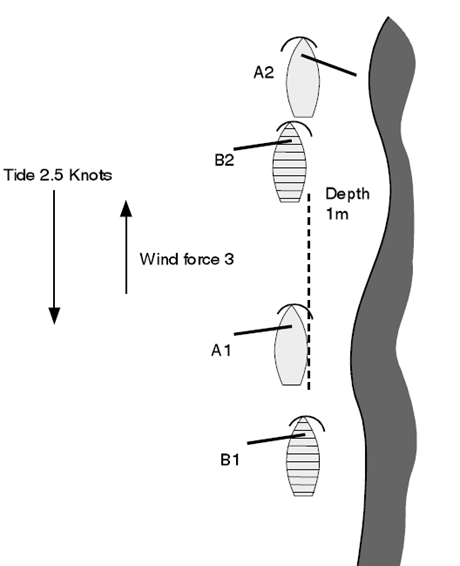
Boats A and B were running on starboard tack close to the shore against a strong ebb tide in a Force 3 breeze. A was not more than half a hull length clear ahead of B. B blanketed A, causing A to gybe unintentionally. This was immediately followed by a collision, although without damage or injury, and B protested A under rule 10. The facts were agreed, and both boats were disqualified: B under rule 12 because she was too close to A to be keeping clear, and A under rule 10 for failing to keep clear of a starboard-tack boat.

A appealed on the grounds that she was compelled by B’s action to break rule 10. The protest committee, commenting on the appeal, stated that B caused both A’s gybe and the collision by not keeping clear when both boats were on the same tack.

Decision

The boats were passing close to the shoreline, which was an obstruction and also a continuing obstruction. Therefore, the conditions for rule 19 to apply were met. However, because the boats were not overlapped, neither of the two parts of rule 19 that place an obligation on a boat (rules 19.2(b) and 19.2(c)) applied. When B was clear astern of A she was required by rule 12 to keep clear but failed to do so. Her breach occurred before the collision, at the moment when A first needed ‘to take avoiding action’ (see the definition Keep Clear). When B collided with A she also broke rule 14.

However, at that time she held right of way under rule 10, so is not subject to penalty under rule 14 because there was no damage or injury. After gybing, A became the keep-clear boat under rule 10, even though she had not intended to gybe. She broke that rule, but only because B’s breach of rule 12 made it impossible for A to keep clear. A did not break rule 14 because it was not ‘reasonably possible’ for her to avoid contact.

Accordingly, B was properly disqualified by the protest committee under rule 12. However, A is exonerated under rule 64.1(c) for her breach of rule 10. A’s appeal is upheld, and she is to be reinstated.

RYA 1974/3

blogcolorstripe

In this post rule 19 has no effect although it applies. I’ve drafted another post from one of the ESS acts where it does. Come back tomorrow and read about it.

The conclusion that A is to be exonerated can only be reached if you write down the facts found in chronological order. Then it becomes clear that the infringement of rule 12 by boat B already occurred before rule 10 came into play.

Nevertheless I can understand the PC that made this mistake. They could not use rule 15 because boat A gybed and therefore boat B acquired row because of the other boat’s actions.

Monday, 19 December 2011

(pillow)Case of the week (49/11) – 32

(This is an instalment in a series of blogposts about the ISAF Case book 2009-2012 with amendments for 2010. All Cases are official interpretations by the ISAF committees on how the Racing Rules of Sailing should be used or interpreted. The cases are copied from the Casebook, only the comments are written by me.)

(pillow)Case picture

CASE 32

Rule 90.2(c), Race Committee; Sailing Instructions; Scoring: Sailing
Instructions

A competitor is entitled to look exclusively to written sailing instructions and to any written amendments for all details relating to sailing the course.

Summary of the Facts

The sailing instructions included, among other things, the following:

  1. All races will be sailed under The Racing Rules of Sailing except as modified below.
  2. A briefing will be held in the clubroom 60 minutes before the start of the first race each day.
  3. Shortened Course will be signalled by two guns and raising of flag S and the class flag. Boats in that class will round the mark about to be rounded by the leading boat and go straight to the finishing line. This changes the meaning of flag S in the Race Signals.

At one of the briefings, the race officer attempted to clarify the phrase ‘go straight to the finishing line’ in item 3 by stating that when the course was shortened, all boats should cross the finishing line in a windward direction.

This would ensure that all classes, some of which might be finishing from different marks, would finish in the same direction even if that were not the direction of the course from the mark at which the course was shortened.

Subsequently, a race was shortened. Six boats, which had not attended the briefing, followed the written sailing instructions, were recorded as not finishing, and sought redress. The boats alleged that the race committee had improperly changed the definition Finish and had failed to follow the requirements of rule 90.2(c). The protest committee upheld their requests for redress on the grounds they had cited.

The race committee appealed to the national authority, asserting that the briefing sessions were a numbered part of the sailing instructions, all competitors should have attended, and the briefings constituted a procedure for giving oral instructions. Also, it argued that the sailing instructions were not changed but merely clarified by the race officer as to what the words ‘go straight to the finishing line’ meant.

Decision

Appeal dismissed. The remarks of the race officer amounted to more than mere clarification. This is borne out by the fact that the boats that did not attend the briefing acted as they did. Competitors are entitled to look exclusively to the sailing instructions and to any amendments for all particulars of the course. Rule 90.2(c) requires changes to the sailing instructions to be in writing. However, under no circumstance can sailing instructions change the definition Finish or the definition of any other term defined in Definitions (see rule 86).

RYA 1975/3

blogcolorstripe

There’s only one ‘escape’ in giving verbal instructions: That is also in rule 90.2(c):

“Oral changes may be given only on the water, and only if the procedure is stated in the sailing instructions.”

Any change that is discussed verbally in a skippers briefing, regarding the SI or RRS MUST also be written on the notice board with time and date at an appropriate time. Anyway, changing a definition is not permitted anyway.

Monday, 28 November 2011

(pillow)Case of the Week (46/11) - 35

(This is an instalment in a series of blogposts about the ISAF Casebook 2009-2012 with amendments for 2010. All cases are official interpretations by the ISAF committees on how the Racing Rules of Sailing should be used or interpreted. The cases are copied from the Casebook, only the comments are written by me.)

(pillow)Case picture

CASE 35

Rule 20.1(b), Room to Tack at an Obstruction: Hailing and Responding

When a boat is hailed for room to tack at an obstruction and replies ‘You tack’, and the hailing boat is then able to tack and avoid the hailed boat, the hailed boat has complied with rule 20.1(b).

Summary of the Facts

As two close-hauled boats approached a shore, L hailed W for room to tack. W replied ‘You tack’ and L then tacked immediately. After tacking, L bore away in a seamanlike way and passed under W’s stern, which she cleared by three feet (1 m) or more. L protested W under rule 20.1(b). The protest committee decided that W failed to give room as required by rule 20.1(b) and disqualified her. W appealed.

Case 35 diagram

Decision

W’s appeal is upheld, and she is to be reinstated. L’s actions showed that she had room to tack and avoid W. W therefore met her obligation under rule 20.1(b).

USSA 1976/189

blogcolorstripe

The exact wording in rule 20.1(b) is:

……. ,or by immediately replying ‘You tack’ and then giving the hailing boat room to tack and avoid her; …..

In Case 35 boat L made the mistake in thinking that after she was given the reply “You Tack” she was free to do as she pleased. That she was free to tack and go in front of W. But the obligation to keep clear under rule 13 and then under rule 11, is not switched off. The only thing she ‘gained’ is that W took the obligation to give her room to do so, and while L did everything to keep clear, to avoid her.

Right of way is NOT changed by this rule. The hailed boat only gets an additional obligation to give (more) room and make sure that she avoids L.

If L would not have been able to bear away – or only in an un-seamanlike way – then W would not have given her enough room and would have broken rule 20.1(b). The failure to keep clear by L in that case, would be exonerated under rule 20.2

Monday, 21 November 2011

(pillow)Case of the Week (45/11) - 36

(This is an instalment in a series of blogposts about the ISAF Casebook 2009-2012 with amendments for 2010. All cases are official interpretations by the ISAF committees on how the Racing Rules of Sailing should be used or interpreted. The cases are copied from the Casebook, only the comments are written by me.)
(pillow)Case picture
CASE 36
Rule 49.2, Crew Position
Positioning of crew members relative to lifelines.
Summary of the Facts
A boat in an offshore class, while close-hauled, had a crew member positioned, for several minutes on two occasions, next to the shrouds with his feet on the deck and his legs inside but touching the lifelines. While his torso was substantially upright, part of it was outboard of an imaginary line projected vertically from the top of the lifelines. The boat was disqualified under rule 49.2 and appealed.
Case 36 pict
Decision
The appeal is dismissed. To clarify the rule, the drawing shows possible crew positions.
Position 6 is the position of the appellant’s crew member.
Positions 1, 2 and 3 do not break the rule; positions 5 and 6 break it.
On boats equipped with one lifeline, position 4 breaks the rule.
On boats equipped with two wire lifelines, a crew member sitting on deck facing outboard with his waist inside the lower lifeline and the upper part of his body outside the upper lifeline, as shown in position 4, does not break the rule.

USSA 1976/194

blogcolorstripe  
Rule 49.2 is purely a safety issue. We don't want that crew members are compelled to take too much risk in projecting there weight outside to get a little more speed. There is a limit and this is it. Shouldn't be to hard to follow......
 
But if there are no lifelines - only rule 49.1 restricts the crew position....

Monday, 14 November 2011

(pillow)Case of the Week (44/11) - 37

(This is an instalment in a series of blogposts about the ISAF Casebook 2009-2012 with amendments for 2010. All cases are official interpretations by the ISAF committees on how the Racing Rules of Sailing should be used or interpreted. The cases are copied from the Casebook, only the comments are written by me.)

(pillow)Case picture

CASE 37

Rule 32.1(d), Shortening or Abandoning After the Start
Rule 62.1(a), Redress

Each race of a regatta is a separate race; in a multi-class regatta, abandonment may be suitable for some classes, but not for all.

Summary of the Facts

In the third race of a regatta involving about 120 boats and 15 offshore classes, all classes sailed the same course on which a reaching mark was found to have moved almost a mile out of position. Various boats in several classes sought redress because of it. The mark moved out of position over an hour before any of the boats in the last two classes reached it. None of the boats in those two classes requested redress. The protest committee, however, abandoned the races for all classes. The boats in the last two classes then asked for redress, claiming that the abandonment of their races was improper. Redress was denied. They appealed.

Decision

The protest committee failed to distinguish between different procedures under which a race may be abandoned. The race committee could have abandoned the race under rule 32.1(d) because the mark was out of position. It did not do so, however, and appeared to have been satisfied to let the several races stand.

When several classes are racing at the same time, each class is competing in a separate race. If the protest committee had taken up the question on a class-by-class, race-by-race basis, it would have found that there was no requirement or need to abandon the race for the last two classes.

There may have been sufficient reason to abandon the races of some classes, but the protest committee erred when it abandoned the races for the classes in which no redress was requested. Its decision to do so was an ‘improper action’ within the meaning of rule 62.1(a).

The appeals are upheld, and all of the boats in the races of the two classes in question are reinstated in their finishing places.

USSA 1977/200

blogcolorstripe

Abandonment should always be the last options, in my opinion. As long as there’s a fair race – equal for all boats – it is better to keep the results. If races are abandoned for other reasons than mentioned in rule 32.1, we end up on a slippery slope.

As it is, rule 32.1(e) is relatively ‘open’ enough to be used in circumstances where the fairness is in question.

But also remember the rule only states the the Race Committee may abandon. There is no obligation. And not abandoning is in itself not a mistake or omission subject to redress.

Monday, 7 November 2011

(pillow)Case of the Week (43/11) - 38

(This is an instalment in a series of blogposts about the ISAF Casebook 2009-2012 with amendments for 2010. All cases are official interpretations by the ISAF committees on how the Racing Rules of Sailing should be used or interpreted. The cases are copied from the Casebook, only the comments are written by me.)

(pillow)Case picture

CASE 38

International Regulations for Preventing Collisions at Sea

The International Regulations for Preventing Collisions at Sea (IRPCAS) are intended to ensure the safety of vessels at sea by precluding situations that might lead to collisions. When the IRPCAS right-of-way rules replace the rules of Part 2, they effectively prohibit a right-of-way boat from changing course towards the boat obligated to keep clear when she is close to that boat.

Summary of the Facts
At about 0030, L and W were running on starboard tack on parallel courses about two hull lengths apart. W was to windward and clear astern of L and steadily closing up on her. The sailing instructions had, between sundown and sunrise, replaced the rules of Part 2 with the IRPCAS right-of-way rules.

L changed course to starboard, forcing W to respond in order to avoid a collision. W protested L on the grounds that ‘luffing was forbidden at night’. The protest committee upheld the protest under the IRPCAS, Part B, Section II, Rule 17. L appealed on the grounds that the protest committee had misapplied the relevant IRPCAS rules.

Decision
IRPCAS Rule 13(a) states that ‘any vessel overtaking any other shall keep out of the way of the vessel being overtaken’, and Rule 13(b) states, ‘A vessel shall be deemed to be overtaking when coming up with another vessel from a direction more than 22.5 degrees abaft her beam, that is, in such a position with reference to the vessel she is overtaking, that at night she would be able to see only the sternlight of that vessel but neither of her sidelights.’ In the above case W was the overtaking vessel. Rule 13(d) states, ‘Any subsequent alteration of the bearing between the two vessels shall not . . . relieve [the overtaking vessel] of the duty of keeping clear of the overtaken vessel until she is finally past and clear.’

The overtaken vessel, in this case L, has obligations towards the overtaking vessel. These are in Rule 17, which states in part, ‘Where one of two vessels is to keep out of the way, the other shall keep her course and speed.’ It is this rule that prohibits the racing manoeuvre known as ‘luffing’ while the boats are so close that L’s luff forces W to change course to avoid contact. Therefore, L’s appeal is dismissed and the protest committee’s decision to penalize her is upheld.

CYA 1976/32

blogcolorstripe

The IRPCAS are not written for racing. Any situation involving two or more boats meeting, is to be solved by the safest way possible, to ensure no contact will occur.

It will feel ‘unnatural’ to most racing sailors, but that doesn’t mean they don’t have to follow the IRPCAS (or any other Government Right of Way rule) if that is stated in the Sailing Instructions. Then those rules become racing rules.

Do you know the IRPCAS good enough to give an interpretation sitting in a PC? I don’t. If any SI of an event I’m attending does have such a statement, I would have to bone up…..

Links to the International Regulations for Preventing Collisions At Sea (IRPCAS):

The Bosun’s Mate
IRPCAS
Stormy Weather Software

Related Posts Plugin for WordPress, Blogger...