Showing posts with label definitions. Show all posts

Monday, 31 March 2014

Back to the Basics (Part 6); Room

A blog post in a series: Racing Rules for Novices*
(*I'm going to try to do one of these on Mondays)

In this series I would like to give you my insights into those issues in the Racing Rules for Sailing, that nine times out of ten are asked in one of my rules talks, I do for clubs, sailors and/or class organizations, during the winter season.

In a great many rules a boat is entitled to "room". Room to keep clear, room to sail a proper course, room to tack, etc. etc. Even the definition "Mark-room" starts by giving room to pass the mark on the required side.

Frequently I get questions about room involving a specific distance; "If I keep half a meter away from the other boat, do I give enough room?" or "10 centimetres was enough, wasn't it?"

Sometimes I feel almost guilty in having to answer: "It depends". The actual space and time a boat is entitled to when she's been given room under the rules is depending on a number of factors. These factors are all described in the definition of "ROOM";
Room: The space a boat needs in the existing conditions, including space to comply with her obligations under the rules of Part 2 and rule 31, while manoeuvring promptly in a seamanlike way.
Let's go over these factors one by one:
Existing conditions; 
These include things like wind-strength, wave-height and all other environmental conditions. A boat needs more distance in high wave, hard wind conditions then in no waves and low wind. If there are rolling waves shifting the boat to one side, the distance it needs is bigger then when these waves are not there. But existing conditions also include the boat-type. You can imagine that a laser doesn't need as much room as say, a tornado, or a 12 meter yacht.

 
Manoeuvring promptly;
A boat is entitled to the room it needs to do the manoeuvre efficiently and promptly. But she does not get more room, if the crew are beginners who need more time and space to, for example hoist a spinnaker, or gybe or any other manoeuvre. The rules make no allowances for incompetent boat handling. If you are still learning you better make sure you do it away from other boats, because mistakes may result in being protested for taking too much room.

In a seamanlike way;
You are allowed to manoeuvre in a seamanlike way; that is to say with sufficient regard for the safety of the boat and crew. The room you are entitled to, is not so small that only, for instance, a crash-gybe, is possible. Especially rule 15 and 16 are interpreted that way. A keep-clear boat must do everything to keep clear, but not so that only an unsafe - "unseamanlike" - manoeuvre accomplishes that. Than the room provided is not enough.

Including space to comply with her obligations under rules of Part 2 and rule 31;
This addition is from the latest rulebook. But in fact it was already more or less done that way for a long time. The middle boat in a three boat overlapped mark rounding has to give mark-room to the inside boat and that means that the outside boat has to give that middle boat room to not only round the mark in the existing conditions, manoeuvring promptly in a seamanlike way, but also room to be able to give room to the inside boat, which is more room than the previous three conditions provided.

If you consider all these conditions, then you can make an educated guess on the distances involved. An experienced sailor can usually tell if a boat takes more room than the definition provides. As a jury-member I usually ask the sailors at the table, if I don't know the boat well enough. And also going out on the water observing the racing boats can tell you a lot.

And finally the principle of last certainty applies. Only when it is quite clear that a boat is taking more room than she is entitled to, can you start concluding that a rule might be broken.


Monday, 17 March 2014

Back to the Basics (Part 4); Barging I

A blog post in a series: Racing Rules for Novices*
(*I'm going to try to do one of these on Mondays)

In this series I would like to give you my insights into those issues in the Racing Rules for Sailing, that nine times out of ten are asked in one of my rules talks, I do for clubs, sailors and/or class organizations, during the winter season.

This weeks issue is about Barging.
It looks like that I need more than one week to write this up, so next week I'll continue.

Two Traditional Thames Barges in the Lower Thames Estuary, 1935
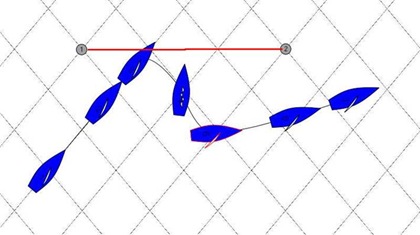
The dictionary has a whole list of explanations when you type in the word "barging". What is most obvious when reading that list, is that "barging" is associated with rude behaviour, to barge in when not appropriate, aggressively and clumsily. In short; a foul nobody wants to make...... or is it?

Barging in sailing happens very early in the race, before the starting signal and is mostly done either by boats who have no clue about the rules or are especially inapt in timing there approach to the start. But wait, it is also done by people who think they can get away with it, because if successful, it has potentially great benefits. The boat that is most close to the committee boat gets free air and can tack as she pleases.

Let us first have a look at why this rule infringement - basically a very simple windward-leeward issue - is still misunderstood by so many.

It begins with that there is a mark involved; a mark of the starting line. That mark can be - and in many cases is - a committee boat. The committee boat at the end of the starting line - if so described in the sailing instructions - is a mark of the starting line, and boats must pass it on the correct side in order to sail the course.

That committee boat is also - by definition - an obstruction. When sailing directly towards it and one of her hull lengths from it, a boat must make a substantial course change to avoid it. The committee boat is big enough to fall into that category, hence it is "an obstruction"

These two facts about the committee boat - it being a mark and also an obstruction - leads by many to the assumption that the rules, governing mark rounding (RRS18) and passing obstructions (RRS19), apply. And that is - surprisingly - partly true.
But - and this is the part a lot of sailors have a hard time grasping - NOT when boats are approaching the committee boat to start, until they have passed it.

The preamble specifically switches off section C (all rules regarding marks and obstructions) during that very brief period. When boats are sailing around in the start area, a couple of minutes before the start and they happen to pass the committee-boat together, overlapped, rule 19 is applicable. Only during the short time approaching the startline these rules are switched off.

So, depending on the type of boat your are sailing, how good you are in slow speed and the angle of approach, that time may vary from a minute or two to 10 seconds before the starting signal.
During that time the rules that dictate the situation are only the rules in section A, B and D. With rule 11 (Windward must keep clear of Leeward) the main right-of-way rule. During that time, windward boats are not entitled to room from the leeward boats to pass the committee boat on the specified side. They are not allowed to barge in.
Both Red boats are "barging", trying to get to the starting line. This is not permitted.

Because of this, an accurate depiction of the situation would be to forget the committee boat and treat the situation as if it was not there. In open water, a windward boat would have no doubt that she could not come down. She would know she had to keep clear. (This is an oversimplification, but on that subject more next week)

To make things even more complicated, there is an exception. If the starting mark (i.e. the committee (boat) is for example on the end of a long pier and therefore NOT surrounded by navigable water, the preamble of Section C does not kick in and rule 19 is once more applicable. In other words, if barging boats have no water to escape on the outside of the starting mark, you have to let them in, you have to give them room. This is not something that happens in normal racing, but I have seen Extreme Sailing Series races, in very narrow and restricted waters, where the committee boat was so close to a harbour wall that, for all intends and purposes, it was no longer surrounded by navigable water. So it does happen, occasionally.

The leeward boat can sail is high as she wants, it does not have to be close-hauled. Even with a rule 17 restriction she may go up to head-to-wind. All windward boats have stop or tack or whatever it takes, to keep clear.


If you can't wait for next week, you can go back to one of my earlier posts on barging:
http://rrsstudy.blogspot.nl/2012/01/ltw-readers-q-56-barging.html

Otherwise, to be continued.
J.

Next week: Barging II

Previous episodes in this series:
Back to the Basics (Part 3): Sweet Seventeen
I am a little disappointed that no courageous sailor, umpire or judge came up with an answer to my last question. Fear not, you can keep trying, I'm not going to tell you.
Back to the Basics (Part 2): Where's the referee?
An uniform is not required, but did you check if the B-flag was where it was suppose to be?
Back to the Basics (Part 1): Keeping Clear

Monday, 10 March 2014

Back to the Basics (Part 3): Sweet Seventeen

A blog post in a series: Racing Rules for Novices*
(*I'm going to try to do one of these on Mondays)

In this series I would like to give you my insights into those issues in the Racing Rules for Sailing, that nine times out of ten are asked in one of my rules talks, I do for clubs, sailors and/or class organizations, during the winter season.

This weeks issue is about rule 17.
Why is rule 17 so difficult for many sailors? Or  - a better analysis - why is "Hé you, so and so [insert appropriate swearword], sail your proper course" so frequently heard on the racecourse, when it is, even without the swearword, completely inappropriate?

First of all, ask yourself, do I understand what "Proper Course" actually is?
If yes, skip one and go to two. If you're not sure, start with one.

ONE
Proper Course is defined in the rulebook.
A course a boat would sail to finish as soon as possible in the absence of the other boats referred to in the rule using the term. A boat has no proper course before her starting signal
"A course a boat would sail to finish as soon as possible...."?

We all know that when you are racing you want to finish as soon as possible - no wait, that's not correct - you want to finish before the other boats do! That means you sometimes want to sail a course that benefits that last goal, but is not the fastest way to finish. If you are the right-of-way boat, you will be able to sail any course you want - provided you don't break a rule. Well, nowhere in the whole rulebook is any rule that states you MUST sail your proper course. So, even when most times, most boats do sail to finish as fast as possible, there's no obligation to do so.

And to make things even more complicated, there might be more than one course that lets you get to the finish faster. Sometimes it is just choosing what you think is best.
There's a patch of wind 50 meters to the left; luff up, go there, and you might gain enough to compensate (and more) for the extra distance you sailed. Than that IS a proper course. As long there is a reasonable assumption that the course you are sailing, might get you to the finish faster, it is - by definition - a proper course.

".....in absence of the other boats referred to in the rule using that term" ?
Let us have a look at which rules are using the term:
Definition Mark-Room:  The other boat is the boat that must give you that Mark-Room
Rule 17: The other boat is the boat to windward you are making an overlap with.
Rule 18.1(b): The other boat is the boat on the opposite tack.
Rule 18.2(c)(2): The other boat is in fact your boat.
Rule 18.4: The other boats are any other boats. The rule actually has no other boat(s)
Rule 24.2: The other boat is the boat taking a penalty or sailing on another leg.
(there are a couple more in the appendixes, but those you can figure out yourself)

If you encounter a situation with multiple boats, the definition does NOT "take away" all those other boats to determine what the course would have been to finish as soon as possible, only the boats that I indicated in the list with rules.

Lets do an example:
Grey has a rule 17 limitation; Is she sailing above her proper course?
Green is taken out (of the picture). What is the answer now?


Two boats sailing on a beam reach encounter a third who luffs. Grey has a rule 17 limitation. She's shall not sail above her proper course. But because she has to keep clear of Blue, she has to luff and forces Green to go up with her. Now Grey is surely sailing above her proper course! Or is she?
The "other boat" referred to in rule 17 is Green. So take away Green.
Then you are left with Grey and Blue, and in absence of Green, Grey would also have luffed to keep clear. In order to finish as fast as possible (without breaking a rule) she must go up. Therefore she is still sailing her proper course. cah-PEESH?

"... A boat has no proper course before her starting signal"

That, as they say, is more or less self-explanatory. You can't sail a course to finish before the starting signal. Or, any course is good. Even head-to-wind.

So, finally we arrive at

TWO

Because most boats want to get to the finish as soon as possible, thinking that that is the whole ballgame - which it is, most of the time, but not always - they assume every other boats must do the same. So when they are held up, usually by a boat that luffs them, or sails a course they don't think is faster to the finish, they get frustrated and start yelling about "proper course".

It is only ever useful, when that other boat has a rule 17 limitation. If that other boat has not, she can sail any course she wants and boats that have to keep clear of her, must keep clear, Regardless if that forces them on a course away from the finish.....
Only a right-of-way boat can HAVE a rule 17 limitation. A keep clear boat never has. And that limitation under rule 17 can only happen to a right-of-way boat, when a set of four conditions are fulfilled. ALL of them. Not one, not two or three, all of them.
Those conditions are:
  • The boats are on the same tack
  • The boat comes from clear astern
  • She makes the overlap to leeward of the other boat
  • The distance between the boats is less than two hull lengths (with two different size boats, the hull length of the leeward boat)
If one of these conditions does not apply, or no longer applies, rule 17 does not apply, or no longer applies. The limitation is lifted, when a boat gybes. It is lifted when the distance becomes more than two hull lengths. It never applies when the overlap is to windward. It never applies when the boat is tacking into that leeward position.... etc. Remember? All of them.

THREE

I'm skipping three, four, five all the way to sixteen, so we finally can get to:

(SWEET) SEVENTEEN

Under a rule 17 limitation a right-of-way boat SHALL not sail above her proper course.
(we used to have a rule restricting sailing below a proper course, but those days are over, forget that)

'Above her proper course'.... hmmm....
The keep-clear boat might have another idea about what a proper course is..... well, tough, she's not the one choosing. The right-of-way boat has that privilege.
The keep-clear boat might think the right-of-way boat IS sailing above her proper course. Again, tough luck, it does not mean she no longer has to keep clear.

I'm doing an animation again. In most rule-talks that seems to work best:

Course to the next mark (Finish) is downwind after the mark.
Two boats, approach a windward mark to be left to port, before going downwind toward the finish.

In position 1, Purple on starboard-tack, establishes an overlap from clear astern, with Grey on the same tack. The distance is less than two hull lengths, therefore from that moment on, Purple has a rule 17 limitation. Purple shall not sail above her proper course.

In position 4 Purple luffs head-to-wind. Is she sailing above her proper course?
According to the definition we first must take away the "other boat" mentioned in the rule. That is Grey in this case. Would Purple have headed up, to finish as soon as possible, in the absence of Grey?
Answer is yes, Purple would have done the same. Shooting the mark takes her to the finish sooner.
In position 4 Purple is NOT sailing above her proper course.

Now we look at positions 5 and 6. Is the rule 17 limitation lifted? Or, does one of the conditions no longer apply? Answer is no. She still has a rule 17 limitation.
Next, take away Grey. Would Purple sail the same course, to finish as soon as possible, if Grey was not there? Answer is NO!
Purple would have gone down toward the finish. So in positions 5 and 6 she IS sailing above her proper course and breaks rule 17. Note: Grey is keeping-clear. If she wouldn't, she also would break a rule (rule 11)

Sweet enough for you?

TWO HUNDRED  SEVENTY FIVE THOUSAND SIX HUNDRED AND TEN.
I'm leaving you with some "homework":
Please tell me what Purple has to do, in the same animation, so she can sail this course without breaking rule 17?

J.


Next week: Barging


Previous episodes in this series:
Back to the Basics (Part 2): Where's the referee?

Back to the Basics (Part 1): Keeping Clear

Monday, 24 February 2014

Back to the Basics (Part1): Keeping Clear

A blog post in a series: Racing Rules for Novices*
(*I'm going to try to do one of these on Mondays)

An explanation and cases for the definition "KEEP CLEAR"

In this series I would like to give you my insights into those issues in the Racing Rules for Sailing, that nine times out of ten are asked in one of my rules talks I do for clubs, sailors and/or class organisations, during the winter season.

KEEP CLEAR; one of the definitions in the rulebook;
Let me start by telling you that it is NOT the same as in, for example, the traffic rules. One car has right-of-way, the other car SHALL give priority to the right-of-way car and do nothing to interfere with its normal operation, wherever (within the boundaries of normal traffic) that car may want to go.
Giving priority: allowing certain drivers to proceed without obstructing their way; (From Road traffic signs and regulations in the Netherlands)
In the RRS the "keep-clear" boat has (only) a very specific set of obligations to fulfil, which are a lot less than never interfering with the "right-of-way" boat (ROW boat). If a boat keeps doing those obligations, nothing more, nothing less, she is doing what the rules say she must and she does not break a rule in Part 2, section A. She is then, by definition, "keeping clear".

Lets analyse what is written:
Keep Clear A boat keeps clear of a right-of-way boat
(a) if the right-of-way boat can sail her course with no need to take avoiding action and,
(b) when the boats are overlapped, if the right-of-way boat can also change course in both directions without immediately making contact.

So whether the keep-clear boat fulfils obligation (a) is depending on the ROW boat. That boat must be able to sail her course - the course she chooses to sail - without having the feeling that she cannot do this, because there is another boat she needs to avoid.

Now the first thing you might want to ask is; One helmsman is not the same as another helmsman?
A beginner might feel the need to avoid much sooner that an experienced skipper. In a big boat you might want to avoid sooner than in a small boat.... Alas, the rules do not specify.
If you take the risk of getting close to a right-of-way boat, you take on the risk that she might feel the need to take avoiding action. There is a limit of course. Any PC will want to have an  understanding that the ROW boat indeed reasonably might feel that need to avoid.

What about a save distance?
Six boat lengths is fine, nobody will reasonably think that a right-of-way boat needs to do anything. One boat length might be too close and half a boat length is most likely getting you into trouble. It also depends on where the closest distance occurs.

Port passing in front of Starboard
Port passing behind Starboard


Ten centimetres passing in front of a right-of-way boat is NOT keeping clear, ten centimetres passing behind a right-of-way boat, is.


The most talked about case in the Casebook is Case 50, dealing with exactly this issue. In short: If a port tack boat passes in front of a starboard tack boat, and the latter changes course, claiming she felt the need to take avoiding action, the port tack boat must convince (read: proof to) the PC that the course change by the starboard tack boat was unnecessary. If Port cannot do this, she is NOT keeping clear. Even if the shortest distance was several meters.
If you "get" case 50, you understand part (a) of the definition.
http://rrsstudy.blogspot.nl/2011/02/pillowcase-of-week-08-50.html

In short, there is no fixed distance. But the closer you get, the more risk you take.

Obligation (b) is a little more complicated.

When boats are overlapped, most likely they are sailing on a parallel course, next to each other. No matter how close the keep-clear boat is getting, as long as the ROW boat is sailing a straight course, the windward boat is fulfilling obligation (a). The ROW boat CAN sail her course without the need to take avoiding action. Save it for situations involving heavy seas, that distance can be pretty close. Certainly less than half a boat length.

Is Windward still keeping clear all the time?
 
Nevertheless is the windward boat - the keep-clear boat under rule 11 - in this situation, NOT keeping clear, now under obligation (b). The ROW boat must be able to change course (in both directions) WITHOUT immediately making contact. From position 3 to 6 the leeward boat cannot luff (or bear off) without immediately hitting the windward boat.
Be aware, under the current rules you can also have an overlap with a boat on opposite tack! For instance, when both are sailing a course below ninety degrees from true wind.

This brings us to the rest of the Casebook. Besides the already mentioned Case 50, there are five more dealing with the definition of "keep clear" specifically:

Case 30 
A boat clear astern that is required to keep clear but collides with the boat clear ahead breaks the right-of-way rule that was applicable before the collision occurred. A boat that loses right of way by unintentionally changing tack is nevertheless required to keep clear.
(pillow)Case of the week (51/11) – 30

Case 60
When a right-of-way boat changes course in such a way that a keep-clear boat, despite having taken avoiding action promptly, cannot keep clear in a seamanlike way, the right-of-way boat breaks rule 16.1.
(pillow)Case of the week (34/11) – 60

Case 77:
Contact with a mark by a boat’s equipment constitutes touching it. A boat obligated to keep clear does not break a rule when touched by a right-of-way boat’s equipment that moves unexpectedly out of normal position.
(pillow)Case of the Week (36) – 77;


Case 88
A boat may avoid contact and yet fail to keep clear.
(pillow)Case of the Week (27) – 88;

Case 91
The fact that a boat required to keep clear is out of control does not entitle her to exoneration for breaking a rule of Part 2. When a right-of-way boat becomes obliged by rule 14 to ‘avoid contact . . . if reasonably possible’ and the only way to do so is to crashgybe, she does not break the rule if she does not crash-gybe. When a boat’s penalty under rule 44.1(b) is to retire, and she does so (whether because of choice or necessity), she cannot then be disqualified.
(pillow)Case of the Week (17) - 99

[Note: I still have to update all the cases with the terminologies of the 2013-2016 rules. Don't worry, the principle (outcomes) in all cases have not changed. If you want to read the latest text, please have a look in the new Casebook. You can find it here on the ISAF website: The Case Book]

Back to the NOT interfering I mentioned in the beginning. Nowhere in the definition of keeping clear is anything written about "not interfering". As long as the keep-clear boat fulfils her obligations (a and/or b) she CAN interfere with the right-of-way boat. In fact, match racers do nothing else but interfere and usually as the keep-clear boat.

If you have specific situations or questions, please don't hesitate to email or write a comment.

Next week (Part 2): Where's the referee?

J.

Wednesday, 10 April 2013

Is the definition finish done?

The 2013-2016 RRS has new wording for the definition: finish
A boat finishes when any part of her hull, or crew or equipment in normal position, crosses the finishing line from the course side. However, she has not finished if after crossing the finishing line she
(a) takes a penalty under rule 44.2,
(b) corrects an error under rule 28.2 made at the line, or
(c) continues to sail the course.
And in the new RRS, the time you have to inform a boat that makes an error in sailing the course, is now specified:
61.1 Informing the Protestee
(a) A boat intending to protest shall inform the other boat at the first reasonable opportunity. When her protest will concern an incident in the racing area that she was involved in or saw, she shall hail ‘Protest’ and conspicuously display a red flag at the first reasonable opportunity for each. She shall display the flag until she is no longer racing. However,
(1) if the other boat is beyond hailing distance, the protesting boat need not hail but she shall inform the other boat at the first reasonable opportunity;
(2) if the hull length of the protesting boat is less than 6 metres, she need not display a red flag;
(3) if the incident was an error by the other boat in sailing the course, she need not hail or display a red flag but she shall inform the other boat before that boat finishes or at the first reasonable opportunity after she finishes;

Let's have a look if we 'combine' these two. First of all, the informing part is mandatory; it says:"...but she SHALL inform…..". You must make a genuine effort to inform the other boat - but when? 


Now imagine this scenario:
A boat (call her CLEAVER) sails through the finish line, you are 20 meters behind. As soon as you also have finished, you manage to get closer to the first boat and tell her that she has missed the last mark before the finish. You don't need to hail protest or show a red flag, but you do anyway, to make sure you are seen 'informing' the other. After that you continue to shore, go to the race-office and fill in the protest form.

CLEAVER is scored in fifth position (you became third).

In the subsequent hearing you explain to the panel what you saw and did.

The representative of CLEAVER however, contents that she hadn't finished the first time. Because after you informed her she went back to the racing area, rounded the last mark and crossed the line again. And according to the definition, she only finished the second time crossing the line because she continued to sail the course. Whatever distances or where she sailed in between the second to last mark and the last mark before the finish, didn't matter. She sailed the course and should be scored.

What should the panel decide?
Can a boat still go back in this new definition?

J.

Friday, 29 June 2012

Kite boarding in Turkey; part 2

Clear Astern and Clear Ahead; Overlap
The definition in the Racing Rules of Sailing says:
Clear Astern and Clear Ahead; Overlap One boat is clear astern of another when her hull and equipment in normal position are behind a line abeam from the aftermost point of the other boat’s hull and equipment in normal position. The other boat is clear ahead. They overlap when neither is clear astern. However, they also overlap when a boat between them overlaps both. These terms always apply to boats on the same tack. They do not apply to boats on opposite tacks unless rule 18 applies or both boats are sailing more than ninety degrees from the true wind.
In Appendix BB (the kite boarding appendix) there's NO change to this definition. The definitions of finish and start are amended so that the kite does not count, but not in clear ahead and clear astern; overlap. There, the kite is part of the equipment and does count for overlap.

Here's the problem:
The kite is a long way ahead and to the side of the rider. Depending on the length of his lines between 20 to 30 meters. The rider cannot see if his kite past the line abeam from the board in front. And it can change in an instant by just raising the kite or lowering it. The rider in front may be able to see if he pays attention to the kites behind, but he has to concentrate on his own - not interfering with kites in front.
To be able to see definitely if kite boarders are overlapped or not, you need a 'wing' boat to windward at every kite board. And that is clearly impossible.

I'm more than ever convinced that this particular definition also needs changing to work on the water.
We all know that the rules change with overlap from 12 to 11, with addition of limitations rules, like 15. The riders are not able to do this with the current definition.

According to the definition these kite boarders are overlapped; #4 has right of way.  The rider with the hat needs to keep clear.

I heard suggestions from judges and from riders what to use. My vote is on the hull alone. If the kite board is overlapped with another's hull, then the rules should change. Before that the rider has to keep clear under rule 12, including his kite.
Everybody can concentrate on their own kite and does not have to worry about someone coming from behind, until they are very near.

Perhaps something to think about when the new 2013-2016 rules will be published?
Appendix BB will be in that rulebook......

J.


Wednesday, 20 June 2012

Finished or not?

A boat in a short regatta (half an hour) crosses the finish line as 7th boat and just after her bow has passed the line, she touches the finish  mark. The Race Committee on the pin-end finish boat see the boat touch the mark. They inform the other finish boat and a note is put on the finish list.

The boat crosses over the line and some heated argument on board is heard by the RC-people. They lose sight of the boat and concentrate on the next boat(s).

The boat returns to the finish line a couple of minutes later and is seen to sail downwind through the line towards the last mark.

Finish

After five minutes the finish window (time limit) runs out and because the next race is scheduled to commence as soon as possible, the committee boats leave their station and go down to the starting area. While they motor down, they see that same boat beating upwind.

The next race is started twenty minutes later after a short postponement because of a wind shift and all boats participate.

After racing the scoring is published and the boat who had touched the finish mark is scored DNF. The PC receives a request for redress within the protest time limit from that same boat, claiming she had finished.

What should they do?
Is that boat finished or not, and what should their score be?

Definition: Finish A boat finishes when any part of her hull, or crew or equipment in nor­­mal position, crosses the finishing line in the direction of the course from the last mark, either for the first time or after taking a penalty under rule 44.2 or, after correcting an error made at the finishing line, under rule 28.1.

Tuesday, 10 April 2012

Taking a Penalty in Match Racing IV (MR04)

As promised this next instalment about penalties in Match Racing is taking one around the pin-end of the finish.

The rules prescribe that you are not allowed to taken penalty within the zone. But that is only for the zone of a rounding mark! The pin-end of the finish is not a rounding mark, it is a passing mark. Therefore penalties are allowed in that zone.

The big advantage of taking your penalty around that mark is that you can finish directly after having completed your penalty - even with little boat speed - by bearing away to the line. It is one manoeuvre that - if you've done your training - has been done a hundred times before.


The Blue boat with the outstanding penalty needs to be approximately 4 to 5 boat lengths ahead, to be able to complete the penalty and still finish first. She enters the zone clear ahead and Yellow must give mark-room in position 1. Blue luffs after passing the mark and makes sure that her spinnaker head is below the goose-neck. (Something that has to be done before passing head to wind, that's when Blue is starting to take her penalty)

Passing head to wind she losses her mark-room under rule 18.2(b) and must keep clear under rule 21.2.
As soon as Blue has reached a course 90 degrees from true wind the penalty is complete. (in position 6). She's on port tack and Yellow is on starboard tack. So Blue is still keep clear boat. But because she now has an overlap with Yellow and is within the zone, rule 18 again switches on again. Blue is inside boat and Yellow must give her mark-room, under rule 18.2(a). Blue is already at the mark, so she's entitled to sail her proper course. Which is to bear away and finish as soon as possible. Yellow must gybe or sail by the lee, to give Blue that room.

Boom?

There's one other thing - besides getting the spinnaker down in time - that is your boom. With bigger boats the boom is almost at a ninety degree angle and really sticks out. In rounding the mark it happens that the boom sticks out so far, that the end is over the mark and over the line. Rule C7.2(d) however dictates that the boat must completely be on the course side, after having completed her penalty, before she can finish. Part of the boom may never be on the correct side. So she can't finish.

If the RC gets a heads up from the umpires about the leading boat having an outstanding penalty, they watch - particularly that boom - so see if Blue ever manages to get completely to the course side, before crossing the line for the second time.

J.

Monday, 19 March 2012

(pillow)Case of the week (12/12) – 17

(This is an instalment in a series of blogposts about the ISAF Case book 2009-2012 with amendments for 2010. All cases are official interpretations by the ISAF committees on how the Racing Rules of Sailing should be used or interpreted. The cases are copied from the Casebook, only the comments are written by me.)

(This weeks case is number 17, because Case 18 is deleted in the Casebook)

(pillow)Case picture

CASE 17

Rule 13, While Tacking

A boat is no longer subject to rule 13 when she is on a close-hauled course, regardless of her movement through the water or the sheeting of her sails.

Question

Rule 13 applies until the tacking boat ‘is on a close-hauled course.’ However, the rule does not say whether the boat must be moving when she assumes a close-hauled course. Is it intended that, at the moment rule 13 ceases to apply, the boat must actually be moving through the water on a close-hauled course and not merely be on such a course?

Answer

A boat is no longer subject to rule 13 when she is on a close-hauled course, regardless of her movement through the water or the sheeting of her sails.

RYA 1967/8

blogcolorstripe

Which makes it harder to see, sometimes. But that’s the way the rule is written and HAS to be used.
I always tell sailors who have a hard time recognizing if a boat has turned from head to wind enough, to use their own boat as reference. As most racing is done in one design classes, that should give them enough to work with.

Skutsje

In the Netherlands we race with ‘traditional’ boats who are equipped with leeboards. Those have a very big angle towards the wind, when sailing close hauled. Nevertheless the moment rule 13 switches off comes sooner than most sailors think. Err on the side of caution is a prudent strategy.

Monday, 19 December 2011

(pillow)Case of the week (49/11) – 32

(This is an instalment in a series of blogposts about the ISAF Case book 2009-2012 with amendments for 2010. All Cases are official interpretations by the ISAF committees on how the Racing Rules of Sailing should be used or interpreted. The cases are copied from the Casebook, only the comments are written by me.)

(pillow)Case picture

CASE 32

Rule 90.2(c), Race Committee; Sailing Instructions; Scoring: Sailing
Instructions

A competitor is entitled to look exclusively to written sailing instructions and to any written amendments for all details relating to sailing the course.

Summary of the Facts

The sailing instructions included, among other things, the following:

  1. All races will be sailed under The Racing Rules of Sailing except as modified below.
  2. A briefing will be held in the clubroom 60 minutes before the start of the first race each day.
  3. Shortened Course will be signalled by two guns and raising of flag S and the class flag. Boats in that class will round the mark about to be rounded by the leading boat and go straight to the finishing line. This changes the meaning of flag S in the Race Signals.

At one of the briefings, the race officer attempted to clarify the phrase ‘go straight to the finishing line’ in item 3 by stating that when the course was shortened, all boats should cross the finishing line in a windward direction.

This would ensure that all classes, some of which might be finishing from different marks, would finish in the same direction even if that were not the direction of the course from the mark at which the course was shortened.

Subsequently, a race was shortened. Six boats, which had not attended the briefing, followed the written sailing instructions, were recorded as not finishing, and sought redress. The boats alleged that the race committee had improperly changed the definition Finish and had failed to follow the requirements of rule 90.2(c). The protest committee upheld their requests for redress on the grounds they had cited.

The race committee appealed to the national authority, asserting that the briefing sessions were a numbered part of the sailing instructions, all competitors should have attended, and the briefings constituted a procedure for giving oral instructions. Also, it argued that the sailing instructions were not changed but merely clarified by the race officer as to what the words ‘go straight to the finishing line’ meant.

Decision

Appeal dismissed. The remarks of the race officer amounted to more than mere clarification. This is borne out by the fact that the boats that did not attend the briefing acted as they did. Competitors are entitled to look exclusively to the sailing instructions and to any amendments for all particulars of the course. Rule 90.2(c) requires changes to the sailing instructions to be in writing. However, under no circumstance can sailing instructions change the definition Finish or the definition of any other term defined in Definitions (see rule 86).

RYA 1975/3

blogcolorstripe

There’s only one ‘escape’ in giving verbal instructions: That is also in rule 90.2(c):

“Oral changes may be given only on the water, and only if the procedure is stated in the sailing instructions.”

Any change that is discussed verbally in a skippers briefing, regarding the SI or RRS MUST also be written on the notice board with time and date at an appropriate time. Anyway, changing a definition is not permitted anyway.

Wednesday, 14 December 2011

Is the Equipment Inspector part of the RC?


Yesterday evening we had a rules clinic in my club - as we do a couple of times each winter - this time with the tricky subject of the role of the equipment inspector slash measurer at an event.

In the discussion ISAF Q&A J 021 was presented:

Question 1
Is an equipment inspector or measurer at an event a member of the race committee for that event?
Answer 1
Not normally. Equipment inspectors or event measurers are responsible for checking that the boats or the personal equipment used by competitors comply with the class rules.
According to the Terminology in the Introduction to the Racing Rules of Sailing, ‘Race committee’ includes any person performing a race committee function. The race committee functions are stated in different rules in Part 7 (conduct races, publish written sailing instructions, score races, etc) and equipment inspection is not one of them.
If however the equipment inspectors or event measurers were appointed by the race committee to conduct such responsibilities on behalf of the race committee, then they are members of the race committee.

If you look at the wording in the answer there seems to be a contradiction. The first part states that equipment inspection is NOT one of the functions the Race Committee has to fullfill.
But if that same RC appoints a person to conduct those inspections, then it suddenly is the responsibility of the race committee..... because they are part of RC?


RSA and ERS

In the RRS an equipment inspector is not defined, but in the Equipment Rules of Sailing it is:
C.4.6 Equipment Inspector
A person appointed by a race committee to carry out equipment inspection.
We also have a submission that would make the equipment inspector or measurer a party in rule 62.1(a). That would suggest he is not part of the Race Committee - otherwise why the change?

Submission 270-11
Proposal
62.1 A request for redress or a protest committee’s decision to consider redress shall be based on a claim or possibility that a boat’s score in a race or series has, through no fault of her own, been made significantly worse by
(a) an improper action or omission of the race committee, protest committee, or organizing authority or an equipment inspector or measurer for an event, but not by a protest committee decision when the boat was a party to the hearing;
I hope by the time I have the next measurement protest, I know the answer.....

Monday, 26 September 2011

(pillow)Case of the week (39/11) - 43

(This is an instalment in a series of blogposts about the ISAF Casebook 2009-2012 with amendments for 2010. All cases are official interpretations by the ISAF committees on how the Racing Rules of Sailing should be used or interpreted. The cases are copied from the Casebook, only the comments are written by me.)
(pillow)Case picture

Case 43

Rule 10, On Opposite Tacks
Rule 14, Avoiding Contact
Rule 19.2(b), Room to Pass an Obstruction: Giving Room at an Obstruction
Definitions, Clear Astern and Clear Ahead; Overlap

A close-hauled port-tack boat that is sailing parallel and close to an obstruction must keep clear of a boat that has completed her tack to starboard and is approaching on a collision course.
Assumed Facts
P is sailing up-river, close-hauled on port tack, very close to the bank. S, unable to point as high as P, is forced to sail away from the bank. She then tacks onto starboard and immediately hails ‘Starboard’ to P. P sails on and, when she reaches a position at which she cannot luff without hitting the bank or bear away without colliding with S, she hails S for room.
image
Question
Which rule or rules apply?

Answer
P is subject to rule 10 and must keep clear. P is also required by rule 14 to avoid contact if reasonably possible. S establishes right of way over P when she tacks onto starboard, but must observe rules 13 and 15. S meets rule 13’s requirement by not tacking so close that P has to take avoiding action before S reaches her close-hauled course. After S acquires right of way over P under rule 10, S complies with rule 15 by initially giving P room to keep clear.

Rule 19.2(b) does not apply because S and P are on opposite tacks, are not both sailing more than 90 degrees from the true wind, and so are not overlapped at positions 3 and 4 (see the last sentence of the definition Clear Astern and Clear Ahead; Overlap).

Rule 20 does not apply because P and S are not on the same tack. Therefore, S is not required to give P room in response to P’s hail for room. However, after it becomes clear that P is not keeping clear, rule 14 requires S, if it is reasonably possible, to avoid contact with P. S would risk disqualification if there were contact that caused damage or injury.

RYA 1978/5

blogcolorstripe

P must, as soon as S has tacked and the collision course is established, do everything (seamanlike) to keep clear. She cannot wait until there’s no escape anymore. In Position 3 she can either slow down to let S cross or bear away to go astern of S.

Monday, 12 September 2011

(pillow)Case of the Week (37/11) - 45

(This is an instalment in a series of blogposts about the ISAF Call book 2009-2012 with amendments for 2010. All calls are official interpretations by the ISAF committees on how the Racing Rules of Sailing should be used or interpreted. The calls are copied from the Call book, only the comments are written by me.)

(pillow)Case picture

Case 45

Rule 62.1(a), Redress
Rule 64.2, Decisions: Decisions on Redress
Definitions, Finish

When a boat fails to finish correctly because of a race committee error, but none of the boats racing gains or loses as a result, an appropriate and fair form of redress is to score all the boats in the order they crossed the finishing line.

Summary of the Facts

During the day, the class sailed two races. After the first race, which the boats finished leaving Mark 1 to starboard, the wind became light. Accordingly, the race officer set a shorter second course and issued a change to the sailing instructions stating that, although Mark B was the last rounding mark, Mark 1 was to be left to starboard. The same mark was being used for the finishing line of another race, and the race officer had been advised not to set courses that might lead to different boats passing a finishing mark or crossing the finishing line in opposite directions.

X and two other boats finished leaving Mark 1 to port and were scored DNF. Y, followed by the rest of the fleet, sailed the course prescribed by the change to the sailing instructions, leaving Mark 1 to starboard. They thus sailed a ‘hook round’ finish as shown in the diagram.

X requested redress on the grounds that the race committee had not applied the definition Finish correctly when it awarded first place to Y, whereas X had been the first boat to finish as required by the definition.

The protest committee gave redress, agreeing that X and the other two boats had finished correctly, and reinstated them in the race. For boats not so finishing, the committee exercised its discretion under rule 64.2 to ‘make as fair an arrangement as possible for all boats affected.’ It adjusted the race scores according to the order in which all the boats crossed the finishing line, without regard to the direction in which they crossed it.

X appealed against the new finishing order, claiming that the wording of the definition Finish was unequivocal and stating that such an arrangement would negate the definition and defeat its purpose, which, she believed, was to prevent ‘hook round’ finishes.

image

Decision

X’s appeal is dismissed. Because the sailing instruction that conflicted with the definition Finish was invalid, issuing it was an improper action of the race committee that qualified the three boats for consideration for redress under rule 62.1(a). None of the boats racing gained or lost as a result of the race committee error, so the redress awarded was appropriate.

It was also as fair an arrangement as possible for all boats, as required by rule 64.2.

RYA 1979/1

blogcolorstripe

Do you remember the wording in the definition finish ?

Better look it up then………

J.

Friday, 9 September 2011

LTW Reader Q&A (54): Proper Course


Hi --
Hello

I am not sure that this is the proper forum for presenting this question, but we've looked in several places and have not found an answer. If this isn't a good place to ask this, I apologize; but, could you refer us to a link for us casual club racers?
No problem, you’re welcome to ask. LTW has been operating partly because I wanted every club & sailor to have a place to go to.

We're a small club in East Texas and don't have access to a rule expert, but we've argued this case over many a beer.
Never mind, that rules expert would demand all the beer anyway for his answers, so please don't get one. Stay with LTW!

Two boats are racing downwind towards a gate mark. Both are on starboard tack. L begins to pass to leeward from clear astern. The winds are light and the pass takes a long time and finally L, though still overlapped, is well past the old "mast abeam" position of the old rules. L wants to round the starboard gate mark; W is sailing for the middle of the gate and has been all during the pass. Both boats are still about 100 meters from the gate. No other boats are nearby. (It is a handicapped race.) The two boats are about 1-2 boat lengths apart.
In this situation the rules say that L has a rule 17 restriction from the moment the overlap was established, until she has sailed clear ahead. If she’s more than 2 boat lengths away, this does NOT apply.

The points in question are:
  1. May L assume the proper course to the starboard gate mark, in spite of the fact that she is "luffing up" slightly?
    YES!
  2. If the answer to question 1, above, is NO, what is L's "proper course?
    L’s proper course is the course she would have sailed if W was not there. Then she would also have luffed up to go to the starboard mark…..
  3. If L breaks the overlap and completes the pass --"bow abeam (?)" -- may she head for the starboard gate mark?
    She may already go to the starboard gate before she becomes ‘clear ahead’.
Proper course is something the right-of-way boat determines, not the keep clear boat. (See Case 46) Even stronger: W must keep clear – even if L sails above her proper course. Otherwise W breaks rule 11.

Thanks again for your help on this.
Your welcome,

John M. Hobbie
P.S. I've followed this blog for a long time and have really learned a lot from it. Thanks for keeping it up.
Where's my beer?

Tuesday, 6 September 2011

(pillow)Case of the Week (36/11) – 46;

(This is an instalment in a series of blogposts about the ISAF Call book 2009-2012 with amendments for 2010. All calls are official interpretations by the ISAF committees on how the Racing Rules of Sailing should be used or interpreted. The calls are copied from the Call book, only the comments are written by me.)
image

Case 46

Rule 11, On the Same Tack, Overlapped
Rule 16.1, Changing Course
Rule 17, On the Same Tack; Proper Course
Definitions, Proper Course

A leeward boat is entitled to sail up to her proper course, even when she has established a leeward overlap from clear astern and within two of her hull lengths of the windward boat.
Summary of the Facts
For some time, W had been sailing almost dead downwind on a straight course towards the starboard end of the finishing line when L, a boat that had been clear astern, became overlapped within two of her hull lengths to leeward of W. In the absence of W, L would have sailed a higher course directly towards the line. In order to do so, she hailed W to come up. There was no response. L hailed again and luffed to a position very close to W, but W still did not respond. L stopped luffing and bore away just before contact would have occurred. L protested under rule 11.
The protest committee held that there was insufficient evidence to show that W would have finished sooner by sailing a higher course. It said that even though there might be conflict between the courses of a windward and a leeward boat, a boat overtaking another from clear astern did not have the right to force a windward boat to sail above her proper course.
The protest was dismissed and L appealed, claiming the right to luff up to her proper course under rule 17.
image
Decision
Rule 11 says that when two boats on the same tack are overlapped the windward boat shall keep clear. A leeward boat’s actions, however, are limited by rules 16.1 and 17. There was room for W to keep clear when L luffed, and so L did not break rule 16.1. The protest committee, although it did not say so explicitly, recognized that L’s proper course was directly towards the finishing line. A direct course to the line was not only closer but would also have put both boats on a faster point of sailing. While L was not entitled to sail above her proper course, she was entitled to sail up to it, even though she had established the overlap from clear astern while within two of her hull lengths of W. Accordingly, she did not exceed the limitation to which rule 17 subjected her.

W’s proper course is not relevant to the application of the rules to this incident. She was required to keep clear of L. When L luffed, she gave W room to keep clear as required by rule 16.1. At the moment L needed to stop luffing and bear away to avoid contact, W broke rule 11. Therefore, L’s appeal is upheld and W is disqualified for breaking rule 11.

USSA 1979/224

image

The fault some sailors make is that a general limitation rule from section B ( rule 14, 15, 16 & 17) is of equal ‘strength’ as (and somehow cancels out) the Right of Way rules from section A. They do not!

The right of way rules do apply, despite the fact that the right of way boat may be ‘restricted’ by one of the rules in section B like in this case, by rule 17.

The keep-clear boat will only not be disqualified if she was ‘COMPELLED” to break a right of way rule (RRS 64.1(c)). In case of rule 17, in a two boat situation, the keep clear boat is never compelled (she wasn’t forced), she can always go up. So even if the right of way boat is sailing above her proper course, the windward boat has no excuse not to keep clear.

Worst case scenario is that both are DSQ-ed. One for 17 and one for 11.

Thursday, 3 February 2011

RAPID RESPONSE MATCH RACING CALL 2010/006

Rule 10 On Opposite Tacks
Rule 11 On the Same Tack, Overlapped
Rule 17 On the Same Tack; Proper Course
Definitions Tack, Starboard or Port

Situation 1:


image

Yellow is a leeward boat subject to rule 17. She is sailing her proper course, which is nearly 140° from the true wind angle. Blue is keeping clear. From position 1 to position 3, Yellow pulls the boom across the centreline to the starboard side of the boat, and almost immediately pulls the boom back across the centreline to the port side of the boat. The force of the pulling action back to the port side causes the mainsail to completely fill in position 2.

Saturday, 29 January 2011

LTW Reader Q&A (49); Finished but still Racing

Since the Readers Q’s have been gathering dust in the attic, I’m trying to clear out the lot, so there’s room for new stuff. Most of them 'I’m answering directly by Email but some are of interest to the blogreaders. Like this one:

Earl has a question about the definition of finishing:

blogcolorstripe

Hello.  I again want to thank you for the effort you put in your blog and let you know how informative I find it.  Even though my club races radio controlled  models we still try and do things "by the book" and I encourage our members to study your blog. 

We recently had an extended discussion about the following situation:

A boat is finishing to windward in very light air and before completely crossing  the line it catches a header and is blown back to the course side. While on the course side, it bears off and then sails around the end of the finish line to the non-course side.  Clearly, the boat has finished under the official definitions and is scored.  The question is, at what point is she no longer racing?

I must confess I find the Q&A (quoted below for your convenience) more than a bit of a muddle, and I also find it  strange that a determination as important as when the rules no longer are in effect is handled in a non-binding Q&A instead of a case.

I interpret the Q&A as saying that the point at which the rules shut off is the point at which the boat is sailing "away" from the line and marks, and the common-sense definition of "away" is that you can't touch the mark without reversing course.  In the situation in the diagram, this would be when the boat crosses the extension of the finish line and is "truly" on the non-course side.

As an aside, I find the second sentence to be internally inconsistent, in that the first clause states that the boat has cleared the line and is therefore no longer racing. I can only assume that the author really meant "finishes close hauled"  instead of "clears the finishing line close-hauled," in which case this is just one of many situations of "finished but still racing" and I fail to see why it deserves special mention.

It seems to me a much simpler clarification would be something like:

"A  boat 'clears the finishing line and marks' when she reaches a point where a reversal of course would be required for her to touch either the line or the marks."

I would dearly love to write this in our sailing instructions but  believe I am precluded from doing so by 86.1 (b), because it would involve changing a definition.

Comments welcome, by you or your readers.

Cheers, Earl

-------------------------------------------------------------------------------------------

E 001 Q&A 2006-002

Revised: 12 January 2009

Question

With respect to the definition Racing, when has a boat 'cleared' the finishing line and marks?

clip_image002Answer

A boat clears the finishing line and marks when no part of her hull, crew or equipment is on the line and when neither mark is influencing her course.

A boat that clears the finishing line close-hauled and continues to sail toward the finishing line pin end mark, where current sets her into the mark, is still racing and has broken 31. A boat that crosses the finishing line, sails away from the line and marks, and then later hits the finishing line mark, does not break rule 31 as she is no longer racing.

blogcolorstripe

I’m not responding to this one until you as readers have had some time to comment. Feel free to “dive” in.

.

Tuesday, 31 August 2010

Catching Up on Cases II

This weeks (pillow)Cases: Click on the W-link to read the post.


87

10

14

Def.

On Opposite Tacks

Avoiding Contact

Keep Clear

W28

86

  Deleted in the Casebook

85

61.1

86.1(c)

Def.

Protest Requirements: Informing the Protestee

Changes to the Racing Rules

Rule

W29

84

Deleted in the Casebook  

Monday, 2 August 2010

(pillow)Case of the Week (31) – 82;

(This is an instalment in a series of blogposts about the ISAF Call book 2009-2012 with amendments for 2010. All calls are official interpretations by the ISAF committees on how the Racing Rules of Sailing should be used or interpreted. The calls are copied from the Call book, only the comments are written by me.)

image

Case 82

Rule 62.1(a), Redress
Definitions, Finish

When a finishing line is laid so nearly in line with the last leg that it cannot be determined which is the correct way to cross it in order to finish according to the definition, a boat may cross the line in either direction and her finish is to be recorded accordingly.
Summary of the Facts

At the finish of a race boat A crossed the finishing line in the direction, she believed, of the course from the last mark, leaving mark F to starboard. She recorded the time she crossed the line. The race officer did not record her as having finished and did not make a sound signal. Hearing no sound signal, A sailed the track shown in the diagram and finally crossed the line leaving mark F to port, at which time the race officer recorded her as having finished and made a sound signal. A requested redress, asking that the time she recorded at her first crossing be used as her finishing time
.
image

The protest committee found as a fact that the committee boat was swinging back and forth across a line parallel to the last leg, but believed that the race officer was watching closely to determine the correct direction for each boat to cross the line. Redress under rule 62.1(a) was denied and A appealed.

Decision

A’s appeal is upheld. Positioning the finishing line marks so that boats cannot easily determine in which direction they should cross the finishing line is an improper action on the part of the race committee. When a boat cannot reasonably ascertain in which direction she should cross the finishing line so as to conform to the definition Finish, she is entitled to finish in either direction. A is therefore entitled to redress under rule 62.1(a). She is to be given her finishing place calculated from the time she herself recorded when she crossed the line for the first time.

image

This case always has me wondering if this finish was a ‘normal finish’ or if the committee vessel was there to shorten the race.

Not that it changes the decision, in both instances the position of the RC-vessel could not have been worse, but then the sailors at least would have a reasonable change of determining how to cross the line equally. They would just sail the course and go to whatever side mark F should be rounded.

J.

Monday, 19 July 2010

(pillow)Case of the Week (29) – 85;

(This is an instalment in a series of blogposts about the ISAF Call book 2009-2012 with amendments for 2010. All calls are official interpretations by the ISAF committees on how the Racing Rules of Sailing should be used or interpreted. The calls are copied from the Call book, only the comments are written by me.)

image

Case 85

Again, to all numerologist: Case 86 has been scrapped.

Rule 61.1, Protest Requirements: Informing the Protestee
Rule 86.1(c), Changes to the Racing Rules
Definitions, Rule
If a racing rule is not one of the rules listed in rule 86.1(c), class rules are not permitted to change it. If a class rule attempts to change such a rule, that class rule is not valid and does not apply.

Summary of the Facts

Boats in the XYZ Class have hulls 8 m long. Rule 5 in the XYZ Class Rules states:
The requirement in racing rule 61.1 to display a red flag shall not apply to the XYZ Class unless specifically required in writing in the sailing instructions of a race or series of races.

In a race for XYZ Class boats, boat A protested boats B and C and noted on her protest form that she did not display a red flag because it was not required by her class rules. The protest committee, relying on class rule 5, decided the protest was valid and B objected to that decision on the grounds that class rule 5 was not valid. Despite B’s objection, the protest committee proceeded with the hearing and disqualified B and C. B appealed.

Decision

B’s appeal is upheld. Paragraph (d) of the definition Rule makes it clear that class rules apply to a race. Class rules may change racing rules, but only the rules listed in rule 86.1(c). Rule 61 is not listed there, and therefore class rule 5, which attempts to change rule 61.1, is not valid and can not apply. The sailing instructions might have changed rule 61.1 as permitted in rule 86.1(b), but did not do so. Therefore, A’s protest was invalid and should have been refused. Accordingly, the protest committee’s decisions are reversed, and the two boats are reinstated in their finishing places.

USSA 1994/299


image

This case illustrates clearly that even if the sailors have done what was expected of them and adhered to the rules as best as they could – as written in the sailing instructions and class rules in this case – the PC has NO option but to follow ALL the rules, including interpretations in the official Case-book.

That may be perceived as very unfair as I have experienced in a recent event.

I’m preparing a post about that, involving BFD and sailing in restarted race.

Watch this space….
J.
Related Posts Plugin for WordPress, Blogger...