Thursday, 29 December 2011

Protest 1 in Sydney-Hobart Yacht Race 2011

The line honour winner of the 2011 Sydney – Hobart Race was protested by the RC for a possible infringement of rule 41 and sailing instruction 49.1.

Up until now it is the only protest lodged in this years race – according to the website. The International Jury published there findings: RSHYR11_Protest_Decision_1.pdf.

To understand you might also want to have a look at the Sailing Instructions:
RSHYR11_SI.pdf

image The case hinges on the questions asked by a crew member of the winning boat to a helicopter pilot not long after start of the race and if the answers could be considered “race information”. In other words, were the answers helping the asking boat in there their race, tactically or otherwise?


The International Jury concluded that there was a clear commercial and personal interest by the crew-member in asking these questions, and of no ‘help’ as provided in rule 41 to the boat.

But even if that question was answered with yes by the IJ, the penalty would have been at their discretion. (SI 49.3).

Lets assume, for the sake of discussion, that there was no personal interest. Then I would ask the following questions:
  • Rule 41 clearly provides for unsolicited information, so asking information is already breaking that rule, is it not?.
  • Also, is information about which sail a opponent is using to be considered “race information”?
  • Does it help the boat tactically or otherwise and break SI 49.2?
  • What kind of discretionary penalty would you impose, if you answered yes to the previous question?
This is NOT to seconds-guess any Jury decision. I completely agree with there findings. Its is just to get some feedback on the issue. An issue that might be before your PC-panel in the next regatta…….

Please, give me your opinion.

Feed me, Seymour!

Kaderpoule Watersportverbond

Vandaag in mijn mailbox:


 Herinnering: Meld u nu aan voor de online kaderpoule! 
Beste wedstrijdofficial, vorige week hebt u een mail ontvangen met een uitnodiging om deel te nemen aan de online kaderpoule van het Watersportverbond. Graag willen we dit nog een keer onder uw aandacht brengen. De eerste 50 personen die zich aanmelden krijgen een waterdichte tas van het Watersportverbond!
Lees verder

Ik heb me al aangemeld. Jij toch ook?
J.

Tuesday, 27 December 2011

Double standard?

Rule 19 deals with both “normal” obstructions and with continuing obstructions:
19.1 When Rule 19 Applies Rule 19 applies between boats at an obstruction except when it is also a mark the boats are required to leave on the same side. However, at a continuing obstruction, rule 19 always applies and rule 18 does not.
First a static picture; I’ve designated the top as situation one and the bottom as situation two.

111226 ESS Act9 two

Below the animation of the two situations with three boats sailing along a continuing obstructions end up in exactly the same situation. In both animations the boat behind the yellow boats is in trouble – she has to dump speed to avoid contact. But in both situations she’s not keeping clear under rule 12.

111226 ESS Act9 two


Yellow protests in position 5: Who do you penalize in situation one and who in situation two?
My answers after the break.

Monday, 26 December 2011

(pillow)Case of the week (51/11) – 30

(This is an instalment in a series of blogposts about the ISAF Casebook 2009-2012 with amendments for 2010. All cases are official interpretations by the ISAF committees on how the Racing Rules of Sailing should be used or interpreted. The cases are copied from the Casebook, only the comments are written by me.)

(pillow)Case picture

CASE 30

Rule 14, Avoiding Contact
Rule 19, Room to Pass an Obstruction
Rule 64.1(c), Decisions: Penalties and Exoneration
Definitions, Keep Clear

A boat clear astern that is required to keep clear but collides with the boat clear ahead breaks the right-of-way rule that was applicable before the collision occurred. A boat that loses right of way by unintentionally changing tack is nevertheless required to keep clear.

image


Summary of the Facts

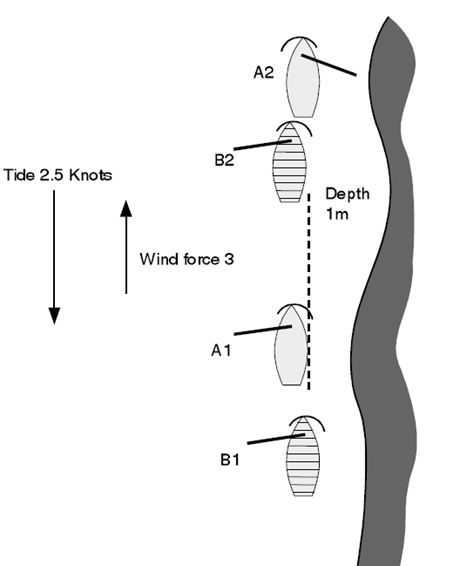
Boats A and B were running on starboard tack close to the shore against a strong ebb tide in a Force 3 breeze. A was not more than half a hull length clear ahead of B. B blanketed A, causing A to gybe unintentionally. This was immediately followed by a collision, although without damage or injury, and B protested A under rule 10. The facts were agreed, and both boats were disqualified: B under rule 12 because she was too close to A to be keeping clear, and A under rule 10 for failing to keep clear of a starboard-tack boat.

A appealed on the grounds that she was compelled by B’s action to break rule 10. The protest committee, commenting on the appeal, stated that B caused both A’s gybe and the collision by not keeping clear when both boats were on the same tack.

Decision

The boats were passing close to the shoreline, which was an obstruction and also a continuing obstruction. Therefore, the conditions for rule 19 to apply were met. However, because the boats were not overlapped, neither of the two parts of rule 19 that place an obligation on a boat (rules 19.2(b) and 19.2(c)) applied. When B was clear astern of A she was required by rule 12 to keep clear but failed to do so. Her breach occurred before the collision, at the moment when A first needed ‘to take avoiding action’ (see the definition Keep Clear). When B collided with A she also broke rule 14.

However, at that time she held right of way under rule 10, so is not subject to penalty under rule 14 because there was no damage or injury. After gybing, A became the keep-clear boat under rule 10, even though she had not intended to gybe. She broke that rule, but only because B’s breach of rule 12 made it impossible for A to keep clear. A did not break rule 14 because it was not ‘reasonably possible’ for her to avoid contact.

Accordingly, B was properly disqualified by the protest committee under rule 12. However, A is exonerated under rule 64.1(c) for her breach of rule 10. A’s appeal is upheld, and she is to be reinstated.

RYA 1974/3

blogcolorstripe

In this post rule 19 has no effect although it applies. I’ve drafted another post from one of the ESS acts where it does. Come back tomorrow and read about it.

The conclusion that A is to be exonerated can only be reached if you write down the facts found in chronological order. Then it becomes clear that the infringement of rule 12 by boat B already occurred before rule 10 came into play.

Nevertheless I can understand the PC that made this mistake. They could not use rule 15 because boat A gybed and therefore boat B acquired row because of the other boat’s actions.

Friday, 23 December 2011

Merry Christmas!

Dear LTW -reader,

The year is almost done, in two days it's Christmas again.
I've looked for an appropriate picture to wish you all a Merry Christmas and to thank all my readers for taking time to read my posts this last year.

I found a "School of Sunfish" on this blog: http://www.kevinmanningphotography.com/blog/ and decided that this perfectly illustrated the my sentiment....


Instead of boats racing with billowing full sails - like on my blog picture - these three boats are in rest, waiting for the wind to come....
Waiting for the new year, waiting for the people to go sailing....

Next year will be the year where I will find out if I can make it, being self employed....
I hope you all stick with me...

Merry Christmas,

J.

Thursday, 22 December 2011

(pillow)Case of the week (50/11) – 31

(This is an instalment in a series of blogposts about the ISAF Casebook 2009-2012 with amendments for 2010. All cases are official interpretations by the ISAF committees on how the Racing Rules of Sailing should be used or interpreted. The cases are copied from the Casebook, only the comments are written by me.)

I’m catching up this week because I realized I’m out of sync with the actual week numbers…..

(pillow)Case picture

CASE 31

Sportsmanship and the Rules
Rule 2, Fair Sailing
Rule 26, Starting Races
Rule 29.1, Recalls: Individual Recall
Rule 64.2, Decisions: Decisions on Redress
Race Signals, X

When the correct visual recall signal for individual recall is made but the required sound signal is not, and when a recalled boat in a position to hear a sound signal does not see the visual signal and does not return, she is entitled to redress. However, if she realizes she is over the line she must return and start correctly.

Summary of the Facts

At the start of a race the visual individual recall signal required by rule 29.1 was correctly made, but the required sound signal was not. One of the recalled boats, A, did not return and later requested redress on the grounds that she started simultaneously with the starting signal and heard no recall sound signal.

The protest committee found that A was not entirely on the pre-start side of the starting line at the starting signal. It gave A a finishing position as redress because of the absence of the sound signal. Another boat, B, then asked for redress, claiming that her finishing position was affected by what she believed to have been an improper decision to give a finishing position to A. B was not given redress, and she appealed on the grounds that rule 26 states: ‘the absence of a sound signal shall be disregarded’.

Decision

B’s appeal is dismissed. The protest committee’s decision to give redress to A is upheld. The requirement in rule 29.1 and in Race Signals regarding the making of a sound signal when flag X is displayed is essential to call the attention of boats to the fact that one or more of them are being recalled.

When the sound signal is omitted from an individual recall, and a recalled boat in a position to hear a sound signal does not see the visual signal and does not return, she is entitled to redress. (If the redress given is to adjust the boat’s race score, it should reflect the fact that, generally, when a recalled boat returns to the pre-course side of the line after her starting signal, she usually starts some time after boats that were not recalled. An allowance for that time should be made.) However, a boat that realizes that she was over the line is not entitled to redress, and she must comply with rules 28.1 and, if it applies, rule 30.1. If she fails to do so, she breaks rule 2 and fails to comply with the Basic Principle, Sportsmanship and the Rules.

Concerning Boat B’s request, the provision of Rule 26 that ‘the absence of a sound signal shall be disregarded’ applies only to the warning, preparatory, one-minute and starting signals. When the individual recall signal is made, both the visual and sound signals are required unless the sailing instructions state otherwise.

RYA 1974/7

blogcolorstripe

To decide on a request for redress you need to answer a couple of essential questions. I’ve set up the following flow diagram to guide you:

Flowdiagram RR 011

In Case 31 the answer to the first question is YES; Boat A was scored OCS which is significantly worse than any place she had sailed.

The answer to the second question is also YES; She was not aware she was over the line. Had she been aware, this question would have to be answered NO; because then not returning would have been (partly) her own fault.

As to the cause in Case 31; not giving a sound signal is covered by 62.1(a); that was an omission by the Race Committee.

We arrive at the outcome: Redress granted

Monday, 19 December 2011

(pillow)Case of the week (49/11) – 32

(This is an instalment in a series of blogposts about the ISAF Case book 2009-2012 with amendments for 2010. All Cases are official interpretations by the ISAF committees on how the Racing Rules of Sailing should be used or interpreted. The cases are copied from the Casebook, only the comments are written by me.)

(pillow)Case picture

CASE 32

Rule 90.2(c), Race Committee; Sailing Instructions; Scoring: Sailing
Instructions

A competitor is entitled to look exclusively to written sailing instructions and to any written amendments for all details relating to sailing the course.

Summary of the Facts

The sailing instructions included, among other things, the following:

  1. All races will be sailed under The Racing Rules of Sailing except as modified below.
  2. A briefing will be held in the clubroom 60 minutes before the start of the first race each day.
  3. Shortened Course will be signalled by two guns and raising of flag S and the class flag. Boats in that class will round the mark about to be rounded by the leading boat and go straight to the finishing line. This changes the meaning of flag S in the Race Signals.

At one of the briefings, the race officer attempted to clarify the phrase ‘go straight to the finishing line’ in item 3 by stating that when the course was shortened, all boats should cross the finishing line in a windward direction.

This would ensure that all classes, some of which might be finishing from different marks, would finish in the same direction even if that were not the direction of the course from the mark at which the course was shortened.

Subsequently, a race was shortened. Six boats, which had not attended the briefing, followed the written sailing instructions, were recorded as not finishing, and sought redress. The boats alleged that the race committee had improperly changed the definition Finish and had failed to follow the requirements of rule 90.2(c). The protest committee upheld their requests for redress on the grounds they had cited.

The race committee appealed to the national authority, asserting that the briefing sessions were a numbered part of the sailing instructions, all competitors should have attended, and the briefings constituted a procedure for giving oral instructions. Also, it argued that the sailing instructions were not changed but merely clarified by the race officer as to what the words ‘go straight to the finishing line’ meant.

Decision

Appeal dismissed. The remarks of the race officer amounted to more than mere clarification. This is borne out by the fact that the boats that did not attend the briefing acted as they did. Competitors are entitled to look exclusively to the sailing instructions and to any amendments for all particulars of the course. Rule 90.2(c) requires changes to the sailing instructions to be in writing. However, under no circumstance can sailing instructions change the definition Finish or the definition of any other term defined in Definitions (see rule 86).

RYA 1975/3

blogcolorstripe

There’s only one ‘escape’ in giving verbal instructions: That is also in rule 90.2(c):

“Oral changes may be given only on the water, and only if the procedure is stated in the sailing instructions.”

Any change that is discussed verbally in a skippers briefing, regarding the SI or RRS MUST also be written on the notice board with time and date at an appropriate time. Anyway, changing a definition is not permitted anyway.

Wednesday, 14 December 2011

Is the Equipment Inspector part of the RC?


Yesterday evening we had a rules clinic in my club - as we do a couple of times each winter - this time with the tricky subject of the role of the equipment inspector slash measurer at an event.

In the discussion ISAF Q&A J 021 was presented:

Question 1
Is an equipment inspector or measurer at an event a member of the race committee for that event?
Answer 1
Not normally. Equipment inspectors or event measurers are responsible for checking that the boats or the personal equipment used by competitors comply with the class rules.
According to the Terminology in the Introduction to the Racing Rules of Sailing, ‘Race committee’ includes any person performing a race committee function. The race committee functions are stated in different rules in Part 7 (conduct races, publish written sailing instructions, score races, etc) and equipment inspection is not one of them.
If however the equipment inspectors or event measurers were appointed by the race committee to conduct such responsibilities on behalf of the race committee, then they are members of the race committee.

If you look at the wording in the answer there seems to be a contradiction. The first part states that equipment inspection is NOT one of the functions the Race Committee has to fullfill.
But if that same RC appoints a person to conduct those inspections, then it suddenly is the responsibility of the race committee..... because they are part of RC?


RSA and ERS

In the RRS an equipment inspector is not defined, but in the Equipment Rules of Sailing it is:
C.4.6 Equipment Inspector
A person appointed by a race committee to carry out equipment inspection.
We also have a submission that would make the equipment inspector or measurer a party in rule 62.1(a). That would suggest he is not part of the Race Committee - otherwise why the change?

Submission 270-11
Proposal
62.1 A request for redress or a protest committee’s decision to consider redress shall be based on a claim or possibility that a boat’s score in a race or series has, through no fault of her own, been made significantly worse by
(a) an improper action or omission of the race committee, protest committee, or organizing authority or an equipment inspector or measurer for an event, but not by a protest committee decision when the boat was a party to the hearing;
I hope by the time I have the next measurement protest, I know the answer.....

Tuesday, 13 December 2011

PERTH 2011; Case 48; RRS 69.1 against Ainslie

From the Perth 2011 Jury Notice Board: Case 48.pdf:

DECISION OF THE INTERNATIONAL JURY IN CASE 48

Rule 69.1 Hearing based on report from Organizing Authority
Ben Ainslie (Finn GBR 3)

Facts Found

As the first two boats in Finn Race 9 rounded the gate for the second beat and headed towards the shore, a media boat followed close to leeward of the leader. This caused wash for GBR 3, who attempted to wave the media boat off.
When the leaders passed through the gate and headed towards the finishing line, the same media boat followed the leader to the finishing line leaving a large wake, which again affected GBR 3's race.

The media boat crossed the finishing line and then stopped in front of GBR 3 after GBR 3 finished. As GBR 3 came alongside, the skipper jumped aboard the media boat.

The skipper grabbed and shook the boat driver, shouting 'You have no respect!' He then walked towards another member of the media boat's crew, but made no contact with him. He then jumped into the water, swam to his boat and sailed away.

On coming ashore, the skipper of GBR 3 wrote a letter of apology and delivered it to the media boat driver. The media boat driver accepted that apology and apologised in a letter for disturbance during the race.

Conclusion

The action of jumping on a media boat with anger and grabbing the driver constitutes physical aggression. Such behaviour is never an acceptable response. Such behaviour not only constitutes a gross breach of good manners but also, coming from a top athlete at a world championship, brings the sport of sailing into disrepute.

However, the repeated nature of the media boats interference over multiple legs is a mitigating circumstance, as is the prompt and unsolicited written apology given to the boat driver.

Decision

GBR 3 is to be scored DGM (disqualification non-excludable for gross misconduct) for Races 9 and 10.


Decision given at 22:40 December 9, 2011
International Jury: Bernard Bonneau (Chairman), Jim Capron, Josje Hofland, Ana Sanchez, Marianne Middelthon

blogcolorstripe

The matter has been dealt with at the event. Is it now over?

Reading Rule 69.1(c):

The protest committee shall promptly report a penalty, but not a warning, to the national authorities of the venue, of the competitor and of the boat owner. If the protest committee is an international jury appointed by the ISAF under rule 89.2(b), it shall send a copy of the report to the ISAF.

That means that four ‘higher’ authorities will be send a report. The Australian MNA: Yachting Australia (because the venue was Perth), the RYA (Ainslie is from GBR), the MNA of the boat-owner (if that is an MNA other than from Australia or Great Britain) and the ISAF.

In all likely hood Yachting Australia and the ISAF will defer from investigating and leave the matter in the hands of the RYA. They are now the first to respond. But if the decision of the RYA is not appropriate in the eyes of either YA or the ISAF, they can then start there own investigation and decide on whether an additional sanction is warranted.

Monday, 12 December 2011

(pillow)Case of the week (48/11) – 33

(This is an instalment in a series of blogposts about the ISAF Case book 2009-2012 with amendments for 2010. All cases are official interpretations by the ISAF committees on how the Racing Rules of Sailing should be used or interpreted. The cases are copied from the Call book, only the comments are written by me.)

(pillow)Case picture

CASE 33

Rule 19.2(b), Room to Pass an Obstruction: Giving Room at an Obstruction
Rule 19.2(c), Room to Pass an Obstruction: Giving Room at an Obstruction
Rule 20.1(b), Room to Tack at an Obstruction: Hailing and Responding
Rule 20.3, Room to Tack at an Obstruction: When not to Hail
Definitions, Clear Astern and Clear Ahead; Overlap

A boat that hails for room to tack before safety requires her to tack is entitled to receive room under rule 20.1(b), but by hailing at that time she breaks rule 20.3. An inside overlapped boat is entitled to room between the outside boat and an obstruction under rule 19.2(b) even though she has tacked into the inside overlapping position.

 image

Assumed Facts for Question 1

There are breakwaters projecting from the shore at fairly regular intervals with a reasonable amount and depth of water between them. To be competitive when beating against a contrary current, it is advantageous to tack into and out of the area between adjacent breakwaters. SL and SW, small keel boats, enter one such area overlapped, close-hauled on starboard tack. In the absence of SW, SL would tack at a point where, on port tack and close-hauled, she would just clear the end of the farther breakwater.

Question 1

If SL were to hail for room to tack at position 2, would SW be required to respond as required by rule 20.1(b)?

Answer 1

Yes. However, because at position 2 SL is not yet in danger of running aground, she would break rule 20.3 if she hailed SW for room to tack at that time. To avoid breaking rule 20.3, she must not hail until safety requires her to tack.

Additional Assumed Facts for Question 2

SL does not hail for room to tack. However, SW tacks between positions 2 and 3 at a point where, after she completes her tack, her close-hauled course passes just to leeward of the end of the farther breakwater. Seeing SW tack, SL immediately tacks as well.

Question 2

After position 2, is PL (formerly SW), required to give PW (formerly SL) room between her and the breakwater?

Answer 2

Yes. When SW tacks, SL is able to tack without breaking a rule. When SW turns past head to wind, the overlap between her and SL ceases to exist, because they are then on opposite tacks and sailing at less than 90 degrees to the true wind (see the definition Clear Astern and Clear Ahead; Overlap). A new overlap begins when SL passes head to wind, at which time the boats are once again on the same tack. After the new overlap begins PL, by bearing off, can easily give PW room between her and the breakwater. Therefore, rule 19.2(b) applies and requires PL to give PW that room.

Although the breakwater is a continuous structure from the shore to its outer end, it does not qualify as a continuing obstruction because the boats pass close to it only briefly, near its outer end. Therefore, rule 19.2(c) does not apply.

RYA 1975/8

blogcolorstripe

Rule 20 is a safety rule and when used by a boat the hailed boat has only two options: Either tack as soon as possible or answer: “You tack” and subsequently give the other boat room to tack and avoid her.

If the hail is inappropriate – like it would be in question 1 in case 33 – the hailed boat still has to respond correctly. But when is it inappropriate?

Please consider you answer in the following situations: Must the hailed boat respond according to rule 20.1(b) or not, when;

  1. The hailing boat is sailing on a reach approaching an obstruction?
  2. The hailing boat is sailing above close hauled (pinching) approaching the finish vessel, while the hailed boat can fetch the finish?
  3. The hailing boat is approaching a rounding mark of the course?
  4. The hailing boat is an floating object in the water that is not an obstruction?
  5. The hailing boat is approaching the end of a pier that can be passed by luffing 15 degrees for three seconds?

Hint: The answers can be found in the wording of the rule……


Case33 answerpic

Related Posts Plugin for WordPress, Blogger...