Monday, 24 December 2012

Why Holland isn't the Netherlands

For everybody who was sick of me talking about Holland, The Netherlands and Dutch:


The next time I'll open my lap top and show you the video, okay?

Have a good Christmas!
Jos

Sunday, 23 December 2012

UK Sailmakers: Rules Quiz program

Received the newsletter from UK Sailmakers and wanted to pass on their latest:
The NEW UK Sailmakers Rules Quiz program
An excerpt from the mail:


UK Sailmaker’s online Rules Quiz Program has been called “the easiest way to learn the Racing Rules of Sailing.” Every four years, when the International Sailing Federation updates the Racing Rules of Sailing, UK’s Rules experts go back to the drawing board and create a fresh collection of animated quizzes to test sailors’ knowledge of key Rules, providing interpretations of the Rules, and giving detailed answers to the question of “who was right and why.” This year, along with updating the content of the quizzes themselves, UK has revamped the technology driving the Rules Quiz, creating more informative and interesting interactive quizzes.

The new Rules Quiz Program has been retooled from stem to stern, reflecting the latest techniques in online learning tools. To help better understand the situations as they unfold and the ultimate answers, UK has added graphic teaching aids including overlap lines, a circle showing the zone, a rotatable grid in one-boatlength increments, the ability to see the past positions of the boats as they advance through the situation, and the ability to see the track lines of the boats. A user-friendly slide bar allows users to easily advance or reverse the animation to a precise position. The new animations are bigger, more colorful, and the boats moving across the screen are more realistic and lifelike. More info...

Click here for sample quiz.


Last minute Holiday Shopping! Pre-Sales Discount!
The program currently has 45 quizzes with more to come throughout the 2013-2016 quadrennial. UK is in the final stages of preparing the program and plans to have it finished by the middle of January 2013. The new Rules Quiz will be available for $55.00 U.S. through the UK Sailmakers online store, but you can purchase a pre-release copy thru December 31,, 2012 at a discounted price of only $40.00 U.S. Since the program lives in the Cloud and won’t come in a box, you can order the program now and still be able give an e-mail gift certificate to someone for Christmas. This is a great present and even better last-minute gift idea.


I've not run every quiz yet, but the ones I did are great! Clear animations with lots of cool additions. Overlap lines, tracks and other information to judge the situations.....

I only wish it was as clear as this in a hearing!
J.

Saturday, 15 December 2012

Changes in Rule 69; part Two

The second change in rule 69 is about the 'standard of proof' that should be used on the evidence:
Rule 69.2(b):
……. If it is established to the comfortable satisfaction of the protest committee, bearing in mind the seriousness of the alleged misconduct, that the competitor has broken rule 69.1(a), it shall either…...
I have had a very hard time finding out what 'comfortable satisfaction' means. The Casebook working party is preparing a Case to explain to protest committees what the “comfortable satisfaction” standard means and how they should apply it. But that will take - according to my sources - several more weeks, before that is finalized.

Search results

A search on the Internet spewed out several doping cases where this 'standard of proof ' is discussed;

A couple of quotes from an article by Daniel Dawer, with the title: Leveling the Playing Field: Why the USADA Must Adopt a Criminal Burden of Proof in Anti-Doping Proceedings
Article 3.1 of the World Anti-Doping Code, states that such a standard "is greater than a mere balance of probability but less than proof beyond a reasonable doubt.“

Accordingly, the WADA established a burden of proof “greater than a mere balance of probability but less than proof beyond a reasonable doubt”: namely, prosecutors must establish an athlete’s guilt “to the comfortable satisfaction of the hearing body.” The standard’s ambiguity emerges from a failure to define “comfortable satisfaction.” Is it closer to preponderance of evidence—the evidentiary standard in civil proceedings—or closer to beyond reasonable doubt?
And from an article by Angel R. Puerta: Uncomfortable Satisfaction
Athletes need no longer be proven guilty "beyond a reasonable doubt" in doping cases - a near impossibility in many instances - but rather they must be proven guilty "to the comfortable satisfaction" of the panels hearing their cases.

The new standard brings common sense into the pursuit of a level playing field. Obvious cheaters can no longer hide beyond a "we have never tested positive" gimmick that is built upon clever drugs and astute event and training schedules.
From an article on Velo News: Dick Pound talks Floyd Landis, Lance Armstrong and the system
“Absolutely,” Pound said. “You can do a lot more with a confession like that and allegations and information that they can provide than you can ever do with results that come from the odd guy who pees in a bottle. In principle, I am very comfortable with it.”

In criminal trials, he said, “you can hang people even without bloodstained clothes. It’s a matter of having the kind of panels and the people on those panels who are in a position to weigh the evidence and arrive at the level of proof — to the comfortable satisfaction of the panel — that CAS has adopted as the standard of proof.”

Pound added that the more rigorous “comfortable satisfaction” standard is applied to anti-doping authorities when presenting their evidence “but the athlete must only meet a ‘balance of probabilities’ standard (when submitting evidence in their defense). It really is all well calibrated.”
Citing a hypothetical example of someone charged with distribution of 300 syringes of Aranesp, Pound said: “You don’t need the actual syringes to make the case. Eyewitness testimony of a delivery, credit card receipts … all of that is admissible and it’s up to the panel to weigh that evidence.”
The legal standards of proof can be found on: http://en.wikipedia.org/wiki/Legal_burden_of_proof
I've compiled a table and placed 'comfortable satisfaction' where I think it should be, which is level 8

Tuesday, 11 December 2012

Changes in RRS 69; part One

In the new RRS 2013-2016, Rule 69 has been extensively rewritten.

The main differences are:

  1. It is now written in the rule that competitor may not commit gross misconduct - and for the purpose of this rule - what a competitor is.
  2. The standard of proof in rule 69 hearings has been changed - in line with the doping rules and the practices of the CAS.
  3. National Authorities have no longer a choice, they must start an investigation if they receive a report involving a rule 69 case.

Let's start with the first difference:
The change in wording makes it clear that committing gross misconduct breaks a rule in the RRS - something that was previously implied - but not actually written in so many words. And since 'breaking a rule in the RRS equals a penalty' is well established in other rules, the rule is now more consistent with the rest of the book.
 
It is now also made clear what is meant by 'competitor' in the rule 69:
Throughout rule 69, ‘competitor’ means a member of the crew, or the owner, of a boat.
There seems to be a typo in this sentence? Should it read 'or a boat'? Or perhaps the comma is misplaced and the sentence should read: 'or the owner of a boat'. I'll leave that one up to the rule makers…..

Several people, to whom I've had contact about this rule, expressed their disappointment that this last change is not nearly far (or good) enough.
Originally in the submission this sentence was:
For the purposes of rule 69, a competitor includes a person in charge, a boat owner and any other person who has agreed to be governed by the rules.
Let me put it this way, in asking this question:

If a parent of a sailor misbehaves, or a coach does something that is absolutely considered misconduct, can the PC or Jury start a rule 69 hearing? 


Friday, 9 November 2012

RRS 2013-2016; Rule 18.3

Rule 18.3 has been changed in the new RRS 2013-2016;
(duh, otherwise I wouldn't have had to write this)
I'm not quite sure if the chosen language does not have a much greater impact than first assumed;

Was it the intention of the Rulescommittee to change the rules for boats changing tack in the zone?

This is what the rule is now:
18.3 Tacking in the Zone
If two boats were approaching a mark on opposite tacks and one of them changes tack, and as a result is subject to rule 13 in the zone when the other is fetching the mark, rule 18.2 does not thereafter apply. The boat that changed tack
(a) shall not cause the other boat to sail above close-hauled to avoid contact or prevent
     the other boat from passing the mark on the required side, and
(b) shall give mark-room if the other boat becomes overlapped inside her.

This is what the rule in 2013-2016 is going to be:
18.3 Tacking in the Zone
If a boat in the zone passes head to wind and is then on the same tack as a boat that is fetching the mark, rule 18.2 does not thereafter apply between them. The boat that changed tack
(a) shall not cause the other boat to sail above close-hauled to avoid contact or prevent
     the other boat from passing the mark on the required side, and
(b) shall give mark-room if the other boat becomes overlapped inside her.
 I have two scenario's for your consideration:


Situation A

Situation B

The PC find as fact that Purple had completed her tack (was no longer subject to rule 13) when the other boats (Grey and/or Red) changed course.

Is in the new rules (RRS 2013-2016) the Purple boat breaking rule 18.3?

Leave a comment.
J.


Wednesday, 7 November 2012

DMTRA Wintertraining Matchracen en Teamzeilen.

De kans om een heel weekend te trainen in de disciplines matchracen en teamzeilen. In het weekend van 24/25 november organiseert de Dutch Match & Team Racing Association (DMTRA) een trainingsweekend voor matchracen en teamzeilen. Twee dagen lang wordt er getraind onder leiding van ervaren trainers en gasttrainers die hun sporen in deze takken van sport hebben verdiend. Het belooft een spetterend en leerzaam weekend te worden.

In hetzelfde weekend vindt, in samenwerking met het Watersportverbond, ook een umpire opleiding plaats.
 

Voor wie is het bedoeld
De DMTRA Wintertraining is zowel bedoeld voor zeilers die kennis willen maken met matchracen en teamzeilen als ook voor zeilers met al enige ervaring in deze disciplines die zich verder willen ontwikkelen. Verder is de Wintertraining bedoeld voor zeilers die willen worden opgeleid tot umpire. Een combinatie van zeiltraining en umpiretraining is ook mogelijk.

Matchrace/Teamzeiltraining
Korte wedstrijden, één tegen één of team tegen team, waarbij de adrenaline vol door de aderen stroomt. Niet op zoek naar vrije wind maar naar je tegenstander. Geen moeilijke situaties vermijden maar de regels ten volle uit nutten. Dat is matchracen en teamzeilen. Dat gaat niet vanzelf maar moet worden getraind. Alle fasen van een race, van prestart tot finish, zullen apart worden geoefend en getraind. Boot-handling, tactiek en regelkennis zullen zowel in de praktijk als in theorie ruimschoots aan bod komen.

Umpire-opleiding
De disciplines matchracen en teamzeilen zijn een jurysport. De sport kan alleen bestaan met de inzet van deskundige umpires. Daarom wordt tijdens de DMTRA Wintertraining, in samenwerking met het Watersportverbond, een umpireopleiding gegeven. Deze umpireopleiding maakt deel uit van de officiële opleiding tot umpire van het Watersportverbond. De opleiding zal voor het grootste deel in de praktijk worden gegeven door erkende umpires waarbij samen met de zeilers wordt getraind op specifieke situaties en fasen in de race. Onderdeel van de opleiding is een gezamenlijke dag met andere race officials in opleiding, later in het jaar.

Plaats & tijd
De trainingen zullen worden gehouden op zeilschool “Us Hiem” in Oudega(W) in Friesland in het weekend van 24/25 november. Iedereen wordt vrijdagavond al verwacht want op vrijdagavond om 20:00 uur gaan we van start.

Kosten
De kosten die verbonden zijn aan deze wintertraining zijn € 40,- voor (staf)leden Vinea/DMTRA en € 60,- voor niet leden. De kosten zijn all in.

Inschrijven
Inschrijven kan vanaf nu door een aanmeldingsformulier in te vullen. Je kunt je individueel inschrijven maar mocht je met je team willen trainen dan kan dat natuurlijk ook .Wij zorgen voor de juiste indeling.

Informatie
Voor informatie kun je terecht op de evenementenpagina van de website van DMTRA (www.dmtra.nl) of kun je contact opnemen via info@dmtra.nl

Saturday, 20 October 2012

RRS 2013-2016; Rule 18.2

I've been brooding on rule 18.2 for a couple of days - (weeks even). Originally had planned to post much earlier. I have a hard time finding a meaningful difference between our current rulebook and the new one, regarding this rule.

The wording has changed:
18.2(c ): When a boat is required to give mark-room by rule 18.2(b),
(1) she shall continue to do so even if later an overlap is broken or a new overlap begins;
(2) if she becomes overlapped inside the boat entitled to mark-room, she shall also give that boat room to sail her proper course while they remain overlapped.
The (1) and (2) split is in line with the general change in the way rules are being written. It makes it clear that both apply all the time for a boat that does not have mark room.

Why the addition of (2)?
In the current rule book a boat that 'stuck its nose in' was not entitled to mark room and could be shut out by the other boat. As long as that boat was sailing its 'proper course' while rounding the mark, it was exonerated for any infringement of a rule of section A and for breaking RRS 15 or 16. It could luff as hard as it wanted - provided it did so, to sail its proper course. If she did more - sail above her proper course - she still cold shut out the inside boat, but she then had limitations under 15 and 16.


This is now directly written in rule 18.2(c)(2) in the RRS 2013-2016.

The definition of mark-room has no longer 'room to sail her proper course while AT the mark' part - so that needed to be addressed by the working party. They have chosen to write that part into the rule directly. Straight into 18.2(c). A proper choice, in my opinion.


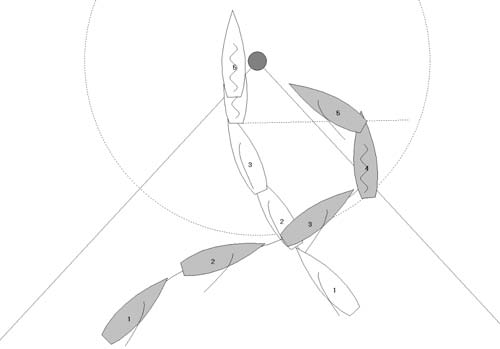
The animation (and picture) show the Grey boat pointing its bow between Red and the mark, trying to 'sneak in'. Red doesn't want that, but leaves a wide enough gab between itself and the mark initially and then forcefully 'shuts the door' by luffing very hard.


In the current rules Red is entitled to mark-room and may sail her proper course AT the mark. She is however sailing well above that proper course. And therefor no longer 'protected' by the mark-room exoneration for breaking rule 16.
In the new rules this is still the case - only now it is written in 18.2(c) directly. Instead  finding this conclusion by way of the definition and exoneration, it's now in the rule.

Grey may try to go inside and she's entitled to a fair cop when caught. Not an entrapment by Red....

Ooh, the other change in rule 18.2 is one from long standing in Match - and Team Racing. To get out of another 'unfair' deal.
18.2(e) If a boat obtained an inside overlap from clear astern or by tacking to windward of the other boat and, from the time the overlap began, the outside boat has been unable to give markroom, she is not required to give it.
From the Team Race Call book: E10:
The current rules dictate that the White boat must give mark-room to the Grey boat...... Even if she's not able to do so, because the overlap was not established from clear astern, but in the tack.
That has now been addressed by the change in 18.2(e).
If White is not able, she doesn't have to give mark-room.

Please leave a comment if you have a different opinion about 18.2.
J.

Next time 18.3. It is slow going, but we will get there, eventually

Friday, 5 October 2012

RRS 2013 - 2016; Mark-room & Tactical rounding


The New Racing Rules for Sailing have been published on the ISAF Website and I've been studying what the changes mean for sailors on the water. In the coming months I hope to write several posts about that and will try to publish on every Friday. (More, if I have time)
The The RRS 2013-2016 do not come into effect until the first of January, but if you want a head start on your competition, have a butcher.*

In order to find out what the effect of changes in rule 18 will be, we need to look first at the definition of mark-room:
Mark-room
Room for a boat to leave a mark on the required side. Also,
(a) room to sail to the mark when her proper course is to sail close to it, and
(b) room to round the mark as necessary to sail the course.
However, mark-room for a boat does not include room to tack unless she is overlapped inside and to windward of the boat required to give mark-room and she would be fetching the mark after her tack.
A boat which has mark-room may sail a course that leaves the mark on the required side. Nothing new there, save it that leaving a mark on the required side can be done at many distances….
You can leave a mark to port (as asked in the SI) as close as the circumstances permit or at several boat lengths.This is important, because you want to know if you always can make a tactical rounding.
Low in - high out, right?

Do the a) and b)- parts of the definition provide you with an answer?

Let's start with b) -  room to round the mark as necessary to sail the course…., hmmm, I don't think so.  Necessary to sail the course is very close - as close as the circumstances permit. Closer if it's only 5 knots, than if it's blowing 30. But close, nevertheless. So no Donald Duck** there
Part b) does not give you the room to do a 'tactical rounding'.

Perhaps part a) does?
 - room to sail to the mark when her proper course is to sail close to it,
Close to it? You will want to sail a boat length beside the mark initially, to do a tactical rounding!
Let me explain why this part was added;
In the RRS 2009-2012 the definition of mark-room gave you the room to sail TO the mark - in a straight line. That gave a windward keep-clear boat, the right to 'shut out' a leeward right-of-way boat. For instance at the finish line:


Purple enters the zone clear ahead. RRS 18.2(b) gives her mark-room. The room to sail TO the mark.
Purple might infringe rule 11, but is exonerated because she's sailing TO the mark.

This was never intended by the rules. Therefore part a) in the new definition now only gives the room to sail close to the mark, to the boat with mark-room, if her proper course is to do so. And in the example it is clearly not. Purple could finish much sooner if she kept on sailing close-hauled.

Part a) clearly also does not give a boat the room to make a tactical rounding. The use of the term 'proper course' is only when that course is CLOSE to the mark. It does not mean you can sail your proper course when that is WIDE from the mark - as is needed when doing a tactical rounding.

The final part of the definition is almost the same as in the previous rules. You get room to tack, if there's a boat to leeward of you at the mark. That is the same as in the 2009-2012 edition. But new: that room is only available if you can fetch the mark after your tack. Not if you have to do another one after that.

In effect the new definition of mark-room is initially more than it was in the RRS 2009-2012. You no longer have to sail straight TO the mark. But it is also less than it was in the RRS 2009-2012; AT the mark you can no longer sail your proper course. In fact it is the room as most sailors have always thought it was; rounding the mark in a seaman-like way to sail the course.
The right to do a tactical rounding however, is solely depending on whether or not you have right-of-way when rounding a mark. If you are the keep-clear boat, all the room you get, is to sail close to it and round it as necessary to sail the course.

Next issue: What is the effect of the changes in Rule 18, with this new definition of mark-room?


(butcher's hook = look)
(Donald Duck = luck)

Wednesday, 3 October 2012

AC 34 Umpire Booth Replay: USC-USS

AC45, umpire booth displays: San Francisco 2012, August 26. Match Race between USC (Coutts) and USS (Spithill).

For those of you who are unfamiliar how umpiring is done at the America's Cup 45 -events; Umpires are stationed in a booth with a display of the boats on the water. The tracking has become quite accurate (within 2 cm) and the system displays all relevant information instantly. Starboard tack boats are green, Port tack boats are red. And when boats are overlapped the hulls are yellow.

When a boat wants to protest because they feel that another has infringed a rule, they press a button and the protest 'flag' is shown on the screen and recorded. Then the umpires - who have been following the incident as if they were on the water - take a decision and press the penalty or green flag button.

In the video you see the zone light up when the first boat enters the zone. USC is at that moment clear ahead and has mark-room. Nevertheless USS goes in and establishes an overlap after. She's not keeping clear under rule 11 and not exonerated because she has no mark-room.

When the penalty is given the boat must slow down until the penalty line has caught up. The line is initially two boat lengths behind the boat and traveling half it's speed. You can see USS luff up to loose speed until the line has caught up

There's also another boat on the screen. That is the on-the-water umpire. (On a jet-ski) He's not umpiring but 'winging'. Giving relevant information to the booth-umpires. Like if a boat is actually doing everything to keep clear, what the closest distance was or is. Things that are not deductible from the electronic display.


Pretty neat, don't you agree?


Tuesday, 2 October 2012

LTW Readers Q&A (63); Tacking at the Finish?

A Q&A from David and Vernice about a situation close to the finishline:

  
A couple of months ago David was a member of a protest committee which heard the following case:

Two one-design boats (Blue and Red) were approaching the upwind finish line in one of several races in a multi-class regatta. Both boats were on port tack near the port (left) end of the line, looking upwind.There were about 2 1/2 boat lengths separating the two boats, gunnel to gunnel.
Both boats were well within the 3-boat-length zone and had entered the zone almost simultaneously, with the windward Blue boat being slightly closer to the finish line than the leeward Red boat.
The leeward (right hand) Red boat suddenly tacked onto starboard. The windward Blue boat, which was slightly closer to the finish line, crash-tacked to avoid a collision.
After her tack, the Blue boat was outside the lay-line, to the left-hand end of the finish line, and had to execute a jibe to circle around and finish after the Red boat had crossed the line.

The Blue boat hailed "protest" and raised a red flag immediately. She filed a protest within the time limit. She alleged, citing Rule 18, that she should have been given mark-room as the inside boat and allowed to finish on her port-tack course.

The facts found that both boats were overlapped on port tack on their approach to the finish line, with 2 1/2 boat lengths of separation, well within the three-boat-length circle. Both boats were within the port-tack layline to the finish, and the Blue boat would have finished first if they both remained on port tack.

Even though both boats entered the zone on the same tack, the P.C. ruled that the last sentence in the preamble to Rule 18 and Rule 18a indicated that Rule 18 did not apply in this situation because: after the leeward boat (Red) tacked, "both boats were on opposite tacks on a beat to windward." Therefore Blue was not entitled to mark-room (since Rule 18 was shut off). Red was within her rights to tack onto starboard within the zone, becoming the Right-of-Way Boat and forcing Blue as the Give-Way Boat (Rule 10) to tack away onto starboard and be unable to fetch the line.


The questions are:
1.) Did the rule-makers intend that the last statement of the Rule 18 Preamble, along with Rule 18a, would allow the outside leeward port (Red) boat to have such a powerful weapon of being able to tack onto starboard and force the windward port boat (Blue) to tack away and be unable to fetch or to claim mark-room, even though both boats entered the zone overlapped on the same (port) tack and with the windward port boat closer to the mark? Was the Blue boat in that situation unable to invoke Rule 18?

2.) Can the last part of the Preamble, along with Rule 18b, be construed to mean that the proper course for the leeward port boat (Red) should always be to tack in this situation, so that she would be able to shut off Rule 18 and finish before the Blue boat?


I have a question of my own: You mention a crash-tack by Blue. Did she have to respond before Red was on a close hauled course? According to my animation of the incident that is almost unavoidable.  I’m assuming the PC did not find that as fact, otherwise they would have DSQ-ed Red for not keeping clear while tacking. And a crash tack is not seaman-like. If that was the only way Blue could keep clear, Red possibly broke rule 15.


Answer 1: YES. As soon as Red tacks to starboard, both boats are on a different tack and rule 18 is switched off per 18.1(a). Have a look at case 95 in the casebook

Answer 2: Proper Course? Maybe you can call it a good tactic, but not proper course. The definition proper course does not take into account whether a boat finishes before or after.
It is only the fastest way to the finish.
But if Blue ‘allows’ this manoeuvre it is a good way for Red to make sure she finishes before Blue.


There is an affective tactic to defend against such a manoeuvre. If Blue makes sure that Red can never complete her tack without keeping clear, she is effectively blocked and Blue wins.
In order to do this she must bear off and close the gap between her and Red. Not too close, she’s still keep clear boat (and has no protection from her mark-room, because she’s not sailing directly TO the mark) but close enough so that Red cannot tack.


David and Vernice came back to me, with an answer to my question and additional questions. Watch this space for part 2 of LTW Readers Q&A (63).


Related Posts Plugin for WordPress, Blogger...