Showing posts with label scoring. Show all posts

Wednesday, 12 March 2014

ISAF Q&A's; Five new ones!

The panel has awakened from it's long winter-break, or so it looks. I received five new Q&A's in my mailbox. Some also very 'useful' for Race Committees.

Q&A 2014.002 B008
As the B indicates, this one is for boats; a clarification on a previous Q&A from 2013, number 017 B005 to be exact. In order to understand the question (and answers) you need at least this diagram:

Diagram from Q&A 2013.017 B005
Both Q&A's, the new one and the one from 2013, hinge on one issue: Has the Blue given mark-room (pas tense) or does she still have to. For (yellow) sailors: If you want to avoid this 'nitpicking' by the rules gurus: Don't go around the mark with so much leeway, stay close, gybe round it and you are covered.....

Q&A 2014.003 F002
Race committees, please pay attention. The Q&A Panel is putting the hammer down. Results are no longer provisional, final or any other adjective you care to give them: They are, from this day forward "RESULTS". Make it so!

Q&A 2014.004 L002
When it rains, it pours. Race Committee, you are again ordered to change your wicked ways. No more multi-discipline races with boards, boats and what not. They can be harmful to your health and create risk of collision, damage and injury.

Q&A 2014.005 F003
Will they never stop? Again and again the poor line-sighting volunteers get it wrong. Identifying wrong boats under the black flag. No wonder the Q&A-panel has to step in, to sort this mess.
No, wait.. at the end a sailor is also ....
Well, you should find out yourself, I can't bear this any more...

Q&A 2014.006 K002
I'm glad this is the last one. The RC has enough on their plate for now. At least this one is about ties in Match Racing. A favourite subject by far, among the scoring people who are volunteering to do it.

Perhaps a decent flow-chart would help. What do you think?

J.


Ooh, I almost forgot: Here's the link to the updated booklet: ISAF Q&A Booklet
Put it in your library now, before you are caught, not having it.... and the Panel comes after YOU!


Wednesday, 20 June 2012

Finished or not?

A boat in a short regatta (half an hour) crosses the finish line as 7th boat and just after her bow has passed the line, she touches the finish  mark. The Race Committee on the pin-end finish boat see the boat touch the mark. They inform the other finish boat and a note is put on the finish list.

The boat crosses over the line and some heated argument on board is heard by the RC-people. They lose sight of the boat and concentrate on the next boat(s).

The boat returns to the finish line a couple of minutes later and is seen to sail downwind through the line towards the last mark.

Finish

After five minutes the finish window (time limit) runs out and because the next race is scheduled to commence as soon as possible, the committee boats leave their station and go down to the starting area. While they motor down, they see that same boat beating upwind.

The next race is started twenty minutes later after a short postponement because of a wind shift and all boats participate.

After racing the scoring is published and the boat who had touched the finish mark is scored DNF. The PC receives a request for redress within the protest time limit from that same boat, claiming she had finished.

What should they do?
Is that boat finished or not, and what should their score be?

Definition: Finish A boat finishes when any part of her hull, or crew or equipment in nor­­mal position, crosses the finishing line in the direction of the course from the last mark, either for the first time or after taking a penalty under rule 44.2 or, after correcting an error made at the finishing line, under rule 28.1.

Friday, 6 April 2012

Final Score in LTW 2012 Winter Challenge

WE HAVE A WINNER!

Scoring this final episode of our LTW 2012 Winter Challenge brought one contestant over the 100 points, and therefore he's declared as the winner. Congratulations Grey Bear, well done!
Your coveted prize will be banged in the post asap….

As to our final Episode, most of you did arrive at the 'correct' answer. Tiger was within the rules to try to improve her series score by making sure Hamilton Eleven finished after other boat(s).

The fact that the score of another boat was improved is more or less the point. If you sail someone to the back of the fleet - early in the race - a lot of boats benefit. The fact that is was only one, makes you think it was done for another reason. It's prudent to investigate the relation between the two boats benefiting from this manoeuvre, but even - like in our case - you can find such a connection, actual team racing is very very hard to prove.

You have to investigate all rules in the incident, because although the protest is about rule 2 and or 69, rule 2 can be infringed if you break a rule of part 2 using this tactic of improving your score. Tiger broke no rules, she was entitled to sail to the mark (18.2(b)), she was right of way boat (11) and Hamilton Eleven had to keep clear, therefore it was no rule 2 infringement nor a rule 69 issue.

Hamilton Eleven should have crossed astern as soon as Tiger luffed and defended her position instead of trying to pass to windward…. But that is hindsight.

Everybody who used Case 78 was deducted one point, it has been withdrawn from the book (well spotted Zaphod). But if you used Q&A 2011-022 you got a bonus point.

Scoring was based on the following criteria:
Adequate facts found? 2 points;
Rule 18 & rule 11 mentioned? 1 point;
Improved scoring (series) for Tiger? 1 point;
No rules broken by Tiger? 1 point;
No rules broken by Banks? 1 point;
Conclusion about rule 2 and 69? 2 points;
Dismissal of the protest? 2 points

Bonus or Malus points
Using Case 78? -1 point
Using Q&A 2011-022? +1 point
(redress 62.1(d)) only for Goomer two +1 point

Which gives us the final result:


I also have to congratulate Zaphod on his (almost) catching up and second place. And Dauphine who - despite not having entered in this last episode - managed to hang on to third place. (I did check the spam box!)

There will be an Epilogue to this series. I'm cooking it, but time is scarce, so it will take (at least) another week before it's ready.

Monday, 2 April 2012

Score 03/23 LTW 2012 Winter Challenge

Scoring Episode 03/13 has been based on the following criteria:
  • Adequate facts found, leading to conclusions about;
  • Validity P1 (valid);
  • Validity P2 (not valid, for several reasons; P-time, flag and hail);
  • Use of rule 60.3(a)(2) by the PC;
  • Yellow's breach of rule 11;
  • Green's breach of rule 11, forcing Yellow's infringement of rule 11;
  • Exoneration of Yellow 64.1(c);
  • No Mark-room for Blue. Because 18.3 switches off 18.2
  • Mark-room for Yellow 18.2(b), Green did not give that, see Case 114
  • Decision to DSQ Green and exonerate Yellow;
All criteria - if solved correctly - earn you 1 point. (in total that makes 10).
Deductions were done if you brought up unnecessary rules: i.e. rule 16 or rule 17. Minus one point for each.
I can accept the use of 15, although I would not have done so.

Have a look at the second entry by Grey Bear.
That is what I would have written when being scribe in an actual panel. (Save conclusion 1)

This gives us the following scoreboard:


With probably one episode to go, it looks like numbers one, two and three are more or less decided.


Sunday, 18 March 2012

Race Management Manual 2012


On the ISAF website I noticed the publication of the 'new' Race Management Manual and had quick look.

It is a whopper!

345 pages about Race Management, with subjects ranging from 'Dealing with the CAS, Crisis Management, Junior Sailors to Handling Misconduct and Dealing with the Media. A real big basic manual, covering everything, in first glance.

I'll be reading it in coming weeks - time permitting - and report back on interesting subjects, but it is already clear to me, that a lot of people have invested a lot of time to get it this extensive.

Illustration on page 335
If you are interested, you can download it on this page: RMManual2012.

Do me a favour, if you do and have read it, give me your tips on interesting parts....

I'm writing this post on Saturday evening, to be published on Sunday - after a day on the water. I was in Lelystad at the sailing centre of Team Heiner for stage 5 in their Match Race Winter series. Nice (and dry) sailing weather for the six teams participating. Tomorrow stage 6.

This means I will - in all likely hood - not be able to score the LTW 2012 Winter Challenge E 03/09 tomorrow. I did however publish the answers already - so you can have a look at what you fellow challengers wrote.

A hint, read rule 42 again and think about why you did not include that rule in your answer........ (save one)

Ohh, will the anonymous challenger who send me his/her answer already last Saturday, please tell me who you are? There are several possibilities and I hate to award a score to the wrong person.

Sunday, 11 March 2012

Score 02/24 LTW 2012 Winter Challenge

As most of you have found the Challenge in episode 02/24 was to choose.
The stories by both sailors (and diagrams) were the same, except in a crucial point:
Did Purple pass head to wind before or after Grey had to bear away to go behind?

Choose!
I've tried to give answers to the questions as if I was the representative of the boat(s). Both truthful and believing in their story, as much as possible.

The PC does not have the luxury to NOT decide an incident. They must choose and write down the facts found - thereby determining what has happened. Sometimes that can be different than what has actually occurred, but they must choose. If you can't, get the parties back in the room and continue the hearing.
A conclusion of "cannot decide" is unacceptable.

The presentation by the party can therefore make a huge difference. If a representative of the boat is able to convince the panel members of his side, they are more likely to go for his version. And since the outcome of a protest is usually very black and white (DSQ or not), that skill should be developed - as much as any sailing technique. It can cost you the race!

I'm happy to see that all of challengers did choose.

Scoring and comments are done with the comments in the original post:
LTW 2012 Winter Challenge 02/24:YES/NO

This is the new scoreboard:


No more ties at the moment. But if they occur, they will be resolved according to RRS A8.

Sunday, 26 February 2012

Score 02/17 LTW 2012 Winter Challenge

For individual comments see my remarks after your entries in the comments of the original post:
LTW 2012 Winter Challenge 02/17: Request for Redress

Key factor in this incident is to find as fact whether Red established the collision course before Purple became keep clear boat or after. In other words, was Red pointing at Purple before Purple passed head to wind or after. A lot of what you conclude is determined by that fact.

Option ONE
If before, Red has no restrictions under rule 16.1 since the course change was before she became ROW boat. And no restriction under 15 because she became ROW boat by Purple's actions. In this scenario Purple breaks rule 13 by not keeping clear as tacking boat and Purple breaks rule 14 because she shouldn't have tacked in that position. It was therefore reasonable possible for her to avoid the contact

Option TWO
If after, Red has a restriction under rule 16 (she changed course as ROW boat and established a collision course) and must give Red room to keep clear - which being a tacking multi hull - can take some time. Then you also must draw a conclusion on whether or not Purple did enough to keep clear. Could she have accelerated faster, getting out of that position in front of Red? If she could have done more, she breaks rule 13, if she couldn't have done more, she's exonerated because of Red's infringement of 16.1.

Could Purple avoid the collision? Once she was in that tack she could do little else than go forward asap. Did she do that? Another conclusion to be drawn. Remember, in option two she is a boat entitled to room, so under rule 14 she didn't need to act to avoid contact until it was clear that Red wasn't going to give her that room. I think not. Purple couldn't reasonably avoid contact any more and did not break rule 14.

When it became clear that Purple wasn't going to keep clear, was it reasonably possible for Red to avoid the collision? The fact that she "missed" hitting Purple only by ten centimetres, is more or less irrelevant. You must either conclude she reasonably could avoid or couldn't.
In my opinion she could. She broke rule 14. And that is completely separate from if you've found as fact option one or two.

Red did a two turns penalty. Is that an appropriate penalty for breaking RRS 14? That depends on the damage - was it serious or not. A boat that cannot continue is serious damage. So Red should have retired> Red DSQ.

If you think Purple is at fault, you nevertheless may not DSQ her. She is to be scored DNF.
She retired and that is an appropriate penalty. The reason for her retirement is irrelevant. (Case 99 & 107)

The protest is valid despite the fact a red flag was not shown. The damage was obvious to both and Red was informed before end of protest-time. RRS 61.1(a)(3)

If you concluded that Purple is to be exonerated for breaking rule 13 and did not break rule 14, she's entitled to redress. In all other scenarios it is more or less her own fault (at least partly) and she's therefore not entitled to redress.

If you give Redress you can give her her first place or an average of her 6 sailed races (excluding or including her discard). For that you need the total number of boats that sailed in the races. Nobody asked this question. But then only one of you granted redress.

This brings our score to:


Equal Points on first place.

I must decide on a way to resolve ties.....
Any suggestions?

.

Sunday, 19 February 2012

Score 02/10 LTW 2012 Winter Challenge

Phew, that were a lot of questions.
Some good, some not so, but because of different perspectives, everybody could experience that a fellow judges question may trigger a thought in your brain. Not so good questions, got 'bad answers', so I'll only count and not value the content... But in a next round I might.. (>.<)

As most of you discovered, this episode was about Case 50. The Port tack boat must convince the PC that their was not a reasonable apprehension of collision by Starboard. Read (pillow)Case of the Week (08) - 50, if you want to brush up.

This was the picture/animation I made when writing the Episode. In it you see the Red boat bearing away in position 3, just short of a boat length from Purple. There's also a Pink boat. It is only to show what would have happened if Red hadn't changed course.


Individual; remarks about FF, Conclusions and Decision are - per usual - in the comments in the original Episode Post: LTW 2012 Winter Challenge 02/10; Questions


The Score:
I've counted the number of questions + 5 points for a perfect and correct answer. Anybody mentioning Case 50 got a bonus point. There were a some challengers who asked questions but didn't send in an answer.....


We are almost halfway towards the hundred points, dear challengers, keep it up!

Tuesday, 14 February 2012

ISAF Q&A 2012 - 001 F12: Scoring and OCS

The first Q&A in 2012!

Is about BFD, rule 28.1 and the obligation by the RC to score a race if a boat finishes within the time limit.
Have a look at: ISAF Q&A 2012-001 F12


As per usual, there's also an updated Q&A Booklet: V12-02-12

My question to you:
Suppose besides a time limit for the first mark and the race, there's also a time limit for the finish in the SI - say 20 minutes. I quote the SI:
10.4 Boats failing to finish within the time stated in the Finish time limit after the first boat sails the course and finishes will be scored Did Not Finish. This changes RRS 35, A4 and A5.
Does the clock start with the finish of boat A, boat B or boat C?

Whereas boat A and B are the boats as described in this Q&A, and boat C is a boat that has started correctly, was not OCS and finished third.

Sunday, 12 February 2012

Score 03/02 in LTW 2012 Winter Challenge

As per usual the scoring for last weeks challenge. You can find the my remarks with the individual entries in the comments in post: LTW 2012 Winter Challenge - Episode 03/02

I've measured the entries against my own Facts Found, Conclusion and Decision:

Facts found:
TUR delivered the protest after time limit because of a cue at the desk.
DEN was on starboard close hauled course on the first beat, toward mark 1 in race 5.
TUR on port close hauled, overlapped with BRA who was 2 meter to leeward and 3/4 BL forward, both on a collision course with DEN.
BRA bore away to go behind DEN and left approx. 0,5 meters of room between her and the transom of DEN.
TUR slowed down and passed very close astern of DEN. BRA luffed to close hauled.
There was collision between TUR’s bow and BRA’s port aft quarter.
No damage to any boat. Neither took a Penalty

Conclusion:

PC extended the time limit, because there was a good reason to do so.
TUR to windward, failed to keep clear of BRA to leeward, but was forced to break rule 11 because BRA as outside boat did not give enough room to pass an obstruction (DEN on starboard) to TUR on the inside, while she was able to. BRA broke rule 19.2(b) and TUR is exonerated under rule 64.1(c).
BRA broke rule 14, because she could reasonably avoid the contact, TUR could not. BRA is not penalized for rule 14 because there was no damage or injury.
Rule(s) applicable:
RRS 10, 11, 14, 16.1, 19.2(b), 61.3, 64.1(c)

Decision:
Protest Upheld
BRA DSQ in race number 5

(232 words)


Deadline for first question in Episode 02/10 is 23:59 tonight.

Sunday, 29 January 2012

Score 20/01 in LTW 2012 Winter Challenge

Episode 20/01 has been scored:


The entries are getting very good already.

Several of the challengers have not send in a entry. Please don't quit so soon. I'm sure you can learn a lot by participating. I've asked for nicknames so you can remain anonymous.


This is what I came up with:


Conclusions
  • Blue on Port tack is keeping clear under rule 10, by passing in front of Orange on Starboard tack.
  • Blue continues to keep clear, first under 13 and then under rule 11 until position 4.
  • Blue is subject to rule 18.3, because she was subject to rule 13 in the zone and Orange is fetching the mark. Boats are overlapped as soon as Blue passes head to wind with Orange as inside boat and entitled to mark-room under rule 18.3(b). Rule 18.2 does not apply. Orange's luff above close hauled was to fetch the mark, not to avoid Blue, therefore Blue did not infringe 18.3. It was also a proper course for Orange therefore any 16.1 infringements are exonerated under rule 18.5
  • Orange is right-of-way boat under rule 11, Blue is not keeping clear in position 5
  • Blue could have avoided the contact, therefore breaks rule 14
  • Orange could not avoid the contact, after it became clear that Blue would not keep clear, so does not break rule 14
Decision
Protest upheld
DSQ Blue
J.


A final question to think over:
What would change if Orange had passed head to wind, just after position 4?

Sunday, 22 January 2012

Score 13/01 in LTW 2012 Winter Challenge

The score for the first episode:


And - as promised - my answer.


Conclusions
  • (Blue complies with rule 10 by keeping clear as Port tack boat from Green as Starboard tack boat; Greens luff does not break 16.2 as Blue does not have to immediately change course to keep clear)
  • (Green is keeping clear as tacking boat under rule 13, and then under 11 as windward boat; Blue does not have to give Green room under rule 15 as long as she maintains a straight course, because it was Green’s actions (her tack) that gave her right-of-way)
  • (In position 3 Blue establishes a leeward overlap while Green as windward boat is still required to keep clear under rule 13, therefore rule 17 is not turned on)
  • When Blue, as right-of-way boat, changed course between positions 3 & 4, she did not give Green enough room to keep clear, and broke rule 16.1.
  • Green broke rule 11 by not keeping clear as windward boat from Blue, but was compelled to break this rule because of Blue change of course and subsequent infringement of rule 16.1 and is therefore exonerated under rule 64.1(c).
  • Green did not break rule 14, because she was entitled to room from Blue (changing course) and by the time it was clear that Blue would not give that room, Green could not reasonably avoid the contact anymore.
  • Blue could reasonably have avoided the contact even after it became clear that Green was not going to keep clear and broke rule 14. There was damage so as right-of-way boat she can be penalized. However Blue took the applicable penalty (rule 44.1(a)) and therefore rule 64.1(a) does not apply. Blue is exonerated under rule 64.1(b).
Decision
Both protests are dismissed

J.

Thursday, 12 January 2012

Changing the ranks; one point at a time

From a presentation I witnessed last Tuesday about the upcoming changes in the rules 2013-2016, I learned that the Bonus point system will be deleted. Rule 90.3, Appendix A4 and A4.1 will be changed accordingly.

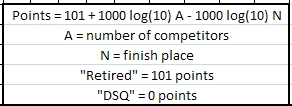
I've done a quick calculation, using the results of the recently sailed Yngling 2012 World Championship in Sydney Austrailia to see what the effect on places would have been. Don't get me wrong, I'm not advocating any particular system, just wanted to have a look if it made any difference.

The first 10 boats out of a fleet of 45 with the Low Points System:


 Then the first 10 boats with the same results with the Bonus Points System:


Finally the first 10 boats with the Austrian Points System:


What is you opinion?
Is the Low Points System enough, or should we keep an option open for other systems?

In the Extreme Sailing Series we use the Low Points System - but in reverse. First place gets most points and the winner is the boat with the most points in the series. (This is because Joe the Public can't understand that someone with 0 points can win anything)


 Explaining


would be next to impossible.

Tuesday, 25 October 2011

Measurer or Equipement Inspector in the Rules

A new Q&A from ISAF, about the measurer or equipment inspector:

ISAF Racing Rules Question and Answer Service
J 021 Q&A 2011-020; Published: 22 October 2011


Question 1
Is an equipment inspector or measurer at an event a member of the race committee for that event?

Answer 1
Not normally. Equipment inspectors or event measurers are responsible for checking that the boats or the personal equipment used by competitors comply with the class rules. According to the Terminology in the Introduction to the Racing Rules of Sailing, ‘Race committee’ includes any person performing a race committee function. The race committee functions are stated in different rules in Part 7 (conduct races, publish written sailing instructions, score races, etc) and equipment inspection is not one of them.

If however the equipment inspectors or event measurers were appointed by the race committee to conduct such responsibilities on behalf of the race committee, then they are members of the race committee.

Question 2
If the answer to Question 1 is yes, can the equipment inspector or the event measurer protest a boat under rule 60.2 without the need for the written report required by rule 78.3?

Answer 2
The equipment inspector or the event measurer can only protest the boat if the race committee delegates this responsibility to him or if the sailing instructions change rules 78.3 and 60.2 accordingly.

Question 3
The rules at an event require that a certificate is produced before a boat races. One boat does not produce a certificate, but the race committee receives a statement signed by the person in charge that a valid certificate exists and that it will be given to the race committee before the end of the event. The race committee does not receive the certificate in time.
Can that boat be scored DSQ for all races without a protest as rule 78.2 indicates?

Answer 3
No. The race committee should protest the boat. Rule A5 lists the scoring actions the race committee may take without a hearing. An action under rule 78.2 is not in that list.


If your boat is measured by a measurer or equipment inspector please check the SI if he/she is a member of the Race Committe. If the SI do not give an answer, ask! Perhaps the OA has appointed him/her?
Then you can request redress because the measurer or equipment inspector is part of the organizing authority.
If that is also not the case, i.e. the OA did not appoint him/her, we get into "murky" water.

If the inspector/measurer doesn't approve a boat or equipment, he is obliged to report that to the RC (Rule 78,3), who then has the obligation to protest you.(rule 60.2). If there's no report, there will be no protest. And you cannot request redress if the measurer or equipment inspector is not part of the RC or OA.....
Please do not hesitate to bring that to the attention of the PRO - he can at least have a "conversation".

After receiving a report, the RC cannot just DSQ a boat without a protest. They can refuse entry (rule 76.1) but they will have to give a reason. And when that happens you can go to the PC requesting redress. The PC will then investigate and hear your argument why you think that reason is not valid.

If you compete with a boat that - according to the measurer or equipment inspector - is not complying with the class rules, AND you think they are wrong (make sure you know what you are taking about) you still can compete in the regatta.

The RC will protest you and the PC will disqualify you, but then you can use rule 64.3(c) to compete in all subsequent races. You will have to appeal the disqualification and argue your case before the appeals committee, but if you win, the results will stand. If you lose that appeal, all results will be deleted and replaced by DSQ..... But then you were DSQed already - and at least you were able to sail the event, no?

Oh, this trick will only work once. If you try this a second time, the appeals committee will slap a rule 2 on you or worse, start an rule 69 investigation.

There is light at the end of the tunnel: A submission to change rule 62.1, so you can request redress for an omission or improper action by a measurer or equipment inspector.

Monday, 16 August 2010

(pillow)Case of the Week (33) – 80;

(This is an instalment in a series of blogposts about the ISAF Call book 2009-2012 with amendments for 2010. All calls are official interpretations by the ISAF committees on how the Racing Rules of Sailing should be used or interpreted. The calls are copied from the Call book, only the comments are written by me.)

image

Case 80

Rule 60, Right to Protest; Right to Request Redress or Rule 69 Action
Rule 61.2(b), Protest Requirements: Protest Contents
Rule 62.1(a), Redress
Rule A5, Scores Determined by the Race Committee

A hearing of a protest or a request for redress must be limited to the alleged incident, action or omission. Although a boat may be scored DNF if she does not finish according to that term’s definition, she may not be scored DNF for failing to sail the course correctly.
Summary of the Facts

When boat A crossed the finishing line in the direction of the course from the last mark, the race committee scored her DNF because it believed from its observations that she had not left one of the rounding marks on the required side and, therefore, had failed to sail the course correctly. A requested redress on the grounds that, even though she had finished properly, she was not given a finishing place. The protest committee did not give A redress, deciding that rule 62.1(a) did not apply because A failed to sail the course correctly, and that her failure to do so was not due to an act or omission of the race committee but was entirely her own fault. A appealed.

Decision

A’s appeal is upheld. The race committee acted improperly in scoring A DNF when she did finish according to the definition Finish. The race committee could have scored boat A as DNF only for failing to finish correctly (see rule A5). Since A crossed the finishing line from the direction of the last mark, she  should have been recorded as having finished.

A fundamental principle of protest committee procedure is that a hearing must be limited to the particular ‘incident’ alleged in a protest (see rule 61.2(b)) or to the particular incident alleged to be ‘an improper action or omission’ in a request for redress under rule 62.1(a). Although the incident that was the subject of A’s request for redress was that she had been incorrectly scored DNF, the protest committee turned to a different incident when it considered whether or not she had failed to sail the course correctly and therefore broken rule 28.1. Since that incident was not the incident alleged in the redress for request, the committee acted improperly.


If a race committee believes from its observations that a boat has not sailed the course correctly, it may protest the boat for that breach as permitted by rule 60.2(a). In this case, the race committee did not protest A. Because A had not been protested for failing to sail the course correctly, she could not be penalized for that failure.


In summary, the facts show that A finished according to the definition Finish. She should not have been scored DNF and was therefore entitled to redress under rule 62.1(a) for an improper action of the race committee. The decision of the protest committee is reversed and A is to be scored as having finished at the time she crossed the finishing line.

USSA 1993/289

image

This principle of sticking to the issue at hand, has frustrated many a hearing.

And the question about how to score a boat that hasn’t rounded all the marks is asked by perhaps all Race Committees. Therefore a useful case, imho.

J.

Monday, 2 August 2010

(pillow)Case of the Week (31) – 82;

(This is an instalment in a series of blogposts about the ISAF Call book 2009-2012 with amendments for 2010. All calls are official interpretations by the ISAF committees on how the Racing Rules of Sailing should be used or interpreted. The calls are copied from the Call book, only the comments are written by me.)

image

Case 82

Rule 62.1(a), Redress
Definitions, Finish

When a finishing line is laid so nearly in line with the last leg that it cannot be determined which is the correct way to cross it in order to finish according to the definition, a boat may cross the line in either direction and her finish is to be recorded accordingly.
Summary of the Facts

At the finish of a race boat A crossed the finishing line in the direction, she believed, of the course from the last mark, leaving mark F to starboard. She recorded the time she crossed the line. The race officer did not record her as having finished and did not make a sound signal. Hearing no sound signal, A sailed the track shown in the diagram and finally crossed the line leaving mark F to port, at which time the race officer recorded her as having finished and made a sound signal. A requested redress, asking that the time she recorded at her first crossing be used as her finishing time
.
image

The protest committee found as a fact that the committee boat was swinging back and forth across a line parallel to the last leg, but believed that the race officer was watching closely to determine the correct direction for each boat to cross the line. Redress under rule 62.1(a) was denied and A appealed.

Decision

A’s appeal is upheld. Positioning the finishing line marks so that boats cannot easily determine in which direction they should cross the finishing line is an improper action on the part of the race committee. When a boat cannot reasonably ascertain in which direction she should cross the finishing line so as to conform to the definition Finish, she is entitled to finish in either direction. A is therefore entitled to redress under rule 62.1(a). She is to be given her finishing place calculated from the time she herself recorded when she crossed the line for the first time.

image

This case always has me wondering if this finish was a ‘normal finish’ or if the committee vessel was there to shorten the race.

Not that it changes the decision, in both instances the position of the RC-vessel could not have been worse, but then the sailors at least would have a reasonable change of determining how to cross the line equally. They would just sail the course and go to whatever side mark F should be rounded.

J.
Related Posts Plugin for WordPress, Blogger...