Showing posts sorted by relevance for query rule 49. Sort by date Show all posts

Monday, 9 July 2012

(pillow)Case of the week (28/12) - 04

(This is an instalment in a series of blogposts about the ISAF Case book 2009-2012 with amendments for 2011. All cases are official interpretations by the ISAF committees on how the Racing Rules of Sailing should be used or interpreted. The cases are copied from the Casebook, only the comments are written by me.)
(pillow)Case picture
Case 4
(Case 5 has been withdrawn for revision during 2009)
Rule 49, Crew Position
Rule 50.3(a), Setting and Sheeting Sails: Use of Outriggers

A competitor may hold a sheet outboard.
Question
Is it permissible for a competitor to hold the sheet of a headsail or spinnaker outboard?
Answer
Rule 50.3(a) prohibits the use of an outrigger and defines it to be a fitting or other device. A competitor is neither a fitting nor a device. It is therefore permissible for a competitor to hold a sheet outboard, provided that rule 49 is complied with.
RYA 1962/41
blogcolorstripe
For those of you who are wondering about rule 49:
49 CREW POSITION
49.1 Competitors shall use no device designed to position their bodies outboard, other than hiking straps and stiffeners worn under the thighs.

49.2 When lifelines are required by the class rules or the sailing instructions they shall be taut, and competitors shall not position any part of their torsos outside them, except briefly to perform a necessary task.
On boats equipped with upper and lower lifelines of wire, a competitor sitting on the deck facing outboard with his waist inside the lower lifeline may have the upper part of his body outside the upper lifeline.
When holding a sheet outboard your torso will be most likely outside the lifelines on a yacht that is equipped with those. Therefore you can only do it briefly to perform a necessary task. Taking the spinnaker pole down just before lowering and then a crewmember holds the sheet outboard to keep the spinnaker drawing, complies with rule 49 and with rule 50.3(a). If you do the same for half a leg – provided you are that strong – it breaks rule 49 and the boat can be protested and DSQ-ed.
And since it is in part 4 of the RRS – no alternative penalty can be taken to exonerate this infringement.
A sheet is not a device designed to position a crew’s body outboard, so you even comply with rule 49.1 by using that same spinnaker sheet as support to prevent you from falling in the water. But, like stated, only briefly!

Monday, 28 February 2011

(pillow)Case of the week (09) – 49

(This is an instalment in a series of blogposts about the ISAF Call book 2009-2012 with amendments for 2010. All calls are official interpretations by the ISAF committees on how the Racing Rules of Sailing should be used or interpreted. The calls are copied from the Call book, only the comments are written by me.)

(pillow)Case picture

CASE 49

Rule 19.2(b), Room to Pass an Obstruction: Giving Room at an Obstruction
Rule 63.3, Hearings: Right to be Present
Rule 64.1(c), Decisions: Penalties and Exoneration

When two protests arise from the same incident, or from very closely connected incidents, they should be heard together in the presence of representatives of all the boats involved.

Summary of the Facts

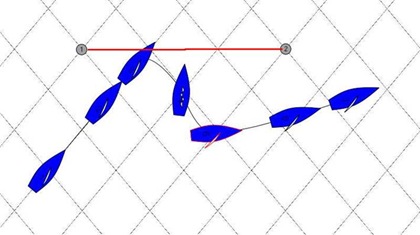
In a moderate to rough sea and a fresh breeze, S, close-hauled on starboard tack on her proper course, converged with PW and PL, overlapped and broad reaching on port tack on a different leg of the course. The rigging of PW and S touched, in spite of S luffing sharply in an attempt to avoid a collision, but there was no damage or injury.

image


Two protests arose from this one incident and were heard separately. In the first protest, S v PW, the latter was disqualified under rule 10. The facts found in that hearing did not mention PL. During the hearing of the second protest, PW v PL, PL stated that she knew that S was converging with PW and PL, that PW would be likely to need room from PL to avoid a possibly serious collision, and that the situation was developing rapidly. PL was disqualified under rule 19.2(b) for not giving PW room between her and S, an obstruction. PW appealed the decision of the protest committee disqualifying her for breaking rule 10.

Decision

In cases of this kind, the two protests should be heard together in the presence of representatives of all the boats involved. This ensures that all of them hear all of the testimony given to the protest committee about the incident, as required by rule 63.3. Had this procedure been followed, the protest committee would have learned that the collision between PW and S arose from the inability of PW to bear away because PL did not give her room to do so, and, as provided in rule 64.1(c), PW would have been exonerated from her breach of rule 10. PW’s appeal is upheld, and she is to be exonerated from her breach of rule 10 and reinstated. The protest committee’s decision to disqualify PL for breaking rule 19.2(b) was correct.

RYA 1981/6


blogcolorstripe

There are ways to ensure that cases like this are heard together. But it does mean that the person receiving the protest forms – or the one planning the hearings – at least has a basic understanding of the process.

He/She must run trough the following checklist:

  • Have any of the boats on the forms the same numbers?
  • If so, are they the same class?
  • if so, did the incident occur during the same race?
  • if so, compare the incidents described on the forms and look for similarities – if in doubt ask one of the panel members to help.
  • If still in doubt, call the parties involved to come at the same time and ask them.

It is easier to separate if the protest is not about the same incident, than to join, if they are.

Wednesday, 16 June 2010

ISAF Q&A's Fast and Furious

The ISAF Q&A's have been coming fast and furious.
There's a new sheriff in town, so to speak. As I have understood the new chairman has instigated a policy that the Q&A-panel will no longer 'screen' questions for usefulness or worthiness? (is that a proper word?)
All questions will be answered!

The best way to keep track of them is to download the new booklet, where they all are now recoded with a letter and a sequence number.
Go to: QABookletJune92010-[8951].pdf

From the index: I've linked the latest so you can download them also individually:

A - Fair Sailing
A 1 Q&A 07-008 Slowing another boat’s progress in a race.
A 2 Q&A 09-023 A discussion about different aspects of a situation when a boat learns, in an invalid hearing, that she has broken a rule.

B - Boat vs Boat
B 1 Q&A 06-005 A collision between two catamarans on opposite tacks at a narrow gate.
B 2 Q&A 09-004 'Keeping Clear' in a windward /leeward situation.
B 3 Q&A 09-017 When Mark-Room includes room to tack.
B 4 Q&A 09-021 Rights and obligations at obstructions.
B 5 Q&A 09-022 How much room is mark-room?
B 6 Q&A 09-025 Questions about the windward mark and proper course.
B 7 Q&A 09-028 Obligations when a boat hails for room to tack.
B 8 Q&A 09-030 A clarification about rule 18.3.
B 9 Q&A 09-033 How early must a boat start taking action to avoid a collision?
B 10 Q&A 09-036 When does rule 18.3 stop applying?
B 11 Q&A 10-001 3 boats overlapped on port tack approaching an obstruction; a racing boat on starboard tack.
B 12 Q&A 10-009 Finishing mark and rules 18.2 and 18.5.
B 13 Q&A 10-011 Overlap changing from leeward to windward overlap.
B 14 Q&A 10-012 Rule 18.3 and ‘causing a boat to sail above close-hauled’.
B 15 Q&A 10-013 Rules 19 and 20 when multiple boats meet.
B 16 Q&A 10-017 Windward boat must always keep clear.
B 17 Q&A 10-020 Two boats tacking in the zone when another is fetching.

C - Starting
C 1 Q&A 07-004 A clarification about rule 30.1, I Flag Rule (Called Round-an-End Rule).
C 2 Q&A 09-027 When boats start in both directions – what should be done?

D - Sailing the Course
D 1 Q&A 09-008 'Side of a mark' for the purpose of rule 28.
D 2 Q&A 09-010 A boat forced to the wrong side of a mark still needs to sail correctly around that mark. She is not 'compelled' to break rule 28.
D 3 Q&A 09-014 A clarification of rule 28. A catamaran rounding a mark with one hull flying over the mark.
D 4 Q&A 09-034 When one Gate Mark is missing.
D 5 Q&A 10-004 About touching marks and the definitions Finish and Racing.

E - Finishing
E 1 Q&A 06-002 When has a boat 'cleared' the finishing line and marks?
E 2 Q&A 06-003 Race committee action when a boat passes the pin end of the finishing line on the wrong side or touches a finishing mark.
E 3 Q&A 07-003 A clarification of fetching at the finishing mark.
E 4 Q&A 08-002 ’Normal position’ - finishing as a capsized boat.
E 5 Q&A 09-005 Relating to ISAF Case 45 - a case about a sailing instruction that required boats to finish contrary to the definition 'Finish'.
E 6 Q&A 09-016 About shortening of course, finishing when the race committee is positioned at the 'wrong' end of the line.
E 7 Q&A 09-026 When does a boat finish – when is the line a finishing line.
E 8 Q&A 09-035 About Case 112 and Q&A 2009-26.

F – Scoring
F 1 Q&A 01-001 A question relating to the time limit of races.
F 2 Q&A 03-002 Scoring boats OCS after the race based on observations by or statements from competitors or other persons outside the race committee.
F 3 Q&A 03-004 Abandoning a race after some of the boats have finished.
F 4 Q&A 07-001 Awarding of average points in multiple races.
F 5 Q&A 08-001 A clarification about numbering of races.
F 6 Q&A 08-003 A discussion about whether a boat that has retired can un-retire.
F 7 Q&A 09-002 A clarification of ‘number of boats entered in a series’ for the purpose of scoring under Appendix A.
F 8 Q&A 09-006 A clarification of rule 90.3(a): A race cannot be scored when no boats have sailed the course in compliance with rule 28 and finished.
F 9 Q&A 09-013 Scoring series with multiple rankings.
F 10 Q&A 09-031 How may scoring mistakes be corrected after a regatta?
F 11 Q&A 10-023 Resolving ties in series score when redress is involved.

G – Race Management Practices and Policies
G 1 Q&A 09-009 Special sailing instruction to allow shortening races for safety reasons even after some boats have crossed the finishing line.
G 2 Q&A 09-012 When the race committee observes a boat touching a mark.
G 3 Q&A 10-010 Posting OCS lists at the windward mark.
G 4 Q&A 09-015 About abandonment in match racing. Where to draw the line for what would be an improper action by the race committee.
G 5 Q&A 10-015 Changing the meaning of the Race Signals in the sailing instructions.
G 6 Q&A 10-016 When sailing clubs mix responsibilities for club regattas.
G 7 Q&A 10-018 Race committee procedures for sighting the starting line.
G 8 Q&A 10-021 When using VHF to recall boats.

H – International Jury
H 1 Q&A 02-001 Rule N1.1 and International Jury members on signal- and finishing boats.
H 2 Q&A 03-001 A question relating to International Juries and when they are properly constituted.
H 3 Q&A 09-041 A clarification about submitting questions about Jury decisions.

J – Protests, Hearings, Appeals & Procedures
J 1 Q&A 04-008 Signalling a yellow flag penalty after a general recall.
J 2 Q&A 07-006 Notifying boats of a protest by informing the coach, rules advisor or other representative.
J 3 Q&A 09-011 The weighing and credibility of evidence in protest hearings.
J 4 Q&A 09-039 When a protest committee protests a boat under rule 60.3(a)(2).
J 5 Q&A 09-040 About denial of appeal and national prescriptions.
J 6 Q&A 10-003 Compelled to break a rule by an unidentified boat breaking a rule.
J 7 Q&A 10-005 Conditions for a protest committee to reinstate an abandoned race.
J 8 Q&A 10-006 Protest time limit when the race time limit runs out.
J 9 Q&A 10-008 Redress when boats get entangled with marks.

K – Match Race
K 1 Q&A 09-015 About abandonment in match racing. Where to draw the line for what would be an improper action by the race committee.

L – Technical
L 1 Q&A 03-007 A question about the legality of disconnecting the headstay while racing.
L 2 Q&A 08-004 A question about the use of the Yngling gybing line.
L 3 Q&A 09-001 A question about boat wax/polish and rule 53.
L 4 Q&A 09-007 A question about hiking devices and rule 49.1.
L 4 Q&A 09-029 A question about rule 53, textured surfaces and wet sanding.
L 6 Q&A 09-037 Questions about rule 42 when rules 49 to 54 do not apply.
L 7 Q&A 09-038 Using a lead trapeze harness strap buckle (that is a dive weight) and rule 43.1(a).
L 8 Q&A 10-002 Life line material and the Racing Rules of Sailing.

M – Terminology
M 1 Q&A 04-006 When is a boat on a beat to windward?
M 2 Q&A 09-003 Questions about the term ‘Starting Area’.
M 3 Q&A 09-018 Is a finishing line a ’gate’?
M 4 Q&A 09-019 Questions about the new definition Fetching.
M 5 Q&A 09-032 When is a boat ‘sailing on another leg’?
M 6 Q&A 10-019 Changing course and rule 16.
M 7 Q&A 10-022 When touching only the flag on a mark.

N – Prescriptions and other rules
N 1 Q&A 10-007 National prescriptions not complying with rule 86.1(a).
N 2 Q&A 10-014 Approval for appointment of protest committees.

Deleted Q&As

This means that some of the questions may seem a bit simple. But as a policy I agree with answering all questions - the more answers the more consistent we will be to the sailors.

Monday, 6 December 2010

(pillow)Case of the Week (49) - 63

(This is an instalment in a series of blogposts about the ISAF Call book 2009-2012 with amendments for 2010. All calls are official interpretations by the ISAF committees on how the Racing Rules of Sailing should be used or interpreted. The calls are copied from the Call book, only the comments are written by me.)

Case 64 has been deleted in the Casebook.

(pillow)Case picture
CASE 63
Rule 18.2(b), Mark-Room: Giving Mark-Room
Rule 18.5(b), Mark-Room: Exoneration
Definitions, Mark-Room

At a mark, when room is made available to a boat that is not entitled to it, she may, at her own risk, take advantage of the room.
image

Summary of the Facts


Two boats, A and B, broad reaching and about to round the leeward mark, were overlapped with B outside. C was further astern. A passed the mark about one hull length to leeward, as did B, leaving ample room for C to round the mark inside them. B, because of her position outside A, was unable to deny room to C, and at no time during the incident sailed a course that would have resulted in a collision with C. No contact occurred. B protested C.

The protest committee dismissed B’s protest stating that C did not break any rule when she sailed between B and the mark and C did not cause B to take avoiding action or prevent B from luffing. B appealed on the grounds that C’s action prevented her from executing her intended manoeuvre, which had been to slow down by bearing away and then to harden up across A’s transom, thereby denying room to C to pass inside.


Decision 

B’s appeal is dismissed. When B entered the zone she was clear ahead of C, so rule 18.2(b) required C to give B mark-room. Rule 12 (and later rule 11) also required C to keep clear of B. B was not required to give C mark-room. However, B, because she could not prevent it, allowed C room to sail between her and the mark and the protest committee found that she was not in a position to do otherwise. When C sailed between B and the mark C broke no rule.

When a boat voluntarily or unintentionally makes room at a mark available to another that has no rights to such room, the other boat may take advantage, at her own risk, of the room. The risk she takes is that the boat entitled to mark-room may be able to close the gap between her and the mark while sailing her proper course. In that case, the boat entitled to mark-room will be exonerated if she breaks a rule of Section A or rule 15 or 16 (see rule 18.5(b)), and only rule 14 will inhibit her if she makes a rapid and aggressive attempt to close the gap between herself and the mark.

RYA 1984/1

blogcolorstripe

I wonder how many re- writes this call has gone through since 1984. And now with the latest change in wording with ‘mark-room’, it still works. Shows that not THAT much has changed in the way regatta rules are used on the water.

How’s that saying again: “You Snooze, you Loose”?

And talking about saying:
You have to click over to Tillerman’s post on Paul Elstrøm: What Did Elvstrøm Say?

Perhaps a genuine htg rules-nerd can find the answer…

J.

Sunday, 17 January 2010

Sunday Rules Snap; Rule 49

Luigi send me the following snap (together with his best wishes for 2010):

and asks in his mail: "Is this an infringement of rule 49?"

Dear Luigi,
I hope your year may be eventful and happy as well and I'll let the LTW_readers come up with the answer to your query. Thanks for sending it in!
Cheers, Jos

Tuesday, 15 December 2009

Protest by the Protest Committee?

ISAF Q&A 2009-039 deals with a protest by the PC under rule 60.3(a)(2):

A protest committee may (a) protest a boat, (2) if during the hearing of a valid protest it learns that the boat, although not a party to the hearing, was involved in the incident and may have broken a rule;

What the Q&A is stating, is that although the PC may have not complied with all the validity requirements, its decision in the protest is still valid. As long as the PC does not change its decision, either by acting under rule 66, realising that it had made an error about the validity of the protest, or until the decision has been reversed or changed on appeal.

This is on of the reasons sometimes sailors get very frustrated. They feel that they have a legitimate claim that an error has been made, but still the PC will not 'budge'.

One of the reasons I think that it is very important to always at least listen to the sailor bringing the argument. PCees should not be afraid to use rule 66 and at the very minimum investigate that they may have made an error. It might be that the error is not something that changes the outcome and even after admitting that they made that error, the decision can stand. But if there's an error that has influenced the scoring, it should be corrected.

Rule 66 is very one sided: The PC MAY reopen a hearing.
Even if the mistake is obvious, the PC still has the power not to re-open. Then the sailor has no other recourse then to appeal. Something not everybody is willing to do.
Something to consider the next time a sailor asks you for a re-opening...

Three more Q&A's have been published on the ISAF Website:
ISAF Q&A 2009-037; Questions about rule 42 when rules 49 to 54 do not apply. This is for the AC33
ISAF Q&A 2009-038; Using a lead trapeze harness strap buckle (that is a dive weight) and rule 43.1(a).
ISAF Q&A 2009-040; About denial of appeal and national prescriptions.

Saturday, 16 May 2009

iShares Cup 2009 Venice | 03

You must be wondering what I'm doing! It's very frustrating at the moment, I'm not able to connect to any wifi network. It's now 12:49 on Friday and no connection since yesterday evening.

I'll keep writing and will post as soon as there's an opportunity.

Venice is spectacular. A very special place with old and new mixed together, boats everywhere, big and small, official and working, choppy water and white coloured water (not to clean). I feel privileged to have to have the opportunity to come here.

This morning Thibaut (yes, the guy who writes Boat Scenario) an I went out with the ribs. We had to drive trough the big canal to get some fuel for our umpire boats. We went past all the famous sights - with piazza San Marco as the most prominent one - all packed with people.
Water taxis left and right, but no vaporettas (that's the public transport boats - instead of buses), who are on strike today.
Cruise ships 8 decks high sliding by, between two tugs, carabinieri and police all over the place. One thing we must definitely do is put up an Italian courtesy flag!

This afternoon we are going racing in very narrow water, a little more to the east then I showed on the map yesterday. The channel where we can race is cordoned of between 1430 and 1730 and only 200 meters wide… Hopefully we will have an up- and downwind course.

Rules. Well a lot of changes to the SSI, amendments left and notices right. A bit on the heavy sight I would say. A lot for all the sailors to soak up. We didn't have many questions, but that's more to do with lack of understanding then anything else, I suspect. I'll ask for permission to post them, since a couple of you have been mailing me asking this

Friday 19:01; still no connection. *&^*&$&^@&^#
We went out and had five races. Pretty good in these light conditions. The canal was completely cordoned of and all the traffic was directed to a side canal. Only very big ferry's and cruise ships were allowed to pass. In between we did our course A and B races…
Shortened to two laps to stay within target time of 15 minutes.

Today I went with David and we did the windward roundings. Staying pretty much up there. A couple 18.3, a couple Port-Starboard and other incidents.
In the fifth race there was a collision between two boats. Rule 11. One going downwind to the finish, one still on the beat going upwind.
We had a pretty fundamental discussion about rule 14 in the hearing afterwards. What does the rule actual say? When should the keep-clear act to avoid the collision?
One direction is that the keep clear boat always has an option before going into this situation to go another way. Not choose the "risky" option and thereby avoiding the collision. Besides breaking the appropriate right of way rule - he then, in this school of thought, would also break rule 14

The other approach to this issue is that we only look at rule 14 at the moment the collision course is established and find out what a boat has done from that moment on. Both boats need to be scrutinized from that exact moment but not before.
The keep clear boat has an obligation to avoid contact from that moment forward. The right of way boat only after is becomes clear that the keep clear boat isn't keeping clear and a collision is imminent.
I'll get back to this issue later this month.

Gitane, the leader of the regatta at the moment. I've lot's more pictures, but those will have to wait. In the mean time visit the official website: iShares Event Site

It's now Saturday 18:34 and since I'm finally been able to go on-line myself I've posted this. I'll try to keep you updated from now on. But tomorrow is already the last day! Time flies when you are having fun.

Monday, 19 December 2011

(pillow)Case of the week (49/11) – 32

(This is an instalment in a series of blogposts about the ISAF Case book 2009-2012 with amendments for 2010. All Cases are official interpretations by the ISAF committees on how the Racing Rules of Sailing should be used or interpreted. The cases are copied from the Casebook, only the comments are written by me.)

(pillow)Case picture

CASE 32

Rule 90.2(c), Race Committee; Sailing Instructions; Scoring: Sailing
Instructions

A competitor is entitled to look exclusively to written sailing instructions and to any written amendments for all details relating to sailing the course.

Summary of the Facts

The sailing instructions included, among other things, the following:

  1. All races will be sailed under The Racing Rules of Sailing except as modified below.
  2. A briefing will be held in the clubroom 60 minutes before the start of the first race each day.
  3. Shortened Course will be signalled by two guns and raising of flag S and the class flag. Boats in that class will round the mark about to be rounded by the leading boat and go straight to the finishing line. This changes the meaning of flag S in the Race Signals.

At one of the briefings, the race officer attempted to clarify the phrase ‘go straight to the finishing line’ in item 3 by stating that when the course was shortened, all boats should cross the finishing line in a windward direction.

This would ensure that all classes, some of which might be finishing from different marks, would finish in the same direction even if that were not the direction of the course from the mark at which the course was shortened.

Subsequently, a race was shortened. Six boats, which had not attended the briefing, followed the written sailing instructions, were recorded as not finishing, and sought redress. The boats alleged that the race committee had improperly changed the definition Finish and had failed to follow the requirements of rule 90.2(c). The protest committee upheld their requests for redress on the grounds they had cited.

The race committee appealed to the national authority, asserting that the briefing sessions were a numbered part of the sailing instructions, all competitors should have attended, and the briefings constituted a procedure for giving oral instructions. Also, it argued that the sailing instructions were not changed but merely clarified by the race officer as to what the words ‘go straight to the finishing line’ meant.

Decision

Appeal dismissed. The remarks of the race officer amounted to more than mere clarification. This is borne out by the fact that the boats that did not attend the briefing acted as they did. Competitors are entitled to look exclusively to the sailing instructions and to any amendments for all particulars of the course. Rule 90.2(c) requires changes to the sailing instructions to be in writing. However, under no circumstance can sailing instructions change the definition Finish or the definition of any other term defined in Definitions (see rule 86).

RYA 1975/3

blogcolorstripe

There’s only one ‘escape’ in giving verbal instructions: That is also in rule 90.2(c):

“Oral changes may be given only on the water, and only if the procedure is stated in the sailing instructions.”

Any change that is discussed verbally in a skippers briefing, regarding the SI or RRS MUST also be written on the notice board with time and date at an appropriate time. Anyway, changing a definition is not permitted anyway.

Thursday, 14 June 2012

Rule 18.5 and exoneration

I’ve been thinking about the intricacies of rule 18.5 and exoneration for breaking rule 16 by the right-of-way boat AT the mark.

Picture this situation:

120614 R18.5 markrounding

Red and Purple approach a leeward mark to be left to port. Purple enters the 3BL Zone first and Red must give markroom. Purple sails a course not directly to the mark but a boat length beside it, to be able to luff and come out ‘high’ next to the mark. She leaves a gab.

Red close astern sees that gab and uses it, to get inside, all the time keeping clear until position 5. Purple luffs very hard in position 5 (breaking rule 16.1) up to head to wind. There’s contact but no damage.

Both boats protest. (with hail and red flag). The PC declares both protest valid.
Red claims that Purple broke rule 16.1 by luffing very hard at the mark and should NOT be exonerated under 18.5(b) because she was not sailing her proper course. It was too soon to tack round the mark.

Purple claims she was prevented from sailing her proper course – already in position 5 – because Red came inside without having markroom and she wanted to “shut the door” .

Have a look at Case 63 (http://rrsstudy.blogspot.nl/2010/12/pillowcase-of-week-49-63.html)

Please give me your opinion.

J.

Saturday, 29 January 2011

LTW Reader Q&A (49); Finished but still Racing

Since the Readers Q’s have been gathering dust in the attic, I’m trying to clear out the lot, so there’s room for new stuff. Most of them 'I’m answering directly by Email but some are of interest to the blogreaders. Like this one:

Earl has a question about the definition of finishing:

blogcolorstripe

Hello.  I again want to thank you for the effort you put in your blog and let you know how informative I find it.  Even though my club races radio controlled  models we still try and do things "by the book" and I encourage our members to study your blog. 

We recently had an extended discussion about the following situation:

A boat is finishing to windward in very light air and before completely crossing  the line it catches a header and is blown back to the course side. While on the course side, it bears off and then sails around the end of the finish line to the non-course side.  Clearly, the boat has finished under the official definitions and is scored.  The question is, at what point is she no longer racing?

I must confess I find the Q&A (quoted below for your convenience) more than a bit of a muddle, and I also find it  strange that a determination as important as when the rules no longer are in effect is handled in a non-binding Q&A instead of a case.

I interpret the Q&A as saying that the point at which the rules shut off is the point at which the boat is sailing "away" from the line and marks, and the common-sense definition of "away" is that you can't touch the mark without reversing course.  In the situation in the diagram, this would be when the boat crosses the extension of the finish line and is "truly" on the non-course side.

As an aside, I find the second sentence to be internally inconsistent, in that the first clause states that the boat has cleared the line and is therefore no longer racing. I can only assume that the author really meant "finishes close hauled"  instead of "clears the finishing line close-hauled," in which case this is just one of many situations of "finished but still racing" and I fail to see why it deserves special mention.

It seems to me a much simpler clarification would be something like:

"A  boat 'clears the finishing line and marks' when she reaches a point where a reversal of course would be required for her to touch either the line or the marks."

I would dearly love to write this in our sailing instructions but  believe I am precluded from doing so by 86.1 (b), because it would involve changing a definition.

Comments welcome, by you or your readers.

Cheers, Earl

-------------------------------------------------------------------------------------------

E 001 Q&A 2006-002

Revised: 12 January 2009

Question

With respect to the definition Racing, when has a boat 'cleared' the finishing line and marks?

clip_image002Answer

A boat clears the finishing line and marks when no part of her hull, crew or equipment is on the line and when neither mark is influencing her course.

A boat that clears the finishing line close-hauled and continues to sail toward the finishing line pin end mark, where current sets her into the mark, is still racing and has broken 31. A boat that crosses the finishing line, sails away from the line and marks, and then later hits the finishing line mark, does not break rule 31 as she is no longer racing.

blogcolorstripe

I’m not responding to this one until you as readers have had some time to comment. Feel free to “dive” in.

.

Related Posts Plugin for WordPress, Blogger...