Showing posts with label virtual. Show all posts

Sunday, 11 September 2011

Sunday Rules Snap: Venn Diagram

Some time ago Google search turned up this diagram:


It is a visual representation of the Racing Rules, concentrated around rule 18, 19 & 20
Each circle represents a specific 'obstacle' a boat can come across on a race course and the relation it has to that boat. For instance another boat (blue), an obstruction (light green), overlapped becoming a boat that is also an obstruction (dark blue).

I came across this in Scuttlebutt (http://www.sailingscuttlebutt.com/photos/11/0225/) and mailed to the one who send it in. Alas, I never received a reply, so I'm using it as if it is in the public domain.

Want to know more about Venn Diagrams: go to http://en.wikipedia.org/wiki/Venn_diagram
I'm working on a Venn Diagram for rules 10, 11, 12 & 13, but haven't found one that is accurate enough. Perhaps some of you can have a go?


I've returned home after a uneventful flight from Dublin to Amsterdam. Looking forward in sleeping in my own bed. Tomorrow I have an Appeals Committee meeting.....and then (Tuesday) travel to Trapani.
J.

Monday, 25 April 2011

Messages - a situation at a windward mark

Boris Kuzminov is asking me about a situation at a windwark mark trough his facebook page
Messages - a situation on windward mark: "- Verzonden met Google Toolbar"


The situation is in a friendly Match Race between the Blue and Yellow boat, and it looks like Blue wants to slow down the other, but that does not succeed.
See also http://live.vsk-match.com/vsk_match/forum/viewtopic.php?f=10&t=1764&sid=2f3ca81b5e4d518973143c7b99e0bee3

Right, this is how I see this:

In position one, Blue enters the zone (which should have been two hull lenghts in a MR) clear ahead. That means that she's entitled to mark room. Besides that, she's also right of way boat.

In position two, Blue is still entitled to mark room - she has luffed but has not passed head to wind - and Yellow still must keep clear.

In position three; the same applies. Blue is ROW either under rule 11 or under rule 12. Yellow is still keep clear boat.

In position four, Blue is no longer right of way boat. She becomes keep clear boat under rule 11. She's still however entitled to mark-room. If she is taking that Mark room she shall be exonerated for not keeping clear under rule 11, a rule in section A (RRS 18.5(a))

Because Blue never passes head to wind, so the second sentence in rule 18.2(c) never applies, she keeps being entitled to mark- room. Rule 18.3 also never applies because boats are not approaching the mark on opposite tacks.

In position five the boom of Blue is touching Yellow. Blue does not keep clear. Having mark-room she must be able to sail to the mark and sail her proper course at the mark. Yellow is preventing her from doing that.
Therefore Blue is exonerated for not keeping clear and Yellow penalized for not giving mark-room

Yellow Penalty.

Friday, 28 January 2011

LTW Reader Q&A (48); Virtual Match Race call

A LTW readers Q&A about a situation in virtual racing. It’s from Alexander from Harrislee, Germany. He writes:
blogcolorstripe
A friend and me do a lot of sailing in RAL and on Virtual as well. Here we have a virtual Match Race Situation, where we are not sure who is right.
I think that Aquabat infringes rule 16.1. He’s changing course and not giving me enough room to keep clear
He off course thinks completely different and thinks I did not do enough to keep clear ( my boat is Fix oder Nix) . So witch rule applies ?
"Agubat" vs "Fix oder Nix"

blogcolorstripe
Alexander did not tell us which boat was Yellow and which was Blue. I’m assigning Blue therefore to Aquabat (the leeward boat) and Yellow to Fix oder Nix (the windward boat)
After the Yankee flag (one either boat) I would display a yellow penalty flag.
Perhaps you want to analyze the situation yourselves first, before you read my reasoning after the break?

Wednesday, 21 April 2010

Transcriptburst > 2034-10-21-14:03:09-LTW-RRS-P17-Mech12-v-Harder^2

@Transcriptburst BEGIN>

Send 2034-10-21-14:03:09 > Received 2034-10-21-14:03:11 > Ident: LTW_RRS > Incident P17 Mech12 V Harder^2. !! Race2 in Series> Harlinger wad > Sailed 2034-10-20 > Club HWS > Arbiter: JMS

From> Psystem V12

To> All involved parties; Scoringtrack HWS; NatA; ISAF education & ROC.

% Data Received from Mech12, Tracking system ISAFv16.2, GPS/Satellite T56 > EUR/NED > Local.

% Data Received from Harder^2, Tracking system GEv12.3, Earth/Google v3 Satellite B1> EUR/EUR > diminished.*

*comp: No greater diversion then through measurement.

Incident solved according to rules in ERRS for Tracking Systems; Monitor and Arbiter involvement indicated as preferred by parties; meeting by snap phone- PC on 2034-10-21 from 13:44:01 till 13:52:34.

Attached course plot Mech12 during Race 2 from 2nd LWm (P11v4.track’d) till 3rd WWm P18v1.track’d) > attached course plot Harder^2, during same period.

Yachts breached safe distance on three occasions during leg; Incident 3 is being disputed by Harder^2. Exoneration for incident is asked and the automatic penalty should be deleted and awarded to Mech12. No further redress is requested.

Motivation given: Plot shows Harder^2 reached fixed 40 meter zone, three seconds earlier then Mech 12. Harder^2 had full rights within zone based on that. + All indicators on board showed green. Course change was impossible because of proximity of Mech12

Counter motivation: Plot on Mech 12 showed both yachts entering simul-taneously; Mech12 had three green and one yellow indicator. No course alteration was therefore necessary. System indicated red only after passing P11v4.track’d.

System analysis> Deviations within prescribed tolerances. GE functioning within 90% accuracy; ISAF within 88,9 %; No other glitches detected. Plot according to GE deemed more reliable as per ERRS 16.22;

Facts determining outcome> Harder ^2 reached fixed 40 meter zone before Mech12. Safety distance breach was below 70% threshold. No damage or personal injury*

* Liability and court findings overrule only financial components in any protest/arbitration hearing according to ERRS 100.2.

Dec> Per ERRS 64.12 Automatic penalty for Harder^2 to be deleted. No penalty awarded to Mech12

@ Transcriptburst END <

blogcolorstripe

Tillerman asked about the changes in sailing in the next 25 years in this months group writing project; Sailing in the Second Space Age. To make a prediction. I’m sticking to the rules – per usual:

Tracking will change the the Racing Rules of Sailing dramatically. No longer will observations by sailors or witnesses be of value, other then to dispute glitches or malfunctions; All racing boats will have indicator lights for different situations ranging from OCS to Zone and be equipped with proximity-alerts.

The fixed wing sails will make it impossible to decide which tack a boat is on – on more then a few courses - and therefore the tracking system will be used to determine ROW.

E-rules will guide the outcome and penalties in the form of additions to time, will be automatically send to scoring.

What do you think?

Friday, 5 March 2010

LTW Readers Q&A | 038; Virtual Boats at the Windward Mark

A Q&A from Thorsten from Germany about virtual boats. Or are they? Read for yourselves and tell me what you think.

blogcolorstripe
Hi Jos,

While playing virtual skipper (an online regatta simulator), the following situation at the windward mark arose in a fleet race.

Since I had similar situations with a H-Boat from time to time on our lake at home, I think the situation would be possible in real life
.
I wondered, what rules apply here, given the fact that both boats are head to wind simultaneously in position 3 and both overturn about 5 or 10 degrees.

TB QA 038 windward mark- htw Animation by Thorsten. Here’s the file: TB QA 038 windward mark – htw.gif

In position 1 and 2 rules 11 and 18.2(a) apply, ok. But what rules apply in position 3, 4 and 5?
Both boats are under rule 13 in position 3 and 4, yellow being obligated to keep clear. Rule 18.3 does not seem to apply, since the boats are not on opposite tacks and there is no boat under rule 13 while the other one can fetch the mark.

Since no other rule switches off rule 18.2, to me it seems that rule 18.2(a) is still on. After overturning 5 to 10 degrees, both boats are now on port tack, though not on a close-hauled course. Yellow would be entitled to mark-room including room to tack.

In position 5, blue ignores yellow, turns to round the mark and pushes yellow onto the mark. Without blues manoeuvre and the contact, yellow would have been able to round the mark. Slowly, but still. So it seems to me that blue breaks rules 16.1 and 18.2(a).

I searched the RRS, the case book and the Q&A Service for similar cases, but that was to no avail. I'm wondering if my conclusion is correct, especially the interpretation of rule 18.2(a) and 18.3.
Maybe you can help me out?

Thanks in advance and best regards from Germany,
Thorsten.

blogcolorstripe

Tuesday, 17 November 2009

LTW Readers Q&A | 034; Tacking /\2

A good number of LTW-Readers are racing in a virtual world using simulators. I’ve been tracking some of what they’re doing on several forums. Apart from never have to deal with injury, I guess the rules play out pretty much the same.

In this readers-Q&A, one of those virtual wizards is asking a question about a situation at the windward mark. He even included a Boats Scenario gif to illustrate. Thanks for sending this in, Thorsten, I hope I haven’t kept you waiting too long.

blogcolorstripe

Hi Jos,

While playing virtual skipper (an online regatta simulator), the following situation at the windward mark arose in a fleet race.

Since I had similar situations with H-Boats from time to time on our lake at home, I think the situation would also be possible in real life. I wondered what rules apply here, given the fact that both boats are head to wind simultaneously in position 3 and both overturn about 5 or 10 degrees.
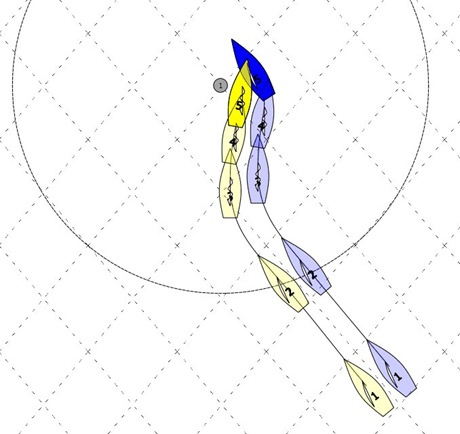
(I can’t seem to get the animation running at the moment, so here’s the jpg)

In position 1 and 2 rules 11 and 18.2(a) apply, ok. But what rules apply in position 3, 4 and 5? Both boats are under rule 13 in position 3 and 4, yellow being obliged to keep clear.

Rule 18.3 does not seem to apply, since the boats are not on opposite tacks and there is no boat under rule 13 while the other one can fetch the mark. Since no other rule switches off rule 18.2, to me it seems that rule 18.2(a) is still on. After overturning 5 to 10 degrees, both boats are now on port tack, though not on a close-hauled course. Yellow would be entitled to mark-room including room to tack. In position 5, Blue ignores Yellow, turns to round the mark and pushes Yellow onto the mark.

Without Blues maneuver and the contact, Yellow would have been able to round the mark. Slowly, but still.

So it seems to me that Blue breaks rules 16.1 and 18.2(a).

I searched the RRS, the case book and the Q&A Service for similar cases,
but that was to no avail. I’m wondering if my conclusion is correct, especially the interpretation of rule 18.2(a) and 18.3.

Maybe you can help me out?

Thanks in advance and best regards from Germany,
Thorsten

blogcolorstripe

Well Thorsten, after discussing this with some others and having a look at the casebook myself, I’m coming to the conclusion that you are pretty much ‘on the ball’. I think you got it right, almost. I differ only in some or the applicable rules.

In position one rule 11 applies, so Blue is keep clear boat.

In position two rule 11 still applies, but now in addition to having to keep clear, Blue also has to give mark-room to Yellow, according to rule 18.2(b).
They enter the zone overlapped on the same tack, with Yellow as inside boat.

In position three Yellow luffs in order to get to the mark and even if he should have established a leeward overlap from clear astern and was under a rule 17 restriction, he may do so. For Yellow ‘shooting the mark’ is her proper course. She would also do this if Blue wasn’t there.

Rule 18.2(c) states that rule 18.2(b) is switched off, when either of the boats passes head to wind. They both do that, just before position 4. So rule 18.2(b) is off, rule 11 is off and rule 13 switches on. Both are tacking boats and rule 13 states that in that case Blue is right of way boat.

They are now both also on port tack and still overlapped. They are in the zone and rule 18.2(b) no longer applies. None of the exceptions in rule 18.1 are applicable. That means rule 18.2(a) is the rule to follow.

In position four Blue still has to give mark-room and that mark-room indeed includes room for her to tack. In position four Yellow is overlapped to windward and on the inside of Blue who has to give mark-room. The fact that that happens while tacking, does not alter that.

In position five Yellow breaks rule 13 by not keeping clear of Blue, but she’s exonerated because Blue fails to give her mark-room (RRS 18.5(b)). She also breaks rule 31, but is again exonerated, now under 64.1(c). Because Blue forced her to break that rule by breaking rule 18.2(a) and yes, also rule 16.1. Blue is NOT the boat with mark-room, so she has to change course, as right of way boat, within the restrictions of rule 16.1.

Now, where are the critical point(s)?

In position three Yellow is entitled to mark-room, but that mark-room does not include room to tack. She’s not overlapped to windward but overlapped to leeward. If Yellow tacks first, forcing Blue to tack as well, she breaks rule 13 and will not be exonerated.

If Blue tacks first, Yellow can follow instantly and is ‘protected’ by the rules mentioned above. A PC handling a protest will need to find as fact which boat tacked first. In case they do it simultaneously, I would give Yellow the benefit of the doubt.

At first I dismissed rule 18.3, like you. Neither of the boats is fetching the mark. But upon looking at you diagram, I started to think. If you take away Yellow, Blue might be able to fetch the mark, she might be able to shoot the mark without ever passing head to wind….

The definition of fetching however, does not have the “absence of the other boats referred to in the rule” - clause. Like in the definition of ‘Proper Course’. In order to fetch the mark, Blue must be in a position to do so, INCLUDING Yellow. That is not the case, so on that grounds 18.3 is not applicable.

What if is was. What if Blue COULD fetch the mark? Would that make rule 18.3 applicable?

The rule begins by stating another provision; Boats must be approaching the mark on opposite tacks. They do not, they approach on the same tack. In position three, four and five they are no longer approaching. They are already in the zone. Because of that rule 18.3 never is applicable, even if Blue could fetch the mark, in my opinion.

Cheers,

J.

Leave a comment if you have an (different) opinion

Related Posts Plugin for WordPress, Blogger...