Some time ago Menno send me a mail about a curious rules issue he had seen on the internet: On the Sailgroove-website in the series Technique Tuesdays, Val Smith explains a ‘loophole’ exploiting the new definition of fetching in the rulebook.
Sailing Videos on Sailgroove
Perhaps you have already seen this.
My question to all LTW readers: Has anybody ever come across this on the water (umpiring) or in the room? Is it being done?
Most regatta’s in my neck of the woods are done in non-tidal waters so there’s very little – if any – current to be exploited. But there must be sailing waters around the world were this kind of ‘fetching’ is possible…..
Thanks Menno, for your contribution. Please keep sending them in.
J.

Sunday, 28 February 2010


Saturday, 27 February 2010
LTW Readers Q&A | 035; Port is slow to respond please be patient
From a Sunny Sydney – (b@b#s!h%sot) – a question from Neil, about that bloody windward mark – again (*^%#(*@)&@!#!!)

During Club racing this situation has recently raised much debate and I would appreciate your thoughts. With many hours researching on the net I have never found this issue discussed.
The scenario.
Neil Johnson.
Neil, this is what I came up with for the facts you’ve described:
By your use of the word ‘barging’ I deduce that you might think that Yellow (Port)has some sort of protection from the Purple (SB) boat, by entering the zone so far ‘ahead’?
I’m afraid I must disappoint you. Rule 18 does not switch on, until position 6 (and there the Purple boat is inside boat with mark-room). The fact that Yellow has an adverse current and has trouble or is slow rounding the mark has no ‘standing’ in the rulebook. She must keep clear as port boat!
NO buts, maybees or otherwise.
And once she’s passed head to wind she must keep clear under rule 13 (tacking boat). Purple gains an inside overlap and is therefore entitled to mark-room under 18.2(a) – not 18.3, because she’s not fetching the mark – including room to tack because she’s overlapped to windward and on the inside of a boat required to give mark-room.
I would understand if you now started cursing yourself, but please keep it civilized. Nanny Ogg would say: “Bugger all that, lets curse someone”
Thanks for you contribution to LTW!
J.
Next time in LTW Readers Q&A: Sheeting in a Laser
.

During Club racing this situation has recently raised much debate and I would appreciate your thoughts. With many hours researching on the net I have never found this issue discussed.
The scenario.
- A windward mark to be passed and cleared to starboard (a clockwise direction).
- Boat A has entered the zone on port and will fetch the mark and with no others boats in the zone.
- Due to an adverse tide and a drop in the wind, Boat A slows at the mark and is still fetching the mark and does not need to tack for rounding.
- Boat B enters the zone on starboard (with a slight increase in wind strength) and hails Boat A to tack while barging inside Boat A at the mark and then Boat B tacks to round the mark forcing Boat A onto starboard and eventually Boat A tacking back on to port to round the mark.
Neil Johnson.
Neil, this is what I came up with for the facts you’ve described:

By your use of the word ‘barging’ I deduce that you might think that Yellow (Port)has some sort of protection from the Purple (SB) boat, by entering the zone so far ‘ahead’?
I’m afraid I must disappoint you. Rule 18 does not switch on, until position 6 (and there the Purple boat is inside boat with mark-room). The fact that Yellow has an adverse current and has trouble or is slow rounding the mark has no ‘standing’ in the rulebook. She must keep clear as port boat!
NO buts, maybees or otherwise.
And once she’s passed head to wind she must keep clear under rule 13 (tacking boat). Purple gains an inside overlap and is therefore entitled to mark-room under 18.2(a) – not 18.3, because she’s not fetching the mark – including room to tack because she’s overlapped to windward and on the inside of a boat required to give mark-room.
I would understand if you now started cursing yourself, but please keep it civilized. Nanny Ogg would say: “Bugger all that, lets curse someone”
Thanks for you contribution to LTW!
J.
Next time in LTW Readers Q&A: Sheeting in a Laser
.
iPhone app: Racing Rules of Sailing
The Racing Rules of Sailing 1.0 | Score: NR | Price: $5.99
Release Date : Feb 27 , 2010
The United States Sailing Association (US SAILING) is proud to present the official iPhone application for The Racing Rules of Sailing for 2009-2012 Including the US SAILING Prescriptions.
The Racing Rules of Sailing app is for you if you are an avid sailor looking for instant access to the official rules and signals.
With this application you will be prepared to answer any rules or signal questions that arise.
Features :

ISAF is the governing body for the rules of sailing in other jurisdictions.
Please contact the appropriate governing body in your jurisdiction with questions regarding the Rules of Sailing.
From: The Racing Rules of Sailing 1.0 for iPhone, iPod touch, and iPad | iPhoneapps360.net (bekijken via Google Sidewiki)
Update 10-03-2010
Received an Email from Brass about this app:
Release Date : Feb 27 , 2010
The United States Sailing Association (US SAILING) is proud to present the official iPhone application for The Racing Rules of Sailing for 2009-2012 Including the US SAILING Prescriptions.
The Racing Rules of Sailing app is for you if you are an avid sailor looking for instant access to the official rules and signals.
With this application you will be prepared to answer any rules or signal questions that arise.
Features :
- The only rules app approved by US SAILING Every rule, appendix and definition available at the touch of a finger
- Simple navigation
- Images and descriptions of all the signal flags
- Convenient word, numeric and phrase search function
- Bookmarking feature for your most referenced to rules and definitions US SAILING is the national governing body for sailing in the United States.

ISAF is the governing body for the rules of sailing in other jurisdictions.
Please contact the appropriate governing body in your jurisdiction with questions regarding the Rules of Sailing.
From: The Racing Rules of Sailing 1.0 for iPhone, iPod touch, and iPad | iPhoneapps360.net (bekijken via Google Sidewiki)
Update 10-03-2010
Received an Email from Brass about this app:
Dear Jos, I just saw this on SA:
It was pointed out to me by a friend last night that the US Sailing Rules app has some incorrect definitions under 'postponements': AP over A and AP over N the defs are wrong. The app is great how it hyperlinks words to other pages. My bro wants his $5.99 back. I'll buy it when it gets fixed.
If you want to go to the forum: Go hereCan anybody tell me what the app says AP over A and AP over N means?
I wonder what on earth the Americans think AP over N means?
Regards, Brass
Friday, 26 February 2010
RR Team Racing Call 2010-002
Just when you think you got your head wrapped around the 2010 RRS changes, the RR-panel throws you out of whack. These situations might happen most often in team racing, but it is also true in Fleet Racing. Not so much in Match racing - but that is because seldom are there more then two boats - I think.... <G>
A new RRTR Call on the ISAF site today, about when an obstruction suddenly ceases to be an obstruction.
Or when a 'right-of-way'-boat that is an obstruction, becomes a 'keep-clear'-boat that isn't (by definition).

RAPID RESPONSE TEAM RACING CALL 2010/002
Rule 11 On the Same Tack, Overlapped
Rule 12 On the Same Tack, Not Overlapped
Rule 19 Room to Pass an Obstruction
Question 1
A and X are sailing on a broad-reach leg and are approaching Y, who is moving slowly. A’s bow is about half of a boat-length behind X’s bow and X is steering a course to pass to leeward of Y. At position 1, A hails for room to pass to leeward of Y. At position 2, X is overlapped to leeward of Y and there is no longer room for A to pass between them. A luffs to keep clear of Y and protests. What should the call be?
 Answer 1
No penalty. When, after position 1, boats A and X are at the obstruction Y, rule 19 requires the outside boat X to give the inside boat A room between X and Y. However, at position 2, X is no longer required to keep clear of Y and, as a result, Y is no longer an obstruction. Because Y is not an obstruction, rule 19 no longer applies between A and X, and X is therefore no longer required to give A room to pass to leeward of Y. A keeps clear of X and Y as required by rules 11 and 12, respectively.
Question 2
Similar to question 1, except that A’s bow is about half of a boat-length ahead of X’s bow and X is steering a course directly toward Y’s transom. At position 2, A becomes overlapped to windward of Y. Shortly thereafter, X bears away and passes to leeward of Y. A protests. What should the call be?

Answer 2
No penalty. Rule 19 begins to apply between positions 1 and 2 when A and X are at the obstruction Y. Rule 19.1(a) gives X the right to choose which side to pass the obstruction. At the time rule 19 begins to apply, neither A nor X is outside or inside with respect to Y, and therefore rule 19.2(b) is not applicable.
At position 2, A becomes overlapped to windward of Y. A is now the outside boat, and must give X room between her and the obstruction under rule 19.2(b) if X chooses to do so. However, X chooses to go below Y. When X becomes overlapped to leeward of Y, X becomes an obstruction to A and Y and, accordingly, A must give Y room between her and X. A gives Y room as required by rule 19.2(b) and keeps clear of her as required by rule 11.
Question 3:
Similar to question 2, except that A and X are steering a course to pass to leeward of Y. At position 2, A becomes overlapped to leeward of Y. Y luffs to keep clear and protests. What should the call be?

Answer 3
No penalty. A and X are sailing a proper course and therefore do not break rule 17. At position 1, A keeps clear of X as required by rule 11. At position 2, A becomes overlapped to leeward of Y. X is now an obstruction to A and Y. As the outside boat, Y must give A room between her and X, provided that she is able to do so from the time the overlap began. Y must also keep clear of A under rule 11. Y gives room and keeps clear by luffing.
In case you are wondering why X already becomes an obstruction to Y in position 2 - remember the definition of overlap. Ooh, and in all animations the coloured boats are my additions. I used TSS this time. Although the animations have improved on the screen, it doesn't translate in the gifs as of yet.
For those of you who want to download the pdf: RRTR Call 2010-002
.
A new RRTR Call on the ISAF site today, about when an obstruction suddenly ceases to be an obstruction.
Or when a 'right-of-way'-boat that is an obstruction, becomes a 'keep-clear'-boat that isn't (by definition).

RAPID RESPONSE TEAM RACING CALL 2010/002
Rule 11 On the Same Tack, Overlapped
Rule 12 On the Same Tack, Not Overlapped
Rule 19 Room to Pass an Obstruction
Question 1
A and X are sailing on a broad-reach leg and are approaching Y, who is moving slowly. A’s bow is about half of a boat-length behind X’s bow and X is steering a course to pass to leeward of Y. At position 1, A hails for room to pass to leeward of Y. At position 2, X is overlapped to leeward of Y and there is no longer room for A to pass between them. A luffs to keep clear of Y and protests. What should the call be?


No penalty. When, after position 1, boats A and X are at the obstruction Y, rule 19 requires the outside boat X to give the inside boat A room between X and Y. However, at position 2, X is no longer required to keep clear of Y and, as a result, Y is no longer an obstruction. Because Y is not an obstruction, rule 19 no longer applies between A and X, and X is therefore no longer required to give A room to pass to leeward of Y. A keeps clear of X and Y as required by rules 11 and 12, respectively.
Question 2
Similar to question 1, except that A’s bow is about half of a boat-length ahead of X’s bow and X is steering a course directly toward Y’s transom. At position 2, A becomes overlapped to windward of Y. Shortly thereafter, X bears away and passes to leeward of Y. A protests. What should the call be?


Answer 2
No penalty. Rule 19 begins to apply between positions 1 and 2 when A and X are at the obstruction Y. Rule 19.1(a) gives X the right to choose which side to pass the obstruction. At the time rule 19 begins to apply, neither A nor X is outside or inside with respect to Y, and therefore rule 19.2(b) is not applicable.
At position 2, A becomes overlapped to windward of Y. A is now the outside boat, and must give X room between her and the obstruction under rule 19.2(b) if X chooses to do so. However, X chooses to go below Y. When X becomes overlapped to leeward of Y, X becomes an obstruction to A and Y and, accordingly, A must give Y room between her and X. A gives Y room as required by rule 19.2(b) and keeps clear of her as required by rule 11.
Question 3:
Similar to question 2, except that A and X are steering a course to pass to leeward of Y. At position 2, A becomes overlapped to leeward of Y. Y luffs to keep clear and protests. What should the call be?


Answer 3
No penalty. A and X are sailing a proper course and therefore do not break rule 17. At position 1, A keeps clear of X as required by rule 11. At position 2, A becomes overlapped to leeward of Y. X is now an obstruction to A and Y. As the outside boat, Y must give A room between her and X, provided that she is able to do so from the time the overlap began. Y must also keep clear of A under rule 11. Y gives room and keeps clear by luffing.
Published February 25, 2010 This call is valid until 1 January 2011
In case you are wondering why X already becomes an obstruction to Y in position 2 - remember the definition of overlap. Ooh, and in all animations the coloured boats are my additions. I used TSS this time. Although the animations have improved on the screen, it doesn't translate in the gifs as of yet.
For those of you who want to download the pdf: RRTR Call 2010-002
.
Thursday, 25 February 2010
Gaastra Winter Test
This you need to see!
Rainbow 114 does NOT want to wait any longer and starts breaking the ice....
Rainbow 114 does NOT want to wait any longer and starts breaking the ice....
ISAF Jury Report Website
The communication between Protest-Committees / Juries in different events has been difficult at best. Only a few issues ever get discussed on a wider scale. Mostly it is the individual panels who have to decide the problems as best as they can.
A few bigger events - particularly World Cup events - have the luxury of a large group of IJs, NJs, IUs and NUs who can discuss issues, they have encountered in the past.
It is however expected that every IJ and IU hands in a report to the ISAF about an event he or she has attended. These reports are not only used to assist the ROC in finding difficulties with individual ROs, but also to have some feedback from the actual events under the ISAF-umbrella.
Since a couple of years excerpts of these Jury Reports are published on the Internet: ISAF JURY REPORT.
And instead of sending in a paper you can fill in the public sheet of the ISAF IJ Report directly on-line.
Every report is checked by the site-administrator (IJ-Report Editor) and a member of the International Judges Sub Committee before it is posted on-line. The site is also used to create a database with the numbers. (So and so many Request for Redress for OCS, or total number of hearings, etc.)
Example: From 2010 Rolex Miami OCR:
If you want to know what is happening at events and what special issues the Juries encounter, have a browse trough the reports. At least it is a glimpse into the IJ-world.
By clicking on the text on the front page you get specific information and wich officials attended.
In case you want to keep up-to-date on the latest, (at least those of you who are using Google-reader) fill in this in your RSS reader: http://www.ijreport.org/ Google feed. This is a new feature of Google-Reader: You can track any changes to a website by letting Google create a feed for it
.
A few bigger events - particularly World Cup events - have the luxury of a large group of IJs, NJs, IUs and NUs who can discuss issues, they have encountered in the past.
It is however expected that every IJ and IU hands in a report to the ISAF about an event he or she has attended. These reports are not only used to assist the ROC in finding difficulties with individual ROs, but also to have some feedback from the actual events under the ISAF-umbrella.
Since a couple of years excerpts of these Jury Reports are published on the Internet: ISAF JURY REPORT.
And instead of sending in a paper you can fill in the public sheet of the ISAF IJ Report directly on-line.
Every report is checked by the site-administrator (IJ-Report Editor) and a member of the International Judges Sub Committee before it is posted on-line. The site is also used to create a database with the numbers. (So and so many Request for Redress for OCS, or total number of hearings, etc.)
Example: From 2010 Rolex Miami OCR:
Judges were split on the new definition of party: does this new definition allow a jury to make a boat that may be affected by a redress decision a party to the hearing, when the jury is not considering redress for this boat?
Requirement for the three highest-ranked boats to wear coloured bibs: one team requested to be exempted from this requirement because of an existing contract with a team sponsor.
There were difficulties in some hearings to get in due time the race committee staff involved in the situation in question.
Too many support boats were not properly identified with national letters. The requirement for coach boats to stay clear of the starting line and its extensions was not popular but we believe this should be applied in all other Sailing World Cup regattas. The course designation based on the number of beats to windward to be sailed should be a standard. When three fleets are racing simultaneously on a trapezoid course the race committee decided to start them on an Outer-Inner-Inner sequence and this caused delays.
If you want to know what is happening at events and what special issues the Juries encounter, have a browse trough the reports. At least it is a glimpse into the IJ-world.
By clicking on the text on the front page you get specific information and wich officials attended.
In case you want to keep up-to-date on the latest, (at least those of you who are using Google-reader) fill in this in your RSS reader: http://www.ijreport.org/ Google feed. This is a new feature of Google-Reader: You can track any changes to a website by letting Google create a feed for it
.
Tuesday, 23 February 2010
Looking for 18.1(b)
Not long ago during a presentation I was asked to give an example of rule 18.1(b). I must confess I was not able to come up with one that was not also already covered by 18.1(a). I've been thinking about it after that, but could use some help.
Lets start at the beginning:
Rule 18.1 is the rule that tells us when rule 18 applies. There are four bullets, from (a) to (d):
The first one is easy enough. For boats on different tack on a beat, approaching a windward mark, there's no rule 18, until one of them changes tack
The third one has been added in the latest rule cycle, but most people already applied it before. No rule 18 between a boat approaching and a boat leaving a mark.
The fourth bullet (d) tells us that in case the mark is also a continues obstruction, rule 19 applies and not rule 18.
That leaves the second one, rule 18.1(b):
Rule 18 does not apply between boats on opposite tacks when the proper course at the mark for one but not both of them is to tack.
The one I came up with was a starboard tack boat on a reach toward a mark and a port tack boat on a beat about to round the same mark. Something like this:
 Rule 18 is off until the Orange boat passes head to wind. Then she becomes inside boat entitled to mark-room. If Purple has to avoid Orange before she's passed head to wind; penalty on Orange
If Purple only has to respond after Orange has passed head to wind, no infringement, no penalty.
READ UPDATE in Comments!
(J. 23/02/10; 21:33 h)
Can you find other situations where rule 18.1(b) is applicable?
Lets start at the beginning:
Rule 18.1 is the rule that tells us when rule 18 applies. There are four bullets, from (a) to (d):
The first one is easy enough. For boats on different tack on a beat, approaching a windward mark, there's no rule 18, until one of them changes tack
The third one has been added in the latest rule cycle, but most people already applied it before. No rule 18 between a boat approaching and a boat leaving a mark.
The fourth bullet (d) tells us that in case the mark is also a continues obstruction, rule 19 applies and not rule 18.
That leaves the second one, rule 18.1(b):
Rule 18 does not apply between boats on opposite tacks when the proper course at the mark for one but not both of them is to tack.
The one I came up with was a starboard tack boat on a reach toward a mark and a port tack boat on a beat about to round the same mark. Something like this:

If Purple only has to respond after Orange has passed head to wind, no infringement, no penalty.
READ UPDATE in Comments!
(J. 23/02/10; 21:33 h)
Can you find other situations where rule 18.1(b) is applicable?
Monday, 22 February 2010
Heads UP: New rules videos on Sailgroove
Just a heads up -- Matt Knowles just posted three new videos on Sailgroove about the latest calls for 2010:
Particularly the last one - about what is sailing "to the mark" and being "at the mark" is also of interest for Fleet and Team racers.
If you want to read the official text of the publications go to new Team Race Call Book for E10, the RR Team Call 2010/001 and the RR Match Race Call 2010/001 on the ISAF Site.
The only thing I wish - as being an umpire/judge active in all disciplines - that what is applicable for one is also applicable for the other. For instance: the situation in RRTR Call 2010/001 is NOT applicable in Match Racing because of the new rule C2.12. which states that if the outside boat is not able to give mark room she does not have to.
But then again if sailing wasn't complicated - it wouldn't be half the fun it is now.
Oooh, thanks Chris, for your heads up!
- Team Race Call E10,
- Rapid Response Team Race Call 2010/001 and
- Rapid Response Match Race Call 2010/001
Particularly the last one - about what is sailing "to the mark" and being "at the mark" is also of interest for Fleet and Team racers.
If you want to read the official text of the publications go to new Team Race Call Book for E10, the RR Team Call 2010/001 and the RR Match Race Call 2010/001 on the ISAF Site.
The only thing I wish - as being an umpire/judge active in all disciplines - that what is applicable for one is also applicable for the other. For instance: the situation in RRTR Call 2010/001 is NOT applicable in Match Racing because of the new rule C2.12. which states that if the outside boat is not able to give mark room she does not have to.
But then again if sailing wasn't complicated - it wouldn't be half the fun it is now.
Oooh, thanks Chris, for your heads up!
(pillow)Case of the Week (8) - 108
Sixth (pillow)Case in our new series. Keep it under your pillow this week and read it before going to sleep.

CASE 108
Rule 28.1, Sailing the Course
Rule 44.1(b), Penalties at the Time of an Incident: Taking a Penalty
Rule 44.2, Penalties at the Time of an Incident: One-Turn and Two- Turns Penalties

Assumed Facts
In each of the four illustrated situations, a boat touches a rounding mark that she is required to leave to port and then makes a turn that includes one tack and one gybe.
Question
In each situation, does the boat take a One-Turn Penalty that complies with rule 44 and with rule 28.1?
Answer
When a boat breaks rule 31, her penalty is usually a One-Turn Penalty. However, if, by touching the mark, she causes injury or serious damage or gains a significant advantage in the race or series, her penalty is to retire (see rule 44.1(b)).
In each illustrated situation she takes a One-Turn Penalty that complies with rule 44.2, provided that :
All four illustrated turns comply with rule 28.1. Provided that the string representing the boat’s track when drawn taut lies on the mark’s required side, the boat would comply with rule 28.1 even if (as not illustrated) a penalty turn resulted in the boat making an extra 360° turn around the mark.
(RYA 2005/4)
.

CASE 108
Rule 44.1(b), Penalties at the Time of an Incident: Taking a Penalty
Rule 44.2, Penalties at the Time of an Incident: One-Turn and Two- Turns Penalties
When taking a penalty after touching a mark, a boat need not complete a full 360° turn, and she may take her penalty while simultaneously rounding the mark. Her turn to round the mark will serve as her penalty if it includes a tack and a gybe, if it is carried out promptly after clearing and remaining clear of the mark and other boats, and when no question of advantage arises.

Assumed Facts
In each of the four illustrated situations, a boat touches a rounding mark that she is required to leave to port and then makes a turn that includes one tack and one gybe.
Question
In each situation, does the boat take a One-Turn Penalty that complies with rule 44 and with rule 28.1?
Answer
When a boat breaks rule 31, her penalty is usually a One-Turn Penalty. However, if, by touching the mark, she causes injury or serious damage or gains a significant advantage in the race or series, her penalty is to retire (see rule 44.1(b)).
In each illustrated situation she takes a One-Turn Penalty that complies with rule 44.2, provided that :
(a) as soon as possible, and before beginning her penalty turn, she sailsRule 44.2 does not require a boat that takes a One-Turn Penalty to complete a full 360° turn, or a turn of any particular number of degrees, and it does not prohibit taking the penalty while making another manoeuvre, such as rounding the mark.
well clear of any other boats and remains clear of them while making
her turn;
(b) when she begins her penalty turn she is no longer touching the mark;
and
(c) she makes her penalty turn promptly after she is clear of other boats.
All four illustrated turns comply with rule 28.1. Provided that the string representing the boat’s track when drawn taut lies on the mark’s required side, the boat would comply with rule 28.1 even if (as not illustrated) a penalty turn resulted in the boat making an extra 360° turn around the mark.
(RYA 2005/4)
.
Sunday, 21 February 2010
Sunday Rules Snap | Soft versus Wing
In a blogpost on SailRaceWin published today, a couple nice pictures were posted: Dubai Traditional 60ft Dhow Sailing Championships: Heat One.
Since I spend half a year in Dubai as a trainee, my interest was peeked.
I know (very) little about the traditional Dhows that are sailed there, but they sure are beautiful. I never got the chance to sail on one, only visited a builders-yard to see the frame, alas.
Anyway here's the picture:
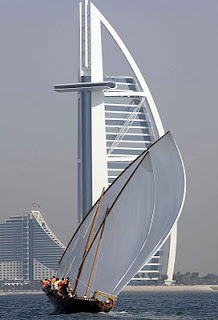
This particular photo struck me as a Port - Starboard situation between the 'softes' sail possible and the ultimate wing!
Since I'm a civil engineer it also is a picture of the two things that take much of my time...
And it sure makes me wish this FFing winter comes to an end....
Since I spend half a year in Dubai as a trainee, my interest was peeked.
I know (very) little about the traditional Dhows that are sailed there, but they sure are beautiful. I never got the chance to sail on one, only visited a builders-yard to see the frame, alas.
Anyway here's the picture:

Image copyright Ashraf Al Amra.
This particular photo struck me as a Port - Starboard situation between the 'softes' sail possible and the ultimate wing!
Since I'm a civil engineer it also is a picture of the two things that take much of my time...
And it sure makes me wish this FFing winter comes to an end....
Subscribe to:
Comments (Atom)
